

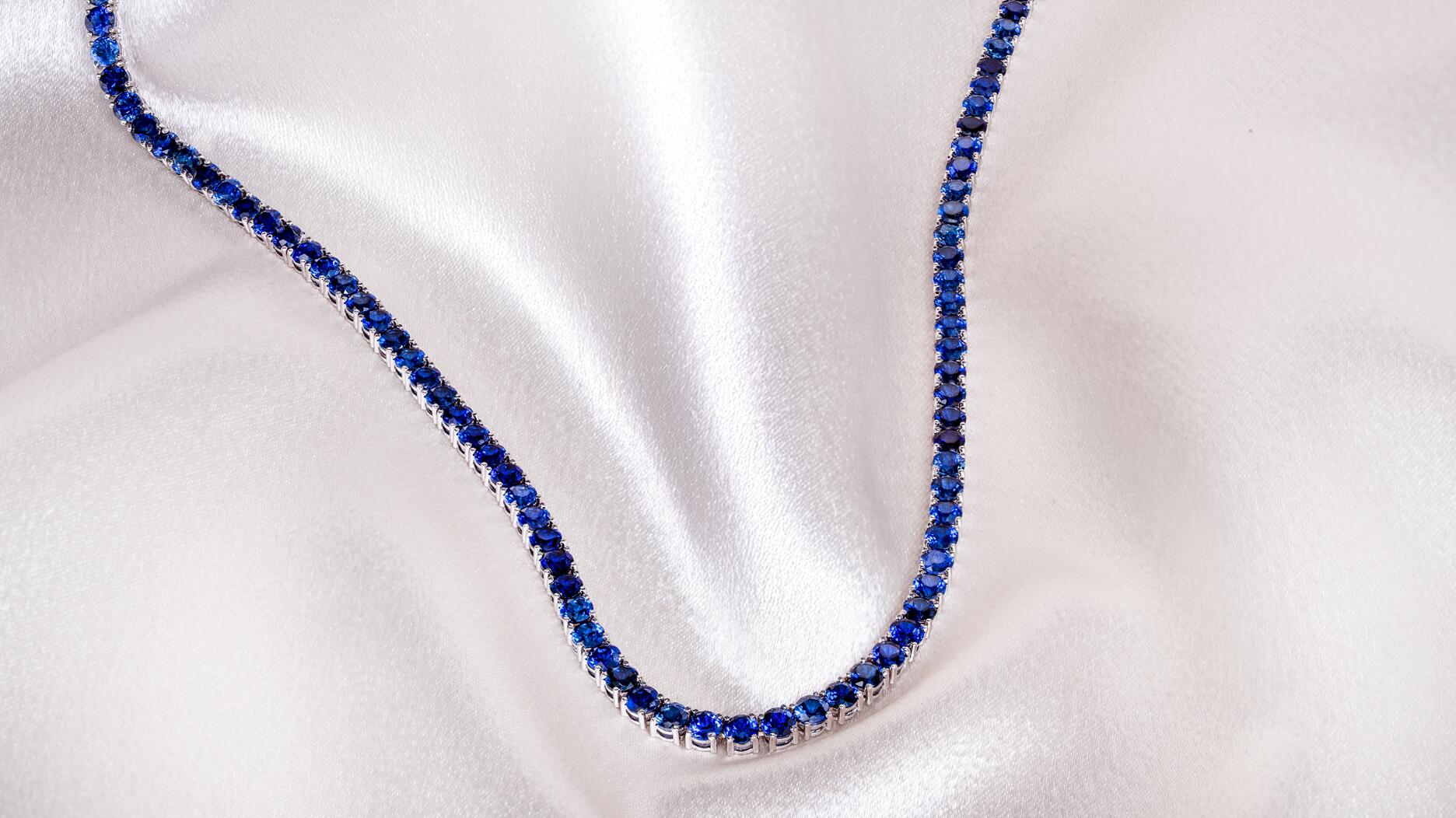


The new pink sapphire version of the piece dances with its wearer in the brand’s “Icons After Dark” holiday campaign.

T.I.A., Part 3: East Africa’s Changing Gemstone Market
As Tanzania and Kenya move to have the export of all rough banned, both will need to focus on growing their cutting industries. Associate Editor Brecken Branstrator talks to a few people who are playing a part in that.

Both Tanzania and Kenya have made announcements that within the next few years (they’re aiming for 2018), both will ban the export of gem-quality rough. Rather, the gemstones will be cut before leaving the country in an effort to add value to the stones and boost the economy.
This is only one part of the change and development that many are trying to bring to the gemstone market in East Africa, but since it also played a part in our trip, I want to focus on this for now.
It’ll be interesting to see if both Tanzania and Kenya are able to meet the deadlines they’ve set for themselves.
Tanzania already has a law in place that no tanzanite rough larger than 1 gram (5 carats) can be exported from the country, so the country’s infrastructure is more equipped to handle such a change over a period of a few years--Tanzania has roughly 600 gem cutters, as well as a number of lapidary schools already established.
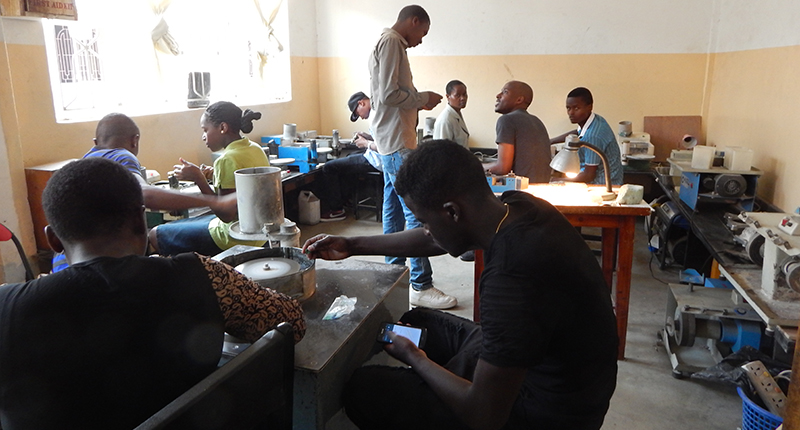
We visited one of these while we were there--the Arusha Gemmological & Jewelry Vocational Training Centre. It’s a small, independent vocational school run by Peter Salla, who was once a full-time trainer for TanzaniteOne. The school has graduated more than 800 students since its founding in 2000, nearly a third of which are women. While many of them pay tuition, Peter also looks for scholarship candidates, many times finding students who have come from very humble and difficult beginnings and wouldn’t have had the opportunity for such learning otherwise.
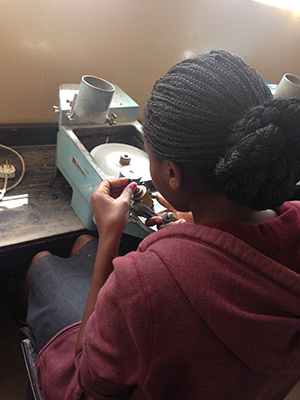
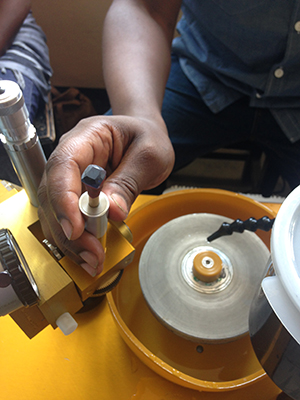
The center has two rooms, one of which is used as a classroom to teach students about grading and evaluating gems, and the other is set up for hands-on faceting work. When we went into the school, a handful of students were at work, dopping the stones with wax to the machines and practicing cutting marbles on various machines.
It’s clear that Peter works very hard to bring this skilled training to his students and is doing the kind of work that is needed if East Africa’s gemstone trade is going to grow and develop.
Kenya’s a little further behind its neighbor in establishing its cutting sector.
Roger told me that he estimates the country has somewhere in the range of 50 to 75 cutters. There also aren’t any lapidary schools operating yet, though the Kenyan government said last summer that it was investing some 30 million shillings (about $293,000) to set up a gemstone cutting center in Voi meant to create employment as well as adding value to the country’s stones.
While I was in East Africa, I also learned about a project that gemstone dealer and broker Gichuchu Okeno and Roger are establishing, along with jewelry blogger Monica Stephenson of iDazzle--a private lapidary center in Kenya designed to help provide training for the people there.
During our drive from the airport to the hotel on the first night we landed at Mt. Kilimanjaro, I had the chance to talk to Okeno about the challenges he’s seeing in the market and what he wants for the future. What continued to strike me about him then, and throughout the trip, was his sincerity in wanting to help others--not only wanting to elevate the gemstone market in East Africa into something sustainable, respected and valued for its quality stones but also wanting to create something that can provide opportunity for the population.
Roger and Monica obviously share the same hopes as they help build the gem community in a way that allows the people involved to flourish and then contribute on their own. This center will definitely play a part in that, and though the conversation about the center was years in the making before the country made its intentions known, it is well-timed to take part in the movement.
It tentatively will be called the Voi Lapidary Centre, but that could change if they decide to add more skills than just gem cutting, Roger told me. Rather than being designed to be a profit center, the school will be meant to help train young people, who, after graduation, will be encouraged to either seek employment by firms or to take in their own work from various mining operations.
The skilled training that it, and places like Peter Salla’s school, offer will be necessary for East Africa’s gem trade to develop, and I’m happy to have met a few of the players who will have a hand in that.
The Latest

A choice that’s generated a lot of commentary, Pantone says “Cloud Dancer” marks a fresh start and encourages relaxation and creativity.

The manufacturer’s holiday campaign features a gift guide filled with trending designs and jewelry that can be personalized.

How Jewelers of America’s 20 Under 40 are leading to ensure a brighter future for the jewelry industry.

The man was charged with theft, accused of ingesting the necklace while in a jewelry store in Auckland, New Zealand.


The Florida independent expanded its store from 8,000 to 14,000 square feet, fulfilling the vision of its late co-founder, Jim Dunn.

Sponsored by De Beers Group

Roseco’s 704-page catalog showcases new lab-grown diamonds, findings, tools & more—available in print or interactive digital editions.

The classic 5600 series G-Shock has been scaled down to about a tenth of its size, becoming a fully functioning watch ring.

The association’s annual conference and gala will take place Feb. 4, 2026, during the Tucson gem shows.

The January show will include a workshop for jewelry retailers on implementing AI to strengthen their businesses.

Fellow musician Maxx Morando proposed to the star with a chunky, cushion-cut diamond ring designed by Jacquie Aiche.

The retailer, which sells billions in fine jewelry and watches, is suing the Trump administration and U.S. Customs and Border Patrol.

Black Friday is still the most popular shopping day over the five-day holiday weekend, as per the National Retail Federation’s survey.

The historic egg, crafted for Russia's ruling family prior to the revolution, was the star of Christie’s recent auction of works by Fabergé.

The retailer offered more fashion jewelry priced under $1,000, including lab-grown diamond and men’s jewelry.

The eau de parfum is held in a fluted glass bottle that mirrors the decor of the brand’s atelier, and its cap is a nod to its “Sloan” ring.

Vivek Gadodia and Juan Kemp, who’ve been serving as interim co-CEOs since February, will continue to lead the diamond mining company.

In addition, a slate of new officers and trustees were appointed to the board.

Witt’s Jewelry in Wayne, Nebraska, is the organization’s new milestone member.

Laurs is the editor-in-chief of Gem-A’s The Journal of Gemmology and an expert on the formation of colored gemstone deposits.

The man, who has a criminal history, is suspected of being the fourth member of the four-man crew that carried out the heist.

The single-owner collection includes one of the largest offerings of Verdura jewels ever to appear at auction, said Christie’s.

Michael Helfer has taken the reins, bringing together two historic Chicago jewelry names.

The guide features all-new platinum designs for the holiday season by brands like Harwell Godfrey, Ritani, and Suna.

During its Q3 call, CEO Efraim Grinberg discussed the deal to lower tariffs on Swiss-made watches, watch market trends, and more.

Rosior’s high jewelry cocktail ring with orange sapphires and green diamonds is the perfect Thanksgiving accessory.