








CrimeSep 24, 2026
From Conclave: Security Measures Jewelers Should Be TakingJSA and Jewelers Mutual shared advice on spotting suspicious behavior, combatting cell phone jammers, and staying safe at home.




Today’s greatest living jeweler straddles the line between fine art and high jewelry.


When the TEFAF Art Fair came to New York this fall, it was the city’s first opportunity to experience the work of Wallace Chan in person.
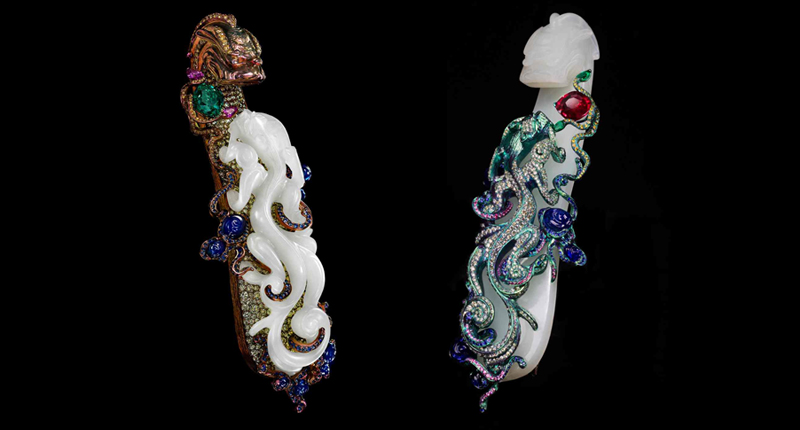
Chan is a visionary who could have worked in a number of mediums, but life surreptitiously put him on the path of jewelry; he started work as a gem carver in Hong Kong, first creating in malachite and lapis, then moving on to more translucent stones like emeralds, rubies and diamonds.
Chan’s path to success was slow and deliberate, involving the dedicated study and acquisition of skills that created the foundation Chan needed to invent his own techniques. Despite this emphasis on craft, and the many formative years Chan spent laboring in carving, he is not afraid of the digital world; rather, he embraces its opportunities and its reach.
In a panel conducted at TEFAF prior to the day I interviewed Chan, he urged the audience not to think of digital and physical methods as opposing forces, but as members of a relationship: two integral ways of approaching and creating art.
“I am sure that the space where the two worlds overlap lies the future of creativity,” Chan said.
It is this sort of embrace of the new and unknown that has made Chan the most riveting and imaginative jeweler of our era.
Below, Chan shares the creation stories of the three pieces of jewelry most meaningful to his career. 
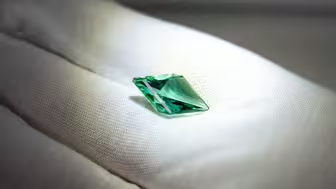
Wallace Chan: This is the Wallace Cut. This was my invention in 1987. What I did was I only cut one face in the back of the stone, but then it became four more faces because of precise calculation of the angles and reflections through the facets.
This particular one is from the late 1980’s. I did about six of these, but then I stopped because I didn’t want to copy myself anymore.
I had to think about opposites when I did the carving. Deep became shallow, left became right and top became bottom.
I had to invent my own tools, so I went to a factory to learn for six months as an apprentice, learning about the mechanics. Finally I thought I could transform a dental drill into the carving knife, but the dental drill was spinning 36,000 times per minute so once it touches the stone’s surface the stone cracks. So I had to put the stone beneath water to carve.
At

“When you are able to empty yourself, you have the space for a lot of wonders to happen.”It’s a smoky quartz. It’s only with a transparent stone that you can do the Wallace Cut. The first cut I do is the nose of the goddess.
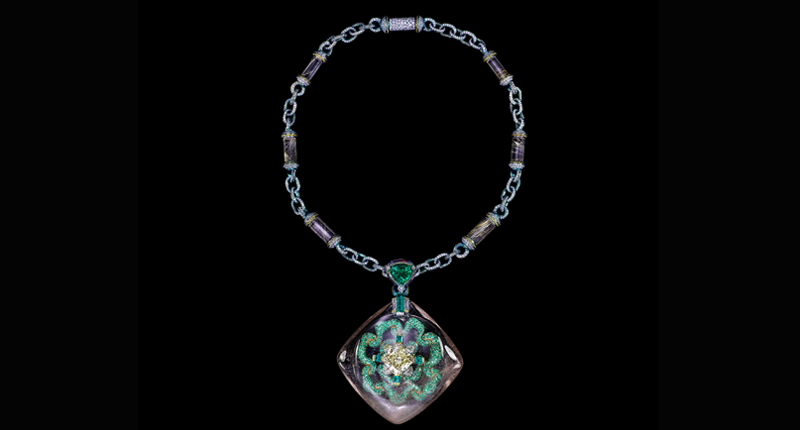
“Because I’m imperfect, that’s why I pursue perfection.”This is a motif of the Chinese lucky cloud. At first I thought of using crystal, but then I thought it would be too clear and people would think I used glass and kind of lasered it back, making a trick out of that, so I used rutilated quartz to emphasize that it is one piece and I couldn’t have opened it and put it back together.

JSA and Jewelers Mutual shared advice on spotting suspicious behavior, combatting cell phone jammers, and staying safe at home.


The fancy light blue diamond is estimated to fetch up to $2.6 million at Elmwood’s next week.

Experience gemstones with greater precision and comfort than ever before.


“Secret Language of Victorian Jewelry” unveils the meaning behind the symbols, motifs, and gemstones used in Victorian-era jewelry.


KIRAJewels.one gives retailers access to more than 500 SKUs of lab-grown diamond rings, earrings, necklaces, and bracelets.

This holiday season, look to pieces that will help to fill out customers’ everyday diamond jewelry wardrobe, experts say.
Submit your pieces for a chance to win in this year's competition.


The Natural Diamond Council is now The Diamond Collective and has announced a new strategy under CEO Amber Pepper.

Paul’s Jewelers sells coffee, chocolate, and cookies from a custom gold-wrapped trailer parked outside the store starting at 7 a.m.

Part of its brand relaunch, the marketing around the campaign includes a contest involving a jacket set with 550 diamonds.

The curation, opening soon at the Crystal Bridges Museum of American Art, honors the jeweler’s heritage through a distinctly American lens.

The jewelry giant has partnered with the famed makeup artist to create a colorful new collection of charms and rings.

The association will mark the milestone at its convention next month.

The jeweler donated school supplies to Memphis, Tennessee, students during the event combining basketball and mentorship.

A federal judge denied Pandora’s motion to dismiss Foundrae’s claim for copyright infringement of its medallions.

People aren’t thinking rationally when they are buying luxury products, and we shouldn’t be selling them that way, Peter Smith writes.

The Baltimore Business Journal recognized the entrepreneur for her leadership in business and the jewelry industry.

The facility is located within SEEPZ and is GCAL by Sarine’s second location in India, joining its existing grading lab in Surat.

The four-day show is slated for Nov. 19-22 at the Metropolitan Pavilion in New York City’s Chelsea neighborhood.

Offered at Sotheby’s Hong Kong, the one-of-a-kind white gold watch now holds the title of most valuable Cartier wristwatch sold at auction.

Bernstein-Gulla has been working in the jewelry industry for 40 years, most recently as chief engagement officer for Hill & Co.

The relocated Glendale store, now at The Americana at Brand, was designed to be a contemporary “timepiece haven” inspired by luxury resorts.


The top lot of the auction house’s Hong Kong jewelry sale was an Art Deco Mauboussin necklace with ruby beads, which sold for $2 million.

Retailers and manufacturers headed to the Capitol this week to discuss tariff exemptions for diamonds and gemstones, among other issues.

Our Piece of the Week is a pair of drop earrings from the “Sway” collection featuring Nanis’ first use of mirror-polished gold.

SynthDetect 2 can scan a full tray in less than five minutes, De Beers said, making it six times faster than its predecessors.



This site uses cookies to give you the best online experience. By continuing to use & browse this site, we assume you agree to our Privacy Policy