





SourcingJul 30, 2026
De Beers Sale in ‘Final, Most Challenging’ Phase, Anglo CEO SaysThe goal is for the De Beers sale to be finished by the second half of 2026, with the subsequent approvals process expected to take a year.





Editor-in-Chief Michelle Graff says innovation will rule while tired practices and retailers will fall by the wayside.


Hello, and Happy New Year.
I like to start off each new 365-day trip around the sun with thoughts on what will be “hot” in retail in the year ahead (this year: innovative spaces will thrive while the same-old, same-old will struggle) and predictions about which businesses will not make it (Sears and lower-end malls).
So here are six predictions for 2018, starting with a little bad news for people who like bad news.
1. The number of jewelry store closings will continue to decline.
Is it because jewelry retail results are earth-shattering? No, it’s more due to the fact that the spike in closings was largely demographic.
Many baby boomers (those born between 1946 and 1964, so about 71 to 53 now), a huge generation that’s comprised the majority of jewelry store owners for years, reached retirement age and made the decision about what to do with their store.
RELATED CONTENT: Demographic Drop-Off
The stores that remain open, for the most part, are those that have survived this demographic shift, in one way or another.
They’ve been handed off and/or sold to the next generation, or have opted to make the changes necessary to compete today: a presence on social media, and a website and in-store experience that align and are up-to- date.
Now, please note, I did not write that the decline would reverse or that the industry would grow; I acknowledge that it remains significantly smaller. I only stated that the slowing of retail closures that we’ve seen over the past three quarters would continue.
2. But online retailers will keep opening stores as will designers and brands.
In 2017, online consignment site The RealReal opened its first brick-and-mortar store, in New York City’s SoHo neighborhood; jewelry designer Jennifer Meyer announced that she was opening her first store, which will be located in her native California; and Vrai & Oro, the jewelry label owned by lab-grown diamond company Diamond Foundry, welcomed its first physical location, just to name a few.
Blue Nile added a sixth “webroom,” in a mall in Salem, New Hampshire.
Outside of jewelry, online giant Amazon now has 13 book stores in seven states with additional ones set to open in Bethesda, Maryland; Austin, Texas; and Washington, D.C., and it also paid $13.4 billion to buy grocery store chain Whole Foods in 2017.
It’s worth noting that the chain Amazon opted to buy, Whole Foods, aka “Whole Paycheck,”

The goal is for the De Beers sale to be finished by the second half of 2026, with the subsequent approvals process expected to take a year.

David Bonaparte, along with Tim Haake and Ronnie VanderLinden, continue to lobby for tariff exemptions for diamonds, gemstones, and pearls.

Survey respondents were concerned about the rising prices of food and groceries as well as unemployment.

Retailers are seeking new ways to attract customers, increase traffic, and create revenue – Estate buying events are a popular solution.


The trade show, slated for Sept. 4-8 in Vicenza, Italy, will feature sessions on trends, AI, gemology, and manufacturing.


The public shopping event featuring art, jewelry, watches, and rare collectibles, will take place in Santa Clara, California, this fall.

Reilly has been with PGI USA for the last 20 years, leading partnership development and professional education.
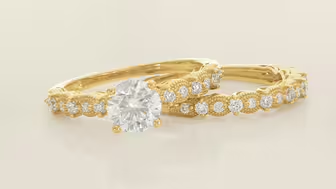
Colored gemstones, artisan finishes, mixed metals, and meaningful details are shaping demand in bridal jewelry.


Boucheron reached record sales while Pomellato found success in its signature collections.


She was one of more than 120 American designers who created flags for the “United Flags of Fashion” project led by CFDA and Vogue.

Smith reveals the method The Retail Smiths use to help retailers and vendors write better job postings.

LVMH’s jewelry and watch brands outperformed the company’s other divisions in an environment the company described as “disrupted.”

“Sacred Heart” features symbols like crosses, angel wings, the Star of David, and the evil eye as a representation of coexistence.
The scholarships will go to early-career professionals looking to study gemology, bench work and jewelry design, or store operations.

Bain & Company delved into the trends shaping the luxury market, the impact of AI, and more in its recent study.

The exhibition reveals the gemology, geology, and cultural history of the iconic red gemstone.

The new sweeping slate of tariffs impacts 60 countries, including India, China, Thailand, Hong Kong, and the United Arab Emirates.

From coin pendants to diamond shields, these old world-inspired jewels are the perfect accessory for an epic journey.

Our Piece of the Week pairs a checkerboard-cut amethyst with an ivy green silk cord.


Mildred Marcano Abrams and Yael Reinhold join the podcast to talk community connections, holiday plans, and preserving Reinhold’s legacy.


Production also was up in the first half of 2026 but is expected to “substantially” decrease in H2 as two key mines undergo maintenance.

“Art Deco” fuses ancestral techniques, rare materials, and modern perspectives as a tribute to the optimism and curiosity of the movement.

The jeweler’s newest store is inside Arkansas’ Saracen Casino Resort.

The watch company will design, manufacture, and distribute Kate Spade New York watches.

The higher tax is set to go into effect in August and will apply to loose polished diamonds as well as precious and base metals jewelry.

The “Enchanted Garden” series features a cherry, lemon, and pear that each hold a little secret inside.

It’s located in Tysons Galleria, an upscale shopping center in the Washington, D.C., metro area.



This site uses cookies to give you the best online experience. By continuing to use & browse this site, we assume you agree to our Privacy Policy