




AuctionsSep 01, 2026
UK Woman Uncovers Rare Patek Philippe Watch in Mom’s Jewelry BoxThe stainless steel Patek Philippe “Calatrava” watch from the 1930s sold for nearly $80,000 at a recent Hansons Cornwall auction.


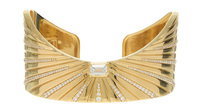



The 0.33-carat stone has a very thin layer of CVD-grown Type IIb diamond on top that earned it a grade of fancy blue.


New York--The Gemological Institute of America reports that a mined white diamond with an extremely thin layer of blue lab-grown diamond on top was submitted to its New York laboratory recently.
According to an article published online now and slated for the summer print edition of “Gems & Gemology,” the 0.33-carat stone is a composite of CVD synthetic Type IIb diamond overgrowth on a natural Type Ia.
The lab-grown diamond layer is only 80 microns (0.003 inches) thick, but it’s enough for the diamond to grade as a fancy blue.
Though the GIA said the stone was not submitted as a lab-grown diamond, there were a few things that tipped off researchers.
As the article states, the diamond had both nitrogen and boron defects. Nitrogen defects are the most common defect found in natural diamonds, while boron is the element that gives diamonds a blue tint and is a rare impurity, which is why natural blue diamonds are so few and so valuable.
The GIA said it is “very unusual” to see these two elements together in a single diamond, as essentially what they were looking at was a mixed Type Ia and Type IIb diamond. The last time the GIA reported on one of these being found in nature was nearly 10 years ago, in the spring 2009 edition of “Gems & Gemology.”
Secondly, a detailed analysis conducted using the DiamondView machine showed a yellowish-green fluorescence zone at the top of the crown that had a clearly defined boundary visible along the interface layer on the crown facets.
This, combined with SiV- defects and phosphorescence, indicated to GIA researchers that the top layer was a diamond grown using the chemical vapor deposition (CVD) process.
The bottom of the stone, meanwhile, displayed blue fluorescence but no phosphorescence in the DiamondView and had a strain pattern in the pavilion, both of which are consistent with a stone that is a natural Type Ia diamond.
This is the not the first diamond that’s a synthetic-natural combination.
The GIA noted in its research article that CVD diamond films have been applied to natural diamonds since the 1960s, and the successful addition of CVD-grown diamond layers on top of mined diamonds happened in 1993.
But this is the first synthetic overgrowth on a natural diamond with a fancy color grade that the GIA said it has ever seen.
As the lab put it

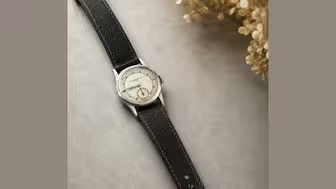
The stainless steel Patek Philippe “Calatrava” watch from the 1930s sold for nearly $80,000 at a recent Hansons Cornwall auction.

Engagement rings are important but don’t ignore the customers who are buying jewelry “just because,” Emmanuel Raheb writes.
Former Pomellato CEO Sabina Belli has been named president of Kering Italia amid a shakeup of Kering's new Jewelry division.
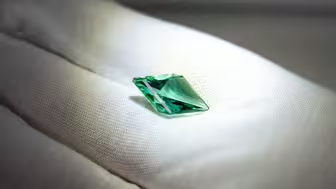
Submit your pieces for a chance to win in this year's competition.


The veteran luxury packaging executive was appointed to help the company grow its North American business.



Once the property of an Egyptian queen, the necklace was part of a larger exhibition of VCA jewelry at the Museum of Applied Arts (MAK).
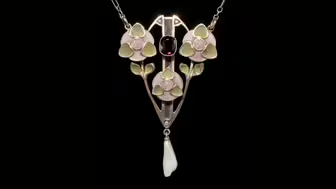
“Chicago Collects: Jewelry in Perspective” at the Oshkosh Public Museum will feature works by Fabergé, Lalique, and Louis Comfort Tiffany.

Retailers are seeking new ways to attract customers, increase traffic, and create revenue – Estate buying events are a popular solution.


The “Worn Well” collection is Catbird's take on classic men's jewelry.
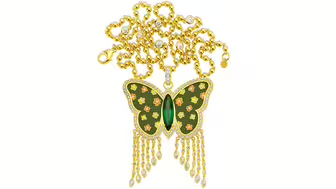
This Buddha Mama butterfly is our Piece of the Week honoring the legend, who embraced the beautiful insect as her symbol.

The former De Beers CEO, and perhaps its next owner, will be a featured speaker at the event, slated for Sept. 4-7 in Italy.

The employee-owned jeweler was named a “Best Place to Work” in Maine, New Hampshire, and for women.
The second iteration of the jewelry collection was inspired by the zodiac and the four elements: earth, water, air and fire.
General License 104B supersedes General License 104A, which was set to expire on Sept. 1.
The package, intercepted in Indianapolis, contained fake Cartier, Tiffany & Co., and Van Cleef and Arpels jewelry.
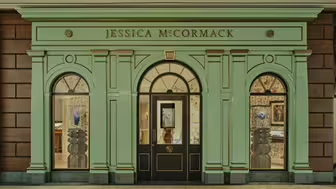
The new location in Costa Mesa, California, marks the brand’s second store in the United States and fourth standalone location worldwide.

The fashion watch category was once threatened by the Apple Watch, but consumers are now opting for new wearables, said Movado’s CEO.
The report delves into trending styles, the most popular jewelry brands by city, and why Belle Époque jewelry could be the next big thing.
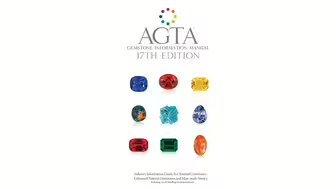
The association added the requirement to its revised "Code of Ethics" and released the 17th edition of its “Gemstone Information Manual.”

Respondents were concerned about the future of the labor market and their income as well as the rising prices of gas and groceries.

The campaign highlights the asymmetrical high jewelry necklace style that the jeweler first created in 1879.

It will explore the life of “The King of Diamonds” and showcase more than 165 creations from the brand.

Two suspects have been arrested in connection with the complex phone scam.

In her first column for National Jeweler, Jennifer Shaheen asks jewelers if they know how to connect with the next generation of consumers.

The annual awards cover tuition for an on-site educational course at the Swiss lab, as well as flights and lodging.
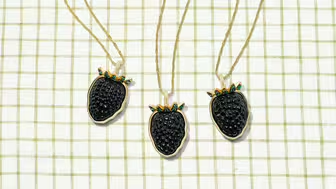
The jeweler partnered with the Tennessee resort to honor its 50th anniversary with limited-edition blackberry pendants and earrings.

The third-generation jeweler shared how the North Carolina retailer is celebrating this milestone and the love story that started it all.



This site uses cookies to give you the best online experience. By continuing to use & browse this site, we assume you agree to our Privacy Policy