




CollectionsAug 28, 2026
Dolly Parton Would Have Loved This Butterfly Necklace This Buddha Mama butterfly is our Piece of the Week honoring the legend, who embraced the beautiful insect as her symbol.




The need for generic diamond marketing and the declining importance of November-December are just two of the points explored in a new report on the state of the U.S. jewelry market.

New York--Edahn Golan, the former editor-in-chief of IDEX Online, has branched out on his own to form a research analysis and consultancy firm for the global diamond industry.
Earlier this spring, the journalist-turned-analyst released his first report on the state of jewelry sales in the U.S. market--who is buying jewelry here along with where, when and how much they’re willing to pay.
Following the release of this report, National Jeweler took some time to talk to the Tel Aviv-based Golan about five points from his report that were particularly interesting.
Here’s what he had to say.
1) The report says: While jewelry sales continued to grow in 2014, the rise in jewelry demand has weakened, and the growth rate has slowed from 2013.
Golan’s take: This is an alarming trend because despite the rise in total sales, as a business, diamond jewelry took a serious hit in 2014. During the most important sales period for jewelry, the November-December holiday season, jewelry stores were visibly less busy than in previous years. Some of the buying shifted to online stores, some took place early but, overall, there was clearly less enthusiasm on the part of American consumers to buy jewelry. The total sales increase reflected mostly purchases of low price point items.
In a way, the issue is one of marketing. The “A Diamond is Forever” campaign lasted for many years and did a fantastic job in generating interest in diamond jewelry. Now, several years after the campaign ended, we are seeing consumer demand waning.
2) The report says: The U.S. economy posted robust growth in the third quarter 2014 and it seemed consumers were poised to spend more than they had in the past few years during the holiday season. They did, but not in the way diamond jewelry retailers had hoped for; consumers bought more items at lower price points as opposed to purchasing higher-ticket items.
Golan’s take: Diamonds, despite their beauty and uniqueness have lost some of their appeal. If you can buy a diamond jewelry item at a discount store for $200, then how can the trade argue that diamonds are special in any way? On one hand, the democratization of diamonds--the fact that they are available to people of all income levels--is wonderful.
On the other hand, if the reason to buy diamond jewelry is that diamonds are rare and beautiful creations of

If we want both segments to continue living side by side, then consumers must understand the difference between a tiny M color, I1 clarity diamond and a J color, VS1 diamond. They must understand that these two stones have very different values and justly so.
Consumers are familiar with that message. Some cars, handbags, shoes and vacations cost more, and others cost less, so putting that out for diamonds is not such a challenge.
3) The report says: It used to be that at least 30 percent of jewelry and watch sales took place in November and December, during the holiday period. Since 2008, jewelry purchases have been more spread out throughout the year.
Golan’s take: Since 2008 we are indeed seeing a decline in the importance of the November-December sales period. If in 2007, for example, the last two months of the year represented more than 30 percent of annual sales, since then it has averaged below 28 percent.
In 2014 it was especially low, just 26 percent.
Partially, this is due to growing purchases in October, when a good number of retailers are trying to get an early start on the holiday season and offer discounts that drive traffic and sales. However, when you look back five, eight years, you see that the October trend (if it is a real trend) is inconsistent.
This is signaling to me that the American consumer market is going through a change in purchasing habits that reflects both a lesser interest in mid- to high-ticket items and a decline in inclination to purchase diamond jewelry as the big expense gift for the holiday. Everybody in the diamond and jewelry value chain should pay attention to that.
4) The reports says: The top buyers of fine jewelry and watches at any time of the year are married people without children between the ages of 55 and 64. However, when one removes watches from the equation, it is the 25-34 age group, the millennials, who buy more jewelry than anyone else.
Golan’s take: In 2013, the last full year for which we have demographic data, millennials were the top jewelry buyers in terms of age group (25-34). They did not have such a big interest in watches. Their increased interest in jewelry was a dramatic change from previous years but might have been short-lived.
According to the latest survey, which covers the first half of 2014, overall expenditure by millennials dropped and with it their spending on jewelry and watches.
This is further proof that the entire interest in jewelry and watches is in flux. It would be fair to suspect that diamond jewelry, the main component of this expenditure, is one item that is seeing the biggest change in demand by American consumers.
5) The report says: Specialty jewelry retailers (retailers that specialize in selling jewelry and carry little or nothing else) still sell the majority of fine jewelry in the United States.
Golan’s take: However, specialty retailers have been losing market share, slowly but steadily, over the past 20 years. Twenty years ago, they sold just over half of all fine jewelry watches (in terms of value.) Since that time, their market share has been sliding and hit a low of 42 percent in 2010.
It since has bounced back a little and is now at about 43 percent, but that can’t be viewed as a trend of regaining market share. The long-term trend is clear: a decline in market share.
This is another aspect of the shift to lower price-point items. Specialty jewelers are a destination for better items, where price is not necessarily the top issue but rather service, variety and, especially, knowledge. Once again, it’s becoming more and more important to create a change in the way top jewelry is perceived in the consumer market.
A PDF of the entire report is available for free here.
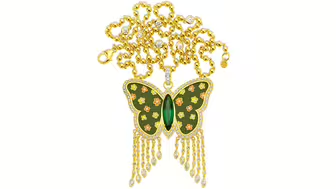
This Buddha Mama butterfly is our Piece of the Week honoring the legend, who embraced the beautiful insect as her symbol.

The former De Beers CEO, and perhaps its next owner, will be a featured speaker at the event, slated for Sept. 4-7 in Italy.

The employee-owned jeweler was named a “Best Place to Work” in Maine, New Hampshire, and for women.
Submit your pieces for a chance to win in this year's competition.


The second iteration of the jewelry collection was inspired by the zodiac and the four elements: earth, water, air and fire.

General License 104B supersedes General License 104A, which was set to expire on Sept. 1.
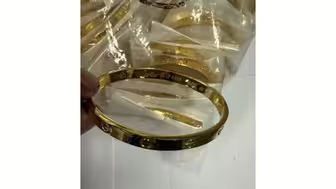
The package, intercepted in Indianapolis, contained fake Cartier, Tiffany & Co., and Van Cleef and Arpels jewelry.

Retailers are seeking new ways to attract customers, increase traffic, and create revenue – Estate buying events are a popular solution.


The new location in Costa Mesa, California, marks the brand’s second store in the United States and fourth standalone location worldwide.
The fashion watch category was once threatened by the Apple Watch, but consumers are now opting for new wearables, said Movado’s CEO.
The association added the requirement to its revised "Code of Ethics" and released the 17th edition of its “Gemstone Information Manual.”

The campaign highlights the asymmetrical high jewelry necklace style that the jeweler first created in 1879.
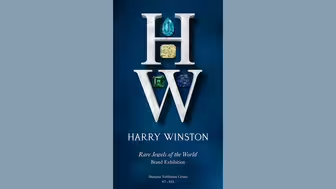
It will explore the life of “The King of Diamonds” and showcase more than 165 creations from the brand.

Two suspects have been arrested in connection with the complex phone scam.

In her first column for National Jeweler, Jennifer Shaheen asks jewelers if they know how to connect with the next generation of consumers.

The annual awards cover tuition for an on-site educational course at the Swiss lab, as well as flights and lodging.
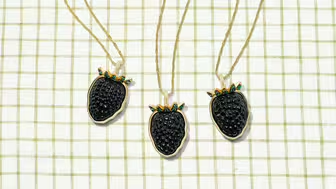
The jeweler partnered with the Tennessee resort to honor its 50th anniversary with limited-edition blackberry pendants and earrings.

The third-generation jeweler shared how the North Carolina retailer is celebrating this milestone and the love story that started it all.
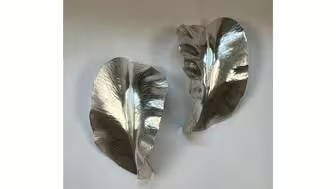
The class, led by renowned metalsmith Cynthia Eid, highlighted Argentium silver as an alternative to gold amid high prices.

The show is slated for Oct. 16-19 at the Miami Beach Convention Center.

The “Empresses” capsule uses 19th-century medals depicting Napoleon, Joséphine, and Marie-Louise across five one-of-a-kind pieces.
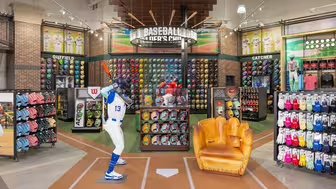
The retailers at the top of the list offer affordable products and fun, discovery-fueled experiences.

Daniel Bing was formerly the marketing director for the Americas at Vacheron Constantin.
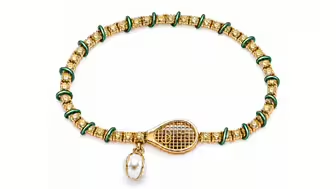
In our Piece of the Week, the designers reimagine the tennis bracelet with green enamel wrapped around a strand of “Desert Diamonds.”


The industry veterans join the podcast to discuss diamond marketing, the FTC Jewelry Guides, and lobbying for lower tariffs.


Founder Vik Westermann said the app is a “starting point” to inspire people to work with appraisers and gem labs, not replace them.
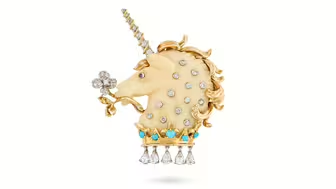
The Verdura brooch, which belonged to the late Virginia Fortune Ryan Ogilvy, was sold to a private collector in Asia.



This site uses cookies to give you the best online experience. By continuing to use & browse this site, we assume you agree to our Privacy Policy