





FinancialsSep 09, 2026
Signet Jewelers to ‘Double Down’ on Blue Nile Amid Strong SalesThe jewelry retailer said it sees opportunity at higher price points, particularly in natural diamonds for bridal and fashion.


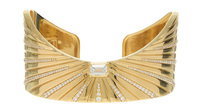



Though sales of luxury goods are expected to grow globally, the U.S. market is grappling with ongoing political uncertainty and struggling department stores, Bain & Co. said.

Milan--The luxury market is expected to get back to growth this year as Chinese spending and consumer confidence in Europe return.
According to management consulting firm Bain & Co., the global personal luxury goods market is predicted to grow in the range of 2 to 4 percent (at constant exchange rates) in 2017, from $284 billion to $290 billion.
The company’s “Worldwide Luxury Monitor 2017 Spring Update” indicates that watches and jewelry are maintaining momentum and while watch sales are down right now, they will soon recover.
However, in the Americas, the study states, the U.S. luxury market “continues to underperform.” A strong dollar, ongoing political uncertainty and struggling department stores have combined to create uncertainty for the country this year, with the market expected to be between a 2 percent decline or flat in 2017.
Meanwhile, Latin America is supported by some local consumption and Canada is poised to slow down--luxury sales there are expected to range between flat and a 2 percent decline.
Europe is still recovering from a decline in tourism last year and is regaining confidence among local consumers, with Spain and the U.K. standing out as bright spots. Bain has forecasted growth of between 7 and 9 percent at constant exchange rates for the region.
Mainland China also is rebounding as its local consumers continue to show a preference for buying luxury goods, driving an expected 6 to 8 percent growth. Chinese tourists also will continue to account for a large portion of international luxury purchases.
While Japan remains a positive market for luxury brands, the environment for the rest of Asia is still difficult: Hong Kong, Macau and Singapore might be improving, but Taiwan and Southeast Asia are facing decreased tourism.
The rest of the world is expected to be flat or see only slight growth of 2 percent.
In its update on the luxury market, Bain also addressed a number of key topics that will drive the luxury market this year, including the following.
1. The U.S. market’s landscape. Even though it’s still the largest market for personal luxury goods, the combined effects of a slowdown in tourism, unsettled political climate and challenging outlook for department stores mean that brands have to have “an impeccable strategy and execution” to survive.
2. The digital and off-price winners. Digital continues to reshape the luxury industry, with Bain indicating it expects online sales to be the leading

The jewelry retailer said it sees opportunity at higher price points, particularly in natural diamonds for bridal and fashion.

The Los Angeles-based, family-owned jeweler was founded by Lenny and Sunny Friedman in 1946.

The auction, held in Bangkok, was 96 percent sold by lot, with nearly 411,000 carats of Mozambiquan rubies sold.
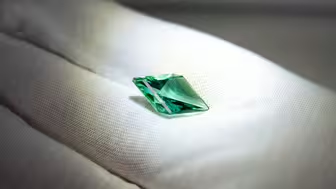
Submit your pieces for a chance to win in this year's competition.


Fine Jewelry 2027-2028 has more than 900 new styles, including silver, gold-filled, gold-plated sterling silver, and vermeil jewelry.


Learn more about the new terms for lab-grown diamonds and composite gemstones, and the major changes in store for precious metals jewelry.

Bromberg is remembered as a Southern gentleman who always wore a suit and tie and treated others with kindness.

Retailers are seeking new ways to attract customers, increase traffic, and create revenue – Estate buying events are a popular solution.


With high durability and a wide range of colors to choose from, sapphires may be the ultimate birthstone, Gizzi claims.

Laughter is often considered a distraction in the workplace, but it has benefits for both staff and management, Peter Smith writes.

Gretchen Koback Pursel is the new chief people officer at the company formerly known as Saks Global.

The California jeweler is renovating its store in Fresno, with plans to show off the new space in December.

A lifelong practitioner of Pilates, Gabrielle looked to the springs’ tension and suspension when creating this ring, our Piece of the Week.

The deadline to apply is Nov. 13.

The auction house has promoted Remi Guillemin, formerly its head of watches for the Americas and EMEA, to the role.

Zaven Ghanimian discussed the value of human craftsmanship and where the implementation of artificial intelligence does work.

Jewelers of America also revealed the recipients of the Seymour & Evelyn Holtzman Bench Scholarship and its own scholarship programs.

The British actor, known for his roles in “Twilight” and “The Odyssey,” will star in a campaign for the Master Control Chronometre.

The “Confetti Disco,” “Champagne Cheers,” “Tuxedo,” and “Classic Punk” jewelry collections each capture a distinct spirit of celebration.

Nelson Holdo of Newport Beach pleaded guilty to multiple counts of felony grand theft and writing bad checks and was sentenced Monday.

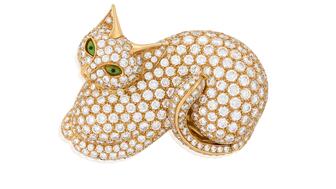
Cat ladies of the jewelry world, unite. Sandy Lerner’s “significant” collection of cat jewelry and other objects is going up for auction.

Arnaud Michon, the former Omega USA President, will now lead Messika’s Americas region during its international development.

The branding references the back-to-back jewelry shows that new parent company Forge will host in Miami's Coconut Grove this November.
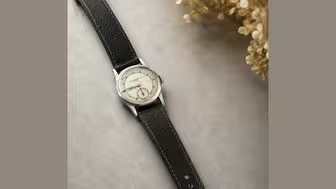
The stainless steel Patek Philippe “Calatrava” watch from the 1930s sold for nearly $80,000 at a recent Hansons Cornwall auction.

Engagement rings are important but don’t ignore the customers who are buying jewelry “just because,” Emmanuel Raheb writes.

Former Pomellato CEO Sabina Belli has been named president of Kering Italia amid a shakeup of Kering's new Jewelry division.

The veteran luxury packaging executive was appointed to help the company grow its North American business.



This site uses cookies to give you the best online experience. By continuing to use & browse this site, we assume you agree to our Privacy Policy