







AuctionsSep 01, 2026
UK Woman Uncovers Rare Patek Philippe Watch in Mom’s Jewelry BoxThe stainless steel Patek Philippe “Calatrava” watch from the 1930s sold for nearly $80,000 at a recent Hansons Cornwall auction.





The statistic was one of many found in a recent survey done for the first edition of the association’s quarterly Consumer View report.


Washington--Despite the increased focus on digital and mobile shopping channels, most consumers still shop in stores primarily, according to a new study from the National Retail Federation.
The NRF just launched Consumer View, a quarterly report designed to gauge consumer behavior and shopping trends.
It partnered with Toluna Analytics to produce the reports, surveying 3,002 consumers between July 20 and 25, and released the first edition with insights into experiences with technology, what brings the younger generation into the store, and what differentiates the online and in-store shopper.
What did the survey uncover about where consumers are shopping today? Among the insights was the fact that brick-and-mortar retail remains an important touchpoint for modern consumers.
In fact, 79 percent of consumers said they purchase half or less of their items online, meaning the majority of them still are primarily in-store shoppers. Only 21 percent indicated that they buy the majority of their goods online.
The latter number, not surprisingly, goes up to 34 percent when isolated to just Generation Z and its slightly older counterpart, Generation Y or the millennials.
However, that doesn’t mean members of these two demographic groups no longer visit stores.
“This report shows that the bricks-and-mortar store is still the cornerstone of American retail and likely will be for many years to come, as consumers seek authentic interaction and experiences with retailers,” NRF President and CEO Matthew Shay said. “Despite the changes in our industry, there is an appeal to seeing and touching merchandise in person and being able to engage with fellow human beings that has yet to go away. Even younger shoppers see the value of the store.”
When it comes to convincing the younger generations to come into the store, the survey shows that they can be swayed to visit physical stores when they are offered a new experience, or to pick up products purchased online.
And, in fact, about half of millennials and Gen Xers surveyed indicated they’re shopping in stores more than they were a year ago.
“Despite the changes in our industry, there is an appeal to seeing and touching merchandise in person and being able to engage with fellow human beings that has yet to go away.”-- Matthew Shay, NRFIn the survey, this holds true across all age groups. Fifty percent of survey-takers said they are visiting physical stores about the same as they used to, with


The stainless steel Patek Philippe “Calatrava” watch from the 1930s sold for nearly $80,000 at a recent Hansons Cornwall auction.

Engagement rings are important but don’t ignore the customers who are buying jewelry “just because,” Emmanuel Raheb writes.

Former Pomellato CEO Sabina Belli has been named president of Kering Italia amid a shakeup of Kering's new Jewelry division.

Submit your pieces for a chance to win in this year's competition.


The veteran luxury packaging executive was appointed to help the company grow its North American business.



Once the property of an Egyptian queen, the necklace was part of a larger exhibition of VCA jewelry at the Museum of Applied Arts (MAK).

The labs’ separate investigations each determined that the East African country is producing copper-bearing tourmaline.

Retailers are seeking new ways to attract customers, increase traffic, and create revenue – Estate buying events are a popular solution.


“Chicago Collects: Jewelry in Perspective” at the Oshkosh Public Museum will feature works by Fabergé, Lalique, and Louis Comfort Tiffany.

The “Worn Well” collection is Catbird's take on classic men's jewelry.
This Buddha Mama butterfly is our Piece of the Week honoring the legend, who embraced the beautiful insect as her symbol.

The former De Beers CEO, and perhaps its next owner, will be a featured speaker at the event, slated for Sept. 4-7 in Italy.

The employee-owned jeweler was named a “Best Place to Work” in Maine, New Hampshire, and for women.

The second iteration of the jewelry collection was inspired by the zodiac and the four elements: earth, water, air and fire.

General License 104B supersedes General License 104A, which was set to expire on Sept. 1.

The package, intercepted in Indianapolis, contained fake Cartier, Tiffany & Co., and Van Cleef and Arpels jewelry.

The new location in Costa Mesa, California, marks the brand’s second store in the United States and fourth standalone location worldwide.

The fashion watch category was once threatened by the Apple Watch, but consumers are now opting for new wearables, said Movado’s CEO.

The association added the requirement to its revised "Code of Ethics" and released the 17th edition of its “Gemstone Information Manual.”

The campaign highlights the asymmetrical high jewelry necklace style that the jeweler first created in 1879.

It will explore the life of “The King of Diamonds” and showcase more than 165 creations from the brand.

Two suspects have been arrested in connection with the complex phone scam.

In her first column for National Jeweler, Jennifer Shaheen asks jewelers if they know how to connect with the next generation of consumers.

The annual awards cover tuition for an on-site educational course at the Swiss lab, as well as flights and lodging.
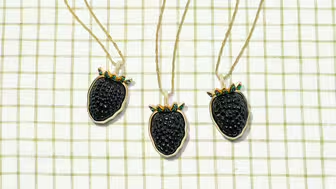
The jeweler partnered with the Tennessee resort to honor its 50th anniversary with limited-edition blackberry pendants and earrings.

The third-generation jeweler shared how the North Carolina retailer is celebrating this milestone and the love story that started it all.

The class, led by renowned metalsmith Cynthia Eid, highlighted Argentium silver as an alternative to gold amid high prices.



This site uses cookies to give you the best online experience. By continuing to use & browse this site, we assume you agree to our Privacy Policy