






CrimeAug 25, 2026
Florida Woman Scammed Out of $1.5M in Jewelry, Precious MetalsTwo suspects have been arrested in connection with the complex phone scam.






Federal judge Jed S. Rakoff ruled that an arbitrator overstepped her bounds in including women who did not opt into the class.

New York--A federal judge ruled last week that the arbitrator in charge of the sex discrimination case against Sterling Jewelers overstepped her bounds in including women who did not opt into the class, and he cut thousands of women from the case.
Arbitrator Kathleen A. Roberts ruled in February 2015 that women could pursue claims of pay and promotion discrimination against the retailer as a class, and certified a class of approximately 70,000 individuals that included all women who had worked for Sterling within a specific range of dates, regardless of whether or not they had said they wanted to be part of the case.
Sterling appealed the decision twice and in July 2017, the U.S. Second Circuit Court of Appeals sided with the retailer, ruling that the issue of whether or not an arbitrator has the power to include people who do not opt into the class had never been “squarely addressed,” and remanded the issue to the U.S. District Court in Manhattan.
On Jan. 16, federal Judge Jed S. Rakoff ruled that the arbitrator does not have this power, writing in his decision, “Arbitrators are not judges. Nowhere in the Federal Arbitration Act does Congress confer upon these private citizens the power to bind individuals and businesses except in so far as the relevant individuals and businesses have bound themselves.”
“The court finds that the arbitrator here had no authority to decide whether the RESOLVE agreement permitted class-action procedures for anyone other than the named parties who chose to present her with that question and those other individuals who chose to opt in to the proceeding before her.”
RESOLVE is the name for Sterling’s internal dispute resolution system; upon hire, all employees agree to settle any workplace disputes in private arbitration, a practice some lawmakers are looking to force companies to change because, they say, it can discourage women who have been discriminated against or sexually harassed from speaking up.
The judge’s ruling cuts the size of the class down from 70,000 to the approximately 250 women who either filed the original arbitration claim under Title VII--which covers claims of promotion discrimination--or were part of the claim before the 2015 class certification that Rakoff just overturned.
There are, however, 10,000 other women who opted into a separate class in 2016 under claims brought under the Equal Pay Act (EPA).
Washington, D.C.-based attorney Joseph Sellers, who represents the women who filed

RELATED CONTENT: EEOC, Signet Reach Settlement in Discrimination CaseThe ruling, and subsequent appeal, is the latest in a convoluted case that has stretched on for nearly a decade and has included numerous rulings and appeals on the issue of allowing the women to pursue their claims as a class even though their case has to be heard in arbitration.

Two suspects have been arrested in connection with the complex phone scam.

In her first column for National Jeweler, Jennifer Shaheen asks jewelers if they know how to connect with the next generation of consumers.

The annual awards cover tuition for an on-site educational course at the Swiss lab, as well as flights and lodging.
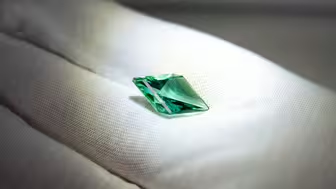
Submit your pieces for a chance to win in this year's competition.

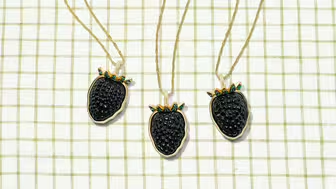
The jeweler partnered with the Tennessee resort to honor its 50th anniversary with limited-edition blackberry pendants and earrings.


The third-generation jeweler shared how the North Carolina retailer is celebrating this milestone and the love story that started it all.

The class, led by renowned metalsmith Cynthia Eid, highlighted Argentium silver as an alternative to gold amid high prices.

Retailers are seeking new ways to attract customers, increase traffic, and create revenue – Estate buying events are a popular solution.


The show is slated for Oct. 16-19 at the Miami Beach Convention Center.

The “Empresses” capsule uses 19th-century medals depicting Napoleon, Joséphine, and Marie-Louise across five one-of-a-kind pieces.

The retailers at the top of the list offer affordable products and fun, discovery-fueled experiences.

Daniel Bing was formerly the marketing director for the Americas at Vacheron Constantin.
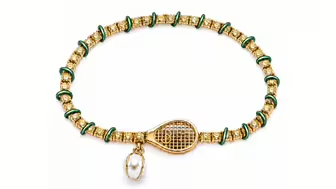
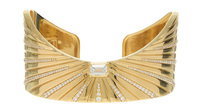
In our Piece of the Week, the designers reimagine the tennis bracelet with green enamel wrapped around a strand of “Desert Diamonds.”


The industry veterans join the podcast to discuss diamond marketing, the FTC Jewelry Guides, and lobbying for lower tariffs.


Founder Vik Westermann said the app is a “starting point” to inspire people to work with appraisers and gem labs, not replace them.
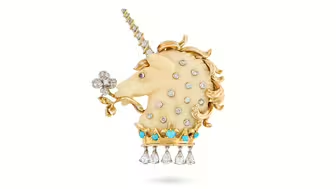
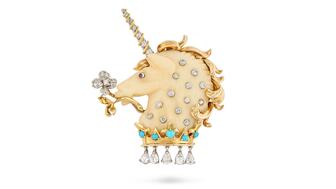
The Verdura brooch, which belonged to the late Virginia Fortune Ryan Ogilvy, was sold to a private collector in Asia.

The five students were awarded a total of $10,000 through the nonprofit’s 2026 “Future of Jewelry Making” scholarship.


The jeweler is encouraging customers who own lookalike rings to come into the store and trade them for credit towards an authentic piece.

The new campaign, “You Are The Occasion,” discourages shoppers from saving their fine jewelry for special occasions only.

Mehta led India’s GJEPC through the 2008 financial crisis and was respected worldwide for his wisdom, integrity, and knowledge.

One is the driver who allegedly crashed a car into a Sacramento jewelry store in April, striking a 71-year-old employee who later died.

In a new column, Peter Smith posits that people actually enjoy putting together IKEA furniture, and the same is true for engagement rings.

9lakha Jewelers in Iselin, New Jersey, was the target of a smash-and-grab robbery on Aug. 8.
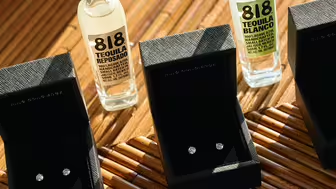
The jeweler has partnered with 818 Tequila to gift lab-grown diamond studs to a bride-to-be and their bridal party.

The exhibition will feature more than 100 drawings of stained-glass lampshades, windows, and more, many created by women and émigrés.
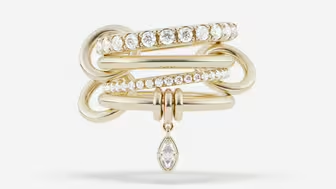
Marquise-cut diamonds in drop charms are the center of the new collection, reflecting the movement of a dancer in modular styles.

The inaugural Fort Lauderdale Jewelry, Antique, & Object Show will be held from Jan. 28 through Feb. 1, 2027.



This site uses cookies to give you the best online experience. By continuing to use & browse this site, we assume you agree to our Privacy Policy