









WatchesJun 30, 2026
Pokémon Fans Will Want to Catch This New G-Shock WatchThe new watch commemorates Pokémon’s 30th anniversary.






In addition to being cheaper, the diamond screening machine is also faster and better, De Beers said.


Hong Kong--De Beers has dropped the price of the device designed to automatically batch screen diamond melee by nearly half.
The second-generation Automated Melee Screener, or AMS, is priced at $45,000, compared with $85,000 ($55,000 plus a three-year, $10,000-a-year support and maintenance charge) for the first-generation version introduced to the market in 2014.
De Beers said the AMS2 also is about 10 times faster than its predecessor and has a substantially lower referral rate, meaning that fewer diamonds need further testing. A company spokeswoman said the referral rate on the AMS2 is less than 0.5 percent, compared with 2 percent on the first version.
Here’s how the AMS and AMS2 devices work.
A user can place up to 500 carats of melee in the machine at once. After the diamonds are inserted, the machine automatically feeds the stones, table down, into a testing station.
Once the stones are tested, they are dispensed into one of five bins:
-- Pass: The stone is not lab-grown or a simulant (meaning CZ, etc.);
-- Refer: More testing is needed;
-- Refer Type II: The stone has a low concentration of nitrogen and further testing is required as it might be lab-grown;
-- Non-diamond: The stone is a simulant or lab-grown; and
-- Purge: This bin is for when the user needs to empty out the machine because, for example, they put in the wrong packet of diamonds.
The AMS device can test colorless or near-colorless diamonds as small as one point and as large as 0.20 carats and was developed to separate man-made melee from natural stones in response to growing industry concerns about undisclosed lab-grown melee in the supply pipeline.
RELATED CONTENT: 5 Takeaways on the Lab-Grown Diamond Market
De Beers’ International Institute of Diamond Grading & Research developed the second-generation AMS device. The IIDGR is a De Beers-owned facility that develops diamond testing equipment and grades stones, and has developed the other products De Beers uses to screen for synthetics, the DiamondView, DiamondSure and PhosView.
When it initially opened, the lab graded only Forevermark stones but it began accepting all diamonds in February 2016. Those who want to send diamonds to the lab can visit the contact details area of IIDGR.com to inquire about the service they want.
The IIDGR has facilities in Maidenhead, United Kingdom; Surat and Antwerp.
De Beers unveiled the AMS2 at the International Diamond, Gem & Pearl Show this week in Hong Kong.
It will

The new watch commemorates Pokémon’s 30th anniversary.

The luxury retailer is now called Exemplar Luxury Group.

The “Lady” collection is a new take on old beauty standards with gemstone-adorned hair pins and combs, a compact mirror necklace, and more.
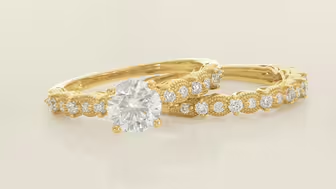
Colored gemstones, artisan finishes, mixed metals, and meaningful details are shaping demand in bridal jewelry.


The new line is included in the e-tailer’s curation of jewelry celebrating America’s 250th anniversary.


The new jewelry collection uses a colorful palette of onyx, malachite, tiger’s eye, mother-of-pearl, lapis, turquoise, and coral.

Lee Michaels Fine Jewelry is celebrating 30 years in the Ridgeland, Mississippi community.

DCA is preparing the next generation of professionals by supporting workforce development, leadership growth, and career advancement.


Classes will begin in August at GIA’s new Canary Wharf location.

A ring set with “hogback” diamonds, an early stone cut dating to around the 16th century, sold for more than $20,000 at a U.K. auction.

The rainbow version of the ring, our Piece of the Week, features angel-cut, octahedral lab-grown sapphires designed to be worn as armor.

The new initiative donates a portion of the proceeds from select charms to charitable causes.

The Brooklyn-based jeweler created a limited-edition version of its “Aura” eternity band, set with gemstones in the team’s colors.

Dallow will lead the International Colored Gemstone Association, effective July 6.

Senior Editor Lenore Fedow headed to Savannah to learn more about the 10-year, $10 million partnership between JM and the art school.

Its new capsule jewelry collection features gold-finished stainless steel pieces designed for a maximalist look without a luxury price tag.

The week-long event in Geneva is slated for April 2027.

The three industry leaders bring financial, communications, and legal expertise to the nonprofit’s board of directors.

Jewelers are missing out by not offering this one key add-on at the online point of sale, Emmanuel Raheb writes.

The fourth collaborative collection from the retailer and jewelry content creator focuses on gemstone charms and strands of colorful beads.

This year’s AGTA Spectrum & Cutting Edge Awards will feature two new categories.

The collection features traceable alexandrite from Brazil in calibrated sizes that is sorted by grade.

Dhaval Raja has been appointed to the role.

The capsule collection looks to vintage trunk pins that echo the spirit of speed, freedom, and the mythology of the American road trip.

SSEF issued a notice about the potential new source of the sought-after gemstone, citing “credible reports” from trade sources.

As Amazon Prime Day kicks off, Etsy is encouraging shoppers to support small businesses.

Cole Winward is the recipient of 2026 AGA Gemological Scholarship.



This site uses cookies to give you the best online experience. By continuing to use & browse this site, we assume you agree to our Privacy Policy