
The deal closed this week, which means Instore will produce the JA NY show slated to take place this fall.
What Is the Mercury-Free Mining Challenge?
It is a challenge being issued by designer Toby Pomeroy that would help to improve the lives of artisanal gold miners worldwide.

There’s a goldsmith in Oregon who has an idea.
Toby Pomeroy wants to find a safe, effective and scalable alternative to mercury in mining.
And he wants to do so by offering a cash prize to whoever comes up with it, in much the same way people were incentivized to find a faster way to clean up oil spills or build a craft to send non-astronauts into space.
The Mercury-Free Mining Challenge is an appeal to scientists and engineers that, Pomeroy hopes, will improve the lives of artisanal gold miners worldwide.
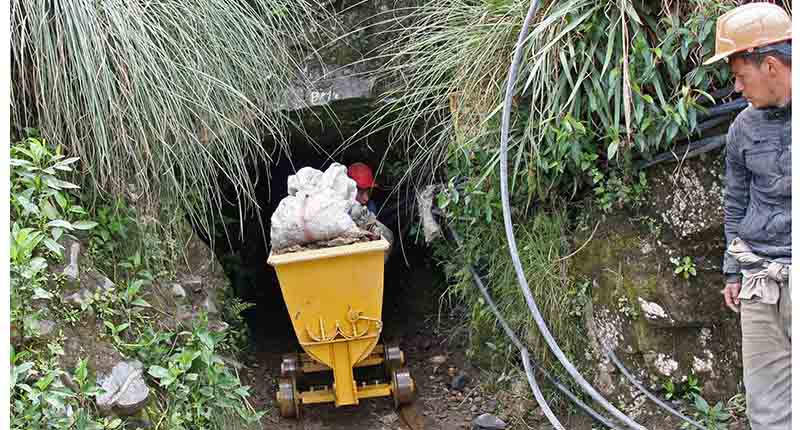
Artisanal miners produce 20 percent of the world’s annual gold supply. Almost all of them use mercury to separate the gold they find from other materials, then burn off the element by heating it, sending toxic particles into the air.
Recently, I talked with Pomeroy over the phone about how he got the idea for his challenge and whether he thinks it’s something the industry can come together to accomplish.
To start, I asked him about his position as a “responsible sourcing” pioneer, if you will.
The Oregon-based jewelry designer was the first one to buy recycled metals from Hoover & Strong and, basically, changed the refiner’s entire business model. After selling recycled metals to Pomeroy in the early aughts, Hoover & Strong went certified 100 percent recycled.
Read on to learn more about Pomeroy and his mercury-free mining ambitions.
This interview has been edited for length and clarity.
National Jeweler: When I heard, Toby, about you and the Mercury-Free Mining Challenge, the first thing that came to mind was that you were doing “responsible sourcing” years ago, before it became this buzzword.
Toby Pomeroy: I think it was 2005, maybe, or ‘04, when I read that website No Dirty Gold, and it was like, “Oh man, I can’t make jewelry anymore.” I just can’t do it because I can’t be associated with this kind of destruction and irresponsibility to the environment and the people. So I basically pulled [back] and didn’t know where to go.
But I had an inspiration one morning while fly fishing ... “Why the heck don’t I just go to Hoover & Strong and ask them to keep their scrap and recycle their scrap only for us?” No newly mined gold; instead: purify it, refine it, and we’ll sell it as “eco-gold.”
Recycled was great. That was wonderful to introduce and give our
I wanted to find a source of gold that was mined responsibly, and that was something that we could shine a light on and say, “This is how it’s done.”
And I wanted to start to promote that in a way that the entire industry saw that possibility, and the mining industry would start to shift from the public’s awareness because it was clear to us, absolutely clear, that the public is willing to pay for responsible sourcing and to have that story that they could tell. They could know the provenance and share it with friends and family; that is good stuff.
NJ: So, you were using a recycled gold and became aware the public was willing to pay for responsible sourcing.
Next you wanted to find, you said, a source of gold that was responsible. And you found that; you worked with a number of companies along the way in places including Colombia and Canada. And now you use recycled metals from Hoover & Strong and buy Fairmined gold through them as well.
TP: Yes.
NJ: So now explain to our readers: What exactly is the Mercury-Free Mining Challenge? I know you talked about this recently on your episode of “Inside the Jewelry Trade,” the podcast hosted by Rod Worley.
TP: Yes, yes. So, it’s the realization that what’s getting done, the breakthroughs that are being accomplished by challenges that are incentivized by prizes, has been huge.
I first became aware of it through the Ansari X Prize, a $10 million prize awarded to the first team of people who could get an aircraft into low Earth orbit, basically into space, carrying three people twice in two weeks.
It was won by Burt Rutan and his team, and the technology was immediately licensed by Richard Branson. Now he’s got Virgin Galactic.
There was also the Wendy Schmidt Oil Cleanup X Challenge. When the (2010 Deepwater Horizon) Gulf spill happened, the technology available for cleanup was the same as it had been, I don’t know, 20 years earlier with the Exxon Valdez. Nobody had improved a thing. So they put up a million-dollar prize. And the winners, I think their method was maybe three times more efficient than had ever been seen before.
People love challenges, and they’ll spend more money in the challenge than they’ll win for bragging rights, for IP. It really calls upon people’s creativity, their inspiration, their engagement, their funds to solve a problem.
I was listening to a podcast of Peter Diamandis one day; Peter Diamandis is the executive chairman of the X Prize Foundation. He asked this question: If you could come up with a purpose for your life that would impact a billion people in the next 10 years, what would that purpose be? And I almost instantly realized that I’d given up on ever making a difference with mercury in the world.
But I realized: “Wait a second. We could incentivize a challenge, incentivize the discovery of a breakthrough solution that would be safe and affordable, and highly effective.” Subsistence gold miners are losing 1,400 tons of mercury into the environment, every year. They’re poisoning themselves and the rest of us.
And so I started the whole thing, but mostly focusing on the jewelry industry with it. I’ve been talking to the RJC. I’ve been talking to the World Gold Council, Jewelers of America, Jewelers Board of Trade.
Everybody likes it but nobody’s … stepped forward with it yet.
NJ: Basically, you’re looking for somebody to step forward and say, “OK, we’re putting out a million dollars.”
TP: Or maybe 10 companies; the leadership of major players in the world could say, “Yeah, we’ve got $100,000 of ours. We’ll put that in escrow and we know it’s only going to be paid if all the parameters of this challenge are met.” And ultimately, if the miners themselves choose it and use it over mercury—that’s really the final word. They have to prefer it.
So yeah, that’s what we’re looking for. We’ve got the most amazing opportunity the industry has ever seen or will ever see. We’ve never had a better story to tell.
NJ: What do you mean by that?
TP: Consumers today are purpose-driven. They want to know what we stand for. Simon Sinek said, “People don’t buy what you do. They buy why you do it.”
People want to know what you’re up to, and they want it to resonate. They want your values to match their values. We are in a shifting paradigm of people caring about, as you said, inclusion and responsibility.
And we are doing nothing. We’re doing little things. We’re taking little potshots at it.
The jewelry industry will come together, and we’ll fund this thing. We’ll help fund the operations of it, and together we can say, “We solved this” or “We made a massive impact on it.”
NJ: I think it’s interesting to hear you say the jewelry industry will come together because I feel like one of our struggles is getting everyone on the same page. Even when everyone agrees on an issue and it seems like we’re making progress toward a solution, something happens and it all falls apart. Sometimes I feel like the industry can’t get out of its own way.
TP: I think so too, and we’ve got a history of being competitive.
As long as we’re going to fight for territory, we are all losing. But if we were willing to come together for this, if we’re willing to say, “This is a universal problem,” and show our strong side, our willingness to engage and be inclusive … this [could be] the best story ever because it resonates.
People [in this industry] do care, but I would say that what we’re missing is something that we can align behind and stand for a future that is inspiring, an inclusive future where artisanal miners are healthy, known and celebrated. We’ve ridden on their backs for centuries, and many established organizations wouldn’t mind if that continues.
I think the biggest opportunity we have is to start to celebrate, acknowledge, recognize and include the people who allow us to do what we do, and customers will delight in that. They will come running back to the jewelry industry when we take a stand that we’re committed, that life works for everybody in our supply chain, and that the environment is clean.
We’re finding a lot of small dealers are participating with us in the Mercury-Free Mining Challenge. They’re helping to fund it. They are sharing about it. My social media is weak, and I need to get some power there, but people get it and they want to have this story.
But I think the whole industry could come together with this good story, and it would turn things on a dime for people wanting to shop jewelry again.
NJ: Is there anything else about the Mercury-Free Mining Challenge that you want to add?
TP: The jewelry industry has an exquisite opportunity to come together and commit to the discovery of a breakthrough alternative, so artisanal and small-scale gold miners can mine safely and effectively without mercury. We can solve the global problem of four tons of toxic mercury being released every day by the communities who dig the gold that ends up in our jewelry.
Let’s support the well-being of our miners and the planet. Let’s create a new story, one we’re proud to tell and completely inspired by.
To learn more about Pomeroy and the Mercury-Free Mining Challenge, visit MercuryFreeMining.org.
The Latest

The company’s jewelry sales were up in Q4 and the fiscal year, with Richemont raising prices in part because of the cost of gold.

The “Bauble” capsule collection of colorful one-of-a-kinds includes our Piece of the Week, the “Bauble” earrings, featuring rose zircon.

As gold prices rise, today’s retailers are looking for alternatives at prices that will appeal to wider audiences.

The updated catalog has a newly dedicated section for gift wrapping.


Everett covers colored stones’ surging popularity, the mellow return of the “Mellon Blue,” and his “The Devil Wears Prada” doppelgänger.

Fourth-generation CEO Lilly Mullen wants to emphasize experience, connection, and personalized service.

With the trade and customer trust in mind, GIA® developed NextGem™ – on-demand training designed specifically for retail.

The new award, created in partnership with Henne Jewelers, honors the late designer’s legacy through supporting jewelry education.

The addition of the diamond-producing countries as nation affiliated members broadens the federation’s global representation, WFDB said.

The NYPD is warning elderly New Yorkers to keep their jewelry hidden when walking outside to avoid being a target.

Designer Viviana Langhoff has realized her dream of owning a space for her Chicago jewelry store that looks and feels like her brand.

The sessions will run from Friday, May 29, to Sunday, May 31, with one being a live taping of an episode of Couture’s podcast.

Former Stephanie Gottlieb Fine Jewelry executive Morgan P. Richardson is joining the lab-grown diamond jewelry brand.

The $400 pocket watch is a blend of Audemars Piguet’s iconic eight-sided Royal Oak and Swatch’s unserious Pop watches from the ‘80s.

With gold prices on the rise, the “Modern Electrum” collection uses an alternative, non-tarnishing metal alloy composed of gold and silver.

Fruchtman Marketing has new owners, Erin Moyer-Carballea and Manuel Carballea, and will relocate to Miami.

In a column for the 2026 State of the Majors issue, Smith lists 10 time-tested principles about sales that still ring true.

In a column for the 2026 State of the Majors issue, Golan spells out how the growing economic divide in the U.S. is reshaping the market.

The “Limitless Expansion of Joy and Hope” collection evokes summer through colored gemstones and motifs of butterflies and florals.

The jewel, circa 1890, is from the late Victorian era and was owned by descendants of the last high king of Ireland.

This is what the nine recipients plan to do with the funds.

The Western star’s 14-karat gold signet ring sold for six times its low estimate following a bidding war at U.K. auction house Elmwood’s.

The discussion, "Rebuilding the Jewelry Workforce," will take place on Saturday, May 16, in Troy, Michigan.

The jewelry industry is reassessing its positioning as Gen Z reshapes the retail landscape and lab grown continues to gain market share.

A matching pair of 18.38-carat, D-color diamonds from Botswana’s Jwaneng mine sold for $3.3 million, the top lot of the jewelry auction.

Sponsored by A Diamond Is Forever