




The special-edition egg pendant ingested in a New Zealand jewelry store was recovered after a six-day wait.
5 Things to Know About … Grandidierite
Learn where and when the gemstone was discovered, its current supply outlook and where you can go to see a few today.

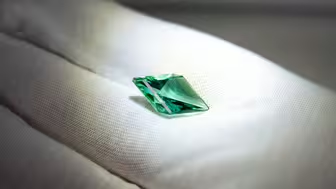
I had heard of the gemstone before but had never seen one in person. As it turns out, not many people have. They’re rare, and let me tell you, they’re gorgeous.
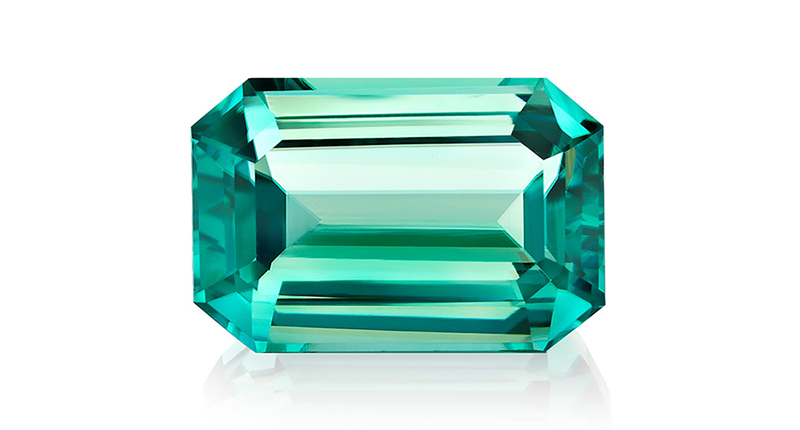
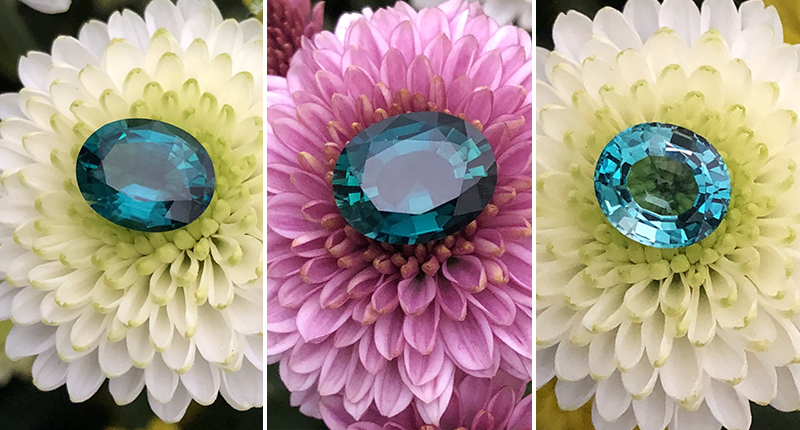
Grandidierite is bluish-green to greenish-blue, with the blue component increasing with the iron content, according to the GIA.
It’s a 7.5 on the Mohs scale, making it suitable for use in jewelry (when available), but according to the International Gem Society, it is difficult to cut because it has good cleavage in two directions.
It also displays trichroic pleochroism, meaning it can show three different colors depending on the angle at which it’s viewed: dark blue-green, pale yellow or colorless, or dark green.
In honor of the stone I was excited to see and learn about in Tucson, here are five things to know about grandidierite.
1. It was first discovered in Madagascar.
French mineralogist Alfred Lacroix found the first reported samples of grandidierite in 1902.
He discovered the gemstone at the cliffs of Andrahomana in southern Madagascar, according to the GIA.
2. It was named for someone.
As is the case with a few other minerals ending in “ite,” grandidierite was named after a person.
Lacroix christened the mineral “grandidierite” in honor of another Alfred: French explorer and naturalist Alfred Grandidier (1836-1912), who was the first explorer to describe Madagascar in detail, according to the Cambridge History of Africa.
He devoted his life to gathering information for his massive “Histoire physique, naturelle et politique de Madagascar,” which was 38 volumes long.
3. It has since been found elsewhere.
In addition to Madagascar, GIA said other reported sources of the mineral include New Zealand, Norway, Suriname, Algeria, Italy, Malawi, India, the United States, Canada, Antarctica and the Czech Republic.
Since its discovery more than a century ago, very little gem-quality grandidierite has surfaced and most of what has been found is translucent.
However, a 2014 discovery of more transparent material outside of Tarnomaro, Madagascar, near the site where the first pieces of grandidierite were found, has resulted in several fine quality faceted stones, according to the Gemmological Association of Great Britain’s Gems & Jewellery spring issue.
4. It is extremely rare.
Despite the number of sources, grandidierite is still extremely rare; pockets tend to be small and quickly become depleted.
Much of the material that comes out of the ground is opaque, IGS said. As mentioned before, even when gem-quality material is produced, it’s often translucent (semi-transparent), and is thereby cut into cabochons ranging in size from about 1 carat to 10 carats and up.
According to GIA’s Gems & Gemology, gem-quality grandidierite of “facetable size” was “almost unheard of” in the market before the summer of 2015.
Bangkok-based gemstone dealer MultiColour Gems said on its website that the ratio of gem-quality crystals to rough is about 1 in 10,000.
The company noted that the Tranomaro deposit, where the 2014 discovery occurred, has produced only about 60 grams (300 carats) of eye-clean crystals.
Given its rarity, fine grandidierite gems can demand significant prices.
For example, gem dealer and Mineral Art manager Brice Gobin is quoted in the Gems & Jewellery article as saying that a buyer paid $50,000 in 2003 for the first known transparent faceted grandidierite, which weighed only 0.29 carats, a fact confirmed by GIA.
Even so, minimal supply goes hand-in-hand with low demand and a lack of knowledge about the stone among many jewelers, according to Gobin.
“Grandidierite is too rare to be able to provide the jewelry market,” he is quoted as saying. “No supply, no demand; it’s as simple as that.”
5. You can see grandidierite gems in New York right now.
For those who haven’t seen grandidierite in person or are looking for the perfect collector gemstone, one Manhattan gallery provides the perfect opportunity.
Gobin sourced a collection of grandidierite gems from the Tranomaro region of Madagascar over an 18-month period, Gems & Jewellery reported. The selection included some 20 gems weighing between 1 and 9-plus carats.
Three of Gobin’s grandidierite gemstones will be on display at the Wilensky Gallery in New York City through at least June, representing the gallery’s foray into faceted gemstones.
They weigh 2.86, 3.14 and 4.96 carats and are priced at $69,000, $78,000 and $129,500, respectively.
I was lucky enough to get to see those, too, during a recent WJA event at the gallery, and I’m telling you: Run, don’t walk, to see these gems before they’re gone.
The Latest

The “Love and Desire” campaign is inspired by the magic that follows when one’s heart leads the way, said the brand.

Two awardees will receive free tuition for an educational course at the Swiss lab, with flights and lodging included.

How Jewelers of America’s 20 Under 40 are leading to ensure a brighter future for the jewelry industry.

Berta de Pablos-Barbier will replace Alexander Lacik at the start of January, two months earlier than expected.


Sotheby’s held its first two jewelry sales at the Breuer building last week, and they totaled nearly $44 million.

Winners will receive free registration and lodging for its fourth annual event in Detroit.

Roseco’s 704-page catalog showcases new lab-grown diamonds, findings, tools & more—available in print or interactive digital editions.

Here are six ideas for making more engaging content for Instagram Reels and TikTok, courtesy of Duvall O’Steen and Jen Cullen Williams.

The honorees include a notable jewelry brand, an industry veteran, and an independent retailer.

Carlos Jose Hernandez and Joshua Zuazo were sentenced to life without the possibility of parole in the 2024 murder of Hussein “Sam” Murray.

Yood will serve alongside Eduard Stefanescu, the sustainability manager for C.Hafner, a precious metals refiner in Germany.

The New Orleans jeweler is also hosting pop-up jewelry boutiques in New York City and Dallas.

Set in a Tiffany & Co. necklace, it sold for $4.2 million, the highest price and price per carat paid for a Paraíba tourmaline at auction.

The jeweler’s “Deep Freeze” display showcases its iconic jewelry designs frozen in a vintage icebox.

Take luxury gifting to new heights this holiday season with the jeweler’s showstopping 12-carat sphene ring.

This year's theme is “Unveiling the Depths of the Ocean.”

In its annual report, Pinterest noted an increase in searches for brooches, heirloom jewelry, and ‘80s luxury.

Starting Jan. 1, customers can request the service for opal, peridot, and demantoid garnet.

The 111-year-old retailer celebrated the opening of its new location in Salem, New Hampshire, which is its third store in the state.

The new catalog features its most popular chains as well as new styles.

The filmmaker’s personal F.P. Journe “FFC” prototype was the star of Phillips’ recent record-setting watch auction in New York.

The new location in the Design District pays homage to Miami’s Art Deco heritage and its connection to the ocean.

Inflations, tariffs, and politics—including the government shutdown—were among consumers’ top concerns last month.

“Longtime favorite” presenters, as well as first-time speakers, will lead talks and workshops at the annual event in Tucson next year.

Silas Smith of Meridian Metalworks won the challenge with his pendant that blends Australian and American landscapes.

The sale of the 31.68-carat, sunset-hued stone was part of Sotheby’s first series of events and auctions in Abu Dhabi.