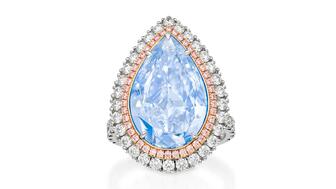
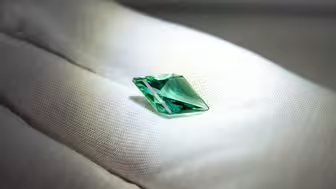
Fancy colored sapphires have been gaining in demand of late. Pictured here a padparadscha sapphire from Omi Gems.
Color never goes out of style.
While the market might swing up and down as the economy, supply and other factors influence it, colored gemstones always will have a place and continue to do well with today’s consumers.
Click here to read the full story in the State of the Majors issue.
Colored gemstones benefit from consumers’ penchant for color and their desire to find something that stands out and also offers a good value, which they deliver with their wide range of price points.
The United States and Japan’s economies are fair and colored stones have been doing OK, says Russell Shor of the Gemological Institute of America, while Europe’s economy is struggling, between the Brexit referendum and the refugee crisis. Perhaps one of the biggest effects on the colored stone market, though, is China and its recent struggles. Demand in the Asian market, generally a notable player because of high demand and the spending ability of the growing upper class, is “off,” Shor says.
The slowing of the economy’s growth and the government’s attempt to curb spending from officials on luxury goods both have played big parts in the drop in demand from China.
Overall, Omi Gems’ Niveet Nagpal characterizes the colored stone market today as being inconsistent.
“We think it’s going to be one stone or a certain price point or a certain type of client and then it switches to something else and it switches to something else,” he says. “There’s no way to predict it and there’s no consistency in it.”
Two-Tier Market Earlier in the year at AGTA GemFair Tucson, GemWorld International President Richard Drucker presented a session about market trends that addressed the fact that the market was only seeing two pricing tiers flourish.
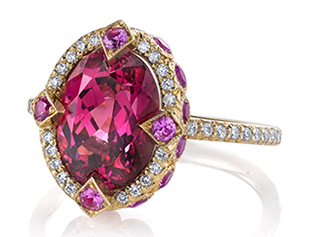
Erica Courtney’s 18-karat yellow gold “Duchess” ring set with a 4.31-carat pink spinel accented with pink sapphires and diamonds ($27,200)
That trend continues today. The under-$499 retail segment is doing OK and above $7,500 is flourishing, while $1,500 to $2,000 is soft and the middle tier of about $2,000 to $6,500 remains weak as the slow economic recovery leaves behind the many in the middle class.
“This (two-tier structure) is a symptom of that,” Shor says. “I can tell you, wages haven’t gone up that much. Housing costs in California are close to where the big boom was, at least in the nicer neighborhoods anyway. We’re kind of dealing with a swelling economy in the U.S. that’s not benefitting everybody.”
The economic pressure put on the middle class is leading to consumer apathy, says Stuart Robertson of GemWorld International, a company that provides gem market analysis, consulting, training, publishing and appraising. Because that segment isn’t feeling comfortable, they’re not spending as much and that’s making sales challenging.
What this has left is a high end that continues to perform very well, from high-quality gems to the unique or rare stones sought after by collectors.
On the flip side, the lower end is doing well too, as people reconsider what kind of gem they’ll buy in order to accommodate their budgets, purchasing, for example, an amethyst or blue topaz instead of a sapphire.
“The opportunity here is to focus on marketing the color and not the gem variety,” says Robertson. “For example, often when a customer says ‘ruby’, they are actually describing a color they would like. Garnet and tourmaline can fit this bill more affordably for those not currently able to afford a natural ruby.”
In Short Supply The colored gemstone market’s supply story couldn’t differ any more from that of diamonds. Where the diamond market is mostly run by just a few players who control large, concentrated pockets of mines, the colored gemstone market remains scattered and in many instances, a small cottage industry.
This very broad aspect of the gemstone market brings a number of issues with it, one of which is the fact that its fractured structure makes it much harder to market.
For decades, De Beers’ iconic “A Diamond is Forever” marketing campaign provided a big lift for all diamonds and diamond jewelry. One hugely successful marketing campaign like this can help to elevate an entire industry.
Colored stones, on the other hand, have too wide a variety of products and too many players to be able to successfully market for the sector as a whole.
For one thing, it’s hard to convince companies to invest in a marketing campaign behind specific stones when the question of supply hangs in the air, Shor says.
“(Supply) is probably the biggest challenge that we face. Where I spend most of my time is just trying to source the finest-quality stones ... We have great contacts with suppliers, but even then, that’s probably been the most difficult part, whether it’s a 1-carat sapphire, like a bread-and-butter 1-carat round sapphire, or whether it’s a 10-carat ruby.” --Niveet Nagpal, Omi Gems
The exception to this is colored gemstone miner Gemfields.
With its projects such as the Montepuez ruby mine in Mozambique and the Kagem emerald mine in Zambia offering a relatively stable supply--for now--the company has really ramped up its marketing spend behind gemstones and attempts to promote color in general.
For example, the company owns jewelry brand Fabergé, which is now selling engagement rings set with sapphires, emeralds and rubies while encouraging brides-to-be to #SayYesinColour via a marketing campaign.
Even so, Gemfields is only one small part of a much larger picture. “It’ll take a few years before anything they do really starts to get traction, mainly because there’s a lot of noise out there,” Shor says. “Everybody’s promoting everything.”
The Retail Reach Retail remains both a challenge and a pivotal opportunity for the market, as colored gemstone jewelry sales are still just a small portion of jewelers’ overall sales.
According to Jewelers of America’s 2015 Cost of Doing Business Report, colored stone jewelry sales (excluding cultured pearls) were only an average of 9 percent of total sales among retailers, though the category had an average gross margin of 51 percent.
This means there is plenty of upside and opportunity for gems in this space.
“I think there’s so much opportunity on the retail end with colored gemstones with the additional margin, and with the stories and the individuality there is.” says Nagpal of Omi Gems. “I think there’s a lack of education at the (retail) level, at the touch point of consumers.” But when Omi can go into stores and train the staff, they notice “an immediate increase in sales” for the retailer.
GemWorld’s Robertson says that retailers’ over-reliance on memo is another issue for the market.
“Retailers, especially larger firms, have introduced a model that has lessened, if not removed, the incentive to know the product and how to sell it,” he says, adding that too much is borrowed on memo with little investment from the retailer, meaning it can be sold quickly at a low margin. This has led to an erosion in profit margin and the sense of “value” for jewelry stores.
Also, once price point became the selling point, product knowledge became much less important.
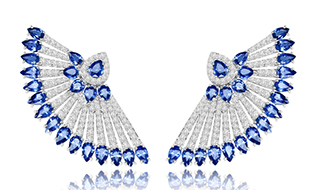
From Sutra’s Fan collection, these earrings feature 10 carats of sapphires and 2.5 carats of diamonds made in 18-karat white gold ($18,000).
While Robertson adds that while there are many stores with well-trained staff who possess gemological knowledge, even they still have to compete on price.
This means the market risks becoming less about the story and value behind the gemstone and more about the number on the price tag that the consumer wants to see.
The Labs’ Role Another area in which the gem market differs greatly from the diamonds is the labs.
With diamonds, almost every stone being sold by a reputable seller comes with a grading report dissecting its cut, clarity, color and carat weight and giving the consumer very specific knowledge about the quality of their stone.
With colored gemstones, it’s not so, Shor says. While stores, designers and dealers can provide the carat weight themselves, not every colored stone is sent to a lab for a report. What’s more, they aren’t required to be.
And, the results that come from sending a stone in for a report can vary from lab to lab. What one might see as a “pigeon’s blood” ruby, another might not. The same can be said for a “cornflower blue” sapphire or exactly which orange-pink shades constitute a padparadscha sapphire.
Popping up of late has been the conversation about “Paraiba” tourmaline: Does the term still refer only to stones that originate from the Paraíba region of Brazil, or can it be used to talk about copper-bearing tourmaline in general? If it is the latter, should it instead be labeled as “Paraiba-type?”
In late 2015, Swiss labs Gemmological Institute SSEF and Gübelin Gem Lab harmonized their standards of color and quality criteria when it comes to the terms “pigeon’s blood red” and “royal blue” for fine rubies and sapphires to bring unity and clarity to the industry. The two established a strict set of requirements in terms of both color and quality.
“Clearly, such stringent sets of criteria imply that only a very small percentage of rubies and sapphires qualify,” Daniel Nyfeler, managing director of the Gübelin Gem Lab, said at the time. “This is in line with the experience and belief of both Gübelin and SSEF that historically only exceptional rubies and sapphires were attributed these quality terms.”
It was not clear by press time whether or not they would continue to harmonize these standards with additional labs.
Today’s consumer also is showing an increased concern with ensuring that what they’re buying is ethically sourced and comes from a sound background, and the industry continues to respond in kind.
But rather than an international agreement on trading between countries and corporations, since the colored stone market is so large and scattered, the governments and organizations around the world are enforcing laws for the import and export of goods.
In March, the Responsible Jewellery Council announced that it would expand its scope to include colored gemstones, a move that came after five years of discussion and collaboration with its members, external stakeholders and the colored gemstone industry.
Last summer, the American Gem Trade Association made a few revisions to its Code of Ethics and Fair Business Practices document to emphasize the importance of transparent supply chains in the colored gemstone world.
The edits were made to emphasize that members are not only giving correct information but also doing everything they can to assure the stones have been sourced in legitimate fashion and comply with U.S. and international laws, AGTA CEO and President Doug Hucker told National Jeweler at the time.
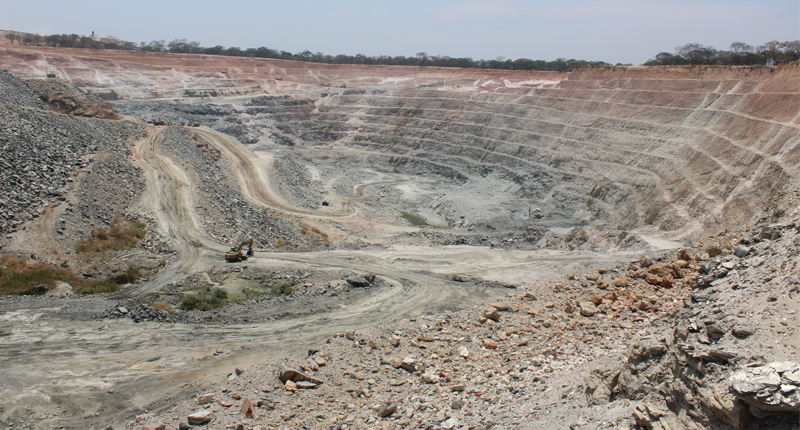
Gemfields has two mining sites in Zambia--the Kagem Emerald Mine (pictured here) and the Kariba Amethyst Mine.
In another nod toward industry members understanding the need to create a set of standards and help get everyone on the same page, the first industry summit dedicated entirely to responsible sourcing, called the Jewelry Industry Summit, took place in 2016 in New York. More are planned for the future.
But the colored stone market, by its fragmented, fractious nature, faces the challenge of how to get everyone on the same page when it comes to instituting a set of standards for ethical sourcing.
The magnitude of the colored stone industry is an important distinction to consider “or else the efforts at ethical sourcing will simply put the vast majority of small-scale folks out of business for lack of resources to meet requirements that have little to do with the actual integrity of the production,” Robertson says, noting that the key will be to educate the consumer while not destroying the ability of small-scale producers to exist.
Stone By Stone Robertson says spinel, which is now an August birthstone, is doing well in the market, as are sapphires.
Among the “big three,” he says that emerald has the most upside, as the gemstone benefits from more promotion from the likes of Gemfields. Even though emerald prices have climbed over the past few years, the increases haven’t been as high as those seen for rubies and sapphires.
Nagpal says that unique stones are doing well for his company, pointing out spinel as a strong performer for Omi Gems too, noting the stone is something he’s been pushing because it is “reasonably priced.” Fancy colored sapphires have been popular with buyers as well.
One of the consumer trends he sees that’s helping the market is colored stone bridal, a trend that has picked up steam in the last few years, with many designers and manufacturers getting on board with it. Another is the rise of gemstone collectors, especially as the internet allows for more education and more awareness among consumers.
But even as demand for the high-end stones soars, supply has not kept pace.
“That’s probably the biggest challenge that we face. Where I spend most of my time is just trying to source the finest-quality stones,” Nagpal says.
“We’ve been doing this for generations and our company’s over 30 years old so we have great contacts with suppliers, but even then, that’s probably been the most difficult part, whether it’s a 1-carat sapphire, like a bread-and-butter 1-carat round sapphire, or whether it’s a 10-carat ruby.”
Brecken Branstratoris the senior editor, gemstones at National Jeweler, covering sourcing, pricing and other developments in the colored stone sector.