New York--Signet rings are having a moment in jewelry design.
Or perhaps it’s more accurate to say that they’re having a millennium, though even that is an understatement; signet rings have been in existence since before the Bible.
Signet rings have graced the fingers of Egyptian queens and Shakespeare, said jewelry expert and editor Lori Ettlinger Gross, noting that in antiquity the rings “were worn and used by anyone who had some kind of social standing and land ownership.”
For a little context on the ubiquitous style, National Jeweler spoke with Gross and historian Emily Stoehrer of the Museum of Fine Arts, Boston, as well as contemporary jewelry designers who are embracing the signet ring now.
How far back do signet rings date? “In our collection alone,” Stoehrer said of the Museum of Fine Arts, Boston’s permanent archives, “we have (signet rings) that go back to ancient Mesopotamia, ancient Egypt and ancient Nubia.”
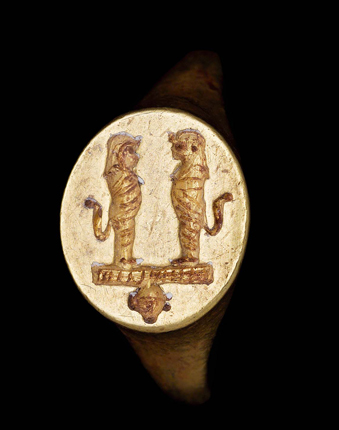
This ring was excavated from Sudan (what was ancient Nubia) by the Harvard University--Boston Museum of Fine Arts Expedition in 1923. It is dated to the Meroitic Period, between 40 B.C. - 40 A.D. It was recovered from the debris of a plundered burial and features an engraving of two mummied figures in gold. Image courtesy of the Museum of Fine Arts, Boston
She said that ancient signet rings have been found primarily in the Mediterranean region, stretching as far as Nubia, or what is now Sudan.
Gross said that signet rings were prevalent enough in human culture that they were mentioned in the Bible, “specifically The Book of Esther, which talks about Persian King Ahasuerus’s signet ring.”
“While the Bible may or may not be taken as entirely factual,” Gross continued, “the way people used and wore them traditionally is useful information that we can culturally rely on.”
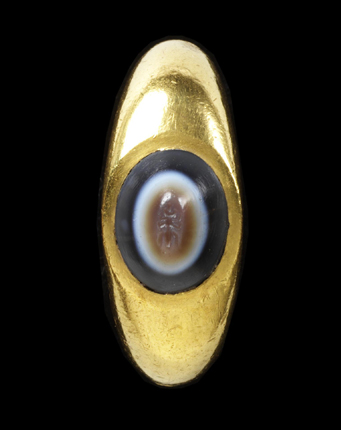
What are the details of the ring’s origins; what was its function? Signet rings were typically made entirely of gold or featured carved gemstones, or intaglios.
“They were really used as a signature would be used today, as a way of leaving your mark and a way of assuring authenticity,” Stoehrer said. “You could mark a document with them, you could leave an impression in wax or clay.”
“Signet rings were used as seals,” Gross explained, “as a symbol or mark of the hand that sent or signed a document. Wax was melted onto the document and the top of the ring was impressed into the wax, leaving a clear and permanent mark. The top of the ring was usually set with a hardstone that had been deeply engraved with some kind of symbol or depiction.”
To denote the ring’s wearer, signets were comprised of “identifying marks” according to Stoehrer, like coats of arms, monograms, family seals or initials.
During which historical periods were signet rings most popular? Signet rings were used from ancient times through the early 19th century, Gross said.
Yet even as more people became literate and the use of signet rings as document seals declined, the pieces maintained their popularity.
Gross explained, “During the late 19th century, (signet) rings became more of a status symbol, rather than a legal mark. The tops of the rings had decoration or engraving (and) often were gem set, or if they were metal intensive, they bore initials done in shallow-yet-decorative engraving. You could probably say that it was in the 19th century that signet rings became more of a personal statement.”
Stoehrer noted that the signet style was most popular in antiquity, with a resurgence in the Middle Ages and the Renaissance period.
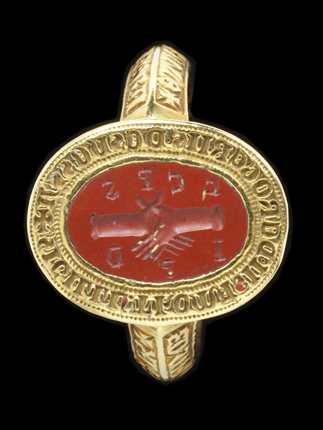
“In (the Museum of Fine Arts, Boston’s) collection of carved gems we have a lot of ancient carved gems that have been set in rings (from the Middle Ages). We see these gemstones being reused by subsequent generations to become more of a fashionable style rather than a signature.”
Stoehrer added that the practice of repurposing gems in updated jewelry styles wasn’t necessarily a new practice in the Middle Ages. “We know that things like cameos were being reused and set into new pieces of jewelry as early as the third century B.C.,” she said.
The Modern Interpretation Today’s signet rings aren’t dissimilar to ancient styles. Many embrace the personalized aspect of signet rings, engraving them with customers’ monograms or the initials of their loved ones, a practice which “makes memories wearable,” according to Single Stone designers Ari and Corina Madilian.
Ariel Gordon has built her fine jewelry business on the nostalgic appeal of custom jewelry like engraved signet rings. She feels that personalization lends an importance to jewelry that goes beyond accessorizing.
“Most of the jewels in my personal uniform are custom engraved or set with birthstones for my loved ones,” said Gordon. “It feels more deliberate this way and less like I’m just piling things on for no reason. A signet ring is the pinnacle of personalized jewelry.”
Designer Elisa Solomon, who makes an oval-shaped signet ring in her signature organic, handmade style said, “I often inscribe (signet rings) with a bride’s married monogram or the first initial of a newborn’s name; I have also created pieces with specific birthstones. I love that they connect to a person’s individuality.”
Many designers noted the automatic heirloom status of a piece of jewelry that has been personalized to represent its wearer.
“My secret hope is that my customers view my designs as modern heirlooms to be passed down through generations, as so many of those seals were in the past,” said Delphine Leymarie, whose skull signet ring invokes the macabre mood of many historical designs.
Letters by Zoe designer Stephanie Hayoun said, “I personally possess my ancestors’ signet rings and love their simple and historic beauty and the tangible link it affords me to my family.”
The Next Incarnation Foundrae designer Beth Bugdaycay constructed an entire range of fine jewelry around enamel-adorned signet rings with inscriptions and images that are talisman-like in their symbolism.
“The cigar bands and signet rings were the very first pieces designed,” she said. “They embodied the idea of creating future heirlooms that capture at least a piece of (a woman’s) story and ideally help to inspire her next chapter.”
Designer Alison Chemla, of the brand Alison Lou, has done the most with signet rings in terms of modernizing the design and adapting the classic style to a uniquely 21st century point of view. Her playful, emoji-inspired offerings are at their wittiest in her hefty signet styles that feel as luxurious as they do clever.
“Playing with classic jewelry norms is something I do often in my designs,” said Chemla. “I love the history behind (signet rings) and the way that they look; however, instead of using my signet rings as a seal of identification, I’ve made them a seal of your personality.”