


FinancialsNov 03, 2021
Pandora’s Lab-Grown Diamond Line Coming to the USLab-GrownNov 04, 2021
Analyst: Fashion Jewelry, Industrial Uses Will Drive Lab-Grown Diamond Demand
Paul Zimnisky shared his short- and long-term outlook for the market in an updated forecast released last week.


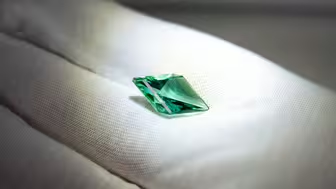
Paul Zimnisky cited the colored lab-grown diamonds Swarovski introduced in 2020 as an example of a major brand positioning the stones for fashion jewelry. Pictured here are three of the 16 colors Swarovski created, clockwise from top, “Disco Ink,” “Electro Arctic,” and “Punk Lipstick.” (© Swarovski)
New York—The long-term growth of the lab-grown diamond market lies in fashion jewelry and industrial applications, one industry analyst said in a forecast released last week.
New York-based diamond industry analyst Paul Zimnisky predicted lab-grown diamonds will constitute 12 percent of the diamond jewelry market by 2025, up from 8 percent in 2021 and 3 percent in 2018, when De Beers shook up the market with the introduction of Lightbox.
(These percentages represent lab-grown diamond value at retail as a percentage of the total polished diamond value at retail, i.e., lab-grown and natural.)
As the market for man-made diamonds grows, however, it appears to be “stratifying,” Zimnisky said, with producers adopting more specific business strategies rather than focusing on “disrupting” the natural diamond industry.
Some producers are intent on creating branded diamonds grown using more sustainable methods to differentiate their product.
Others are making diamonds for low-cost fashion jewelry, while some producers have turned their attention to growing diamonds for industrial purposes.
In the long term, the growth of the market is likely to come from this lower-cost fashion diamond jewelry—not from bridal—as well as from diamonds grown for industrial purposes, such as medical equipment, energy storage, or semiconductors.
Related stories will be right here …
New York-based diamond industry analyst Paul Zimnisky predicted lab-grown diamonds will constitute 12 percent of the diamond jewelry market by 2025, up from 8 percent in 2021 and 3 percent in 2018, when De Beers shook up the market with the introduction of Lightbox.
(These percentages represent lab-grown diamond value at retail as a percentage of the total polished diamond value at retail, i.e., lab-grown and natural.)
As the market for man-made diamonds grows, however, it appears to be “stratifying,” Zimnisky said, with producers adopting more specific business strategies rather than focusing on “disrupting” the natural diamond industry.
Some producers are intent on creating branded diamonds grown using more sustainable methods to differentiate their product.
Others are making diamonds for low-cost fashion jewelry, while some producers have turned their attention to growing diamonds for industrial purposes.
In the long term, the growth of the market is likely to come from this lower-cost fashion diamond jewelry—not from bridal—as well as from diamonds grown for industrial purposes, such as medical equipment, energy storage, or semiconductors.
Zimnisky points to Pandora’s “Brilliance” line, which starts at $350 and was introduced to “democratize” diamonds, and Swarovski’s proprietary colored lab-grown diamonds as examples of two major brands going the fashion route.
On the industrial side, he noted the new 10-million-carats-per-year factory the Diamond Foundry—which emerged onto the scene as a major “disruptor” of the natural diamond market—is building in Spain will focus on growing diamonds for the tech market.
Overall, the market for industrial diamonds is just a lot bigger than the market for man-made diamond jewelry, Zimnisky said, and the industrial end user cares far less whether the diamond they have is lab-grown or natural.
“With industrial applications for diamond, the lower-price option will theoretically win out as long as performance is comparable.
“With diamond jewelry, as is the case with luxury more generally, the consumer rational for purchase is not nearly as practical and is often influenced by more intuitive factors, like emotion or an affinity for rarity,” he concluded.
For the full report, visit Zimnisky’s website.
Editors' Picks
Sponsored by


More on Lab-Grown

The Latest

SourcingOct 02, 2026
De Beers, National Geographic Society Renew Okavango Eternal Partnership The partnership, a pledge to protect Africa’s Okavango River Basin, has been extended for an additional five years.

MajorsOct 02, 2026
Pandora Opens New $150M Manufacturing Facility in VietnamThe new facility, its first outside of Thailand, will boost its manufacturing capacity by 50 percent.


TrendsOct 02, 2026
Hearts On Fire Celebrates 30th Anniversary With Heart PendantThe special-edition “Dream” pendant, our Piece of the Week, was created to mark Hearts On Fire’s 30-year milestone with 30 diamonds.


Brought to you by
Meet Gemology’s Next Generation Microscope: GIA® Gemolite® NXT Professional EditionExperience gemstones with greater precision and comfort than ever before.


CrimeOct 01, 2026
Police Looking for 4 Suspects in $600K Smash-and-Grab RobberyDubai Jewelers in Springfield, Virginia, was once again the target of an armed robbery.
Weekly QuizOct 01, 2026
This Week’s QuizTest your jewelry news knowledge by answering these questions.


SurveysOct 01, 2026
Rolex Ranks Among Most Recommended Brands in US, Survey Says YouGov’s 2026 U.S. Most Recommended Brands report’s out, and a fast-fashion giant is sitting at No. 1 while Rolex is just shy of the top 5.

SourcingOct 01, 2026
Columbia Gem House Opens ‘Cutting Toward Change’ FundraiserProceeds from its jewelry raffle will benefit an organization working in India to combat silicosis, a lung disease affecting stone cutters.

Brought to you by
Your Piece Could Be the One Editors Talk AboutSubmit your pieces for a chance to win in this year's competition.


TrendsOct 01, 2026
Carolina Hurricanes’ Championship Ring Reveals Hidden Hockey Puck PendantThe rings, crafted by Jason of Beverly Hills, celebrate the hockey team’s Stanley Cup win with design elements that honor its traditions.

TrendsOct 01, 2026
Amanda’s Style File: October’s Color Range This roundup of birthstone jewelry for October features vibrant tourmalines and opals with personality.


SourcingSep 30, 2026
Botswana’s President, De Beers CEO Say Diamond Demand Is RecoveringPresident Duma Boko spoke at back-to-back events in the city last week, touting Botswana’s stability and the diamond “bounceback.”

CollectionsSep 30, 2026
Oscar Heyman’s Holiday Book Is ‘A Living Archive’ The catalog showcases 112 new, one-of-a-kind pieces amid highlights from the jeweler’s historic archive.

SourcingSep 30, 2026
Gemfields Posts $98.5M Loss, Writes Down Value of Ruby MineIts Montepuez Ruby Mining operation in Mozambique, which is not yielding enough high-quality rubies, has taken a $125 million hit.

SurveysSep 30, 2026
Consumer Confidence Falls to 12-Year Low in SeptemberThose surveyed were worried about the present and the future, with write-in responses mentioning high oil and gas prices.

Events & AwardsSep 30, 2026
Jewelers of America, JA New York to Host Networking EventThe event will take place on the evening of Oct. 26 in New York City.

IndependentsSep 29, 2026
Christy Bromberg, Longtime Gift Buyer for Underwood Jewelers, Dies at 68She is remembered for her joie de vivre, upbeat personality, genuine interest in other people, and love of the Alabama Crimson Tide.

AuctionsSep 29, 2026
Dionne Warwick’s Jewelry Goes Up for AuctionOnline bidding is open now for Julien’s sale of items owned by the “Walk On By” singer, whose final album comes out this fall.

Events & AwardsSep 29, 2026
Matt Stuller to Receive 2027 Gem Award for Lifetime AchievementThe founder and executive chairman of Stuller Inc. is being honored for his impact on the jewelry industry at the 25th annual Gem Awards.

ColumnistsSep 29, 2026
Your Holiday Marketing Has a Bridal Blind SpotDecember is the most popular month to propose, and jewelers need to keep that in mind when planning their holiday marketing.


AuctionsSep 29, 2026
If You Love Cats, This Jewelry Auction Is for YouCat ladies of the jewelry world, unite. Sandy Lerner’s collection of cat jewelry and other objects is going up for auction Wednesday.

CollectionsSep 28, 2026
De Beers London Drops Water-Inspired High Jewelry Collection“Vibrations” features several firsts for De Beers’ high jewelry, including the use of chalcedony and diamonds sourced from artisanal miners.

CollectionsSep 28, 2026
Jessica McCormack Turns to Classic Motif for New CollectionThe “Bows” collection features three interpretations of the bow motif designed with Georgian and Victorian influences.

Events & AwardsSep 28, 2026
Guy Borenstein, Troy Underwood Among the Professionals Honored at AGS Conclave 2026The American Gem Society recognized industry members, one Guild, and a law enforcement official for their contributions to jewelry.

FinancialsSep 28, 2026
Instappraise, Jewelers Mutual Look to Simplify Jewelry InsuranceThrough a new system integration, customers can now receive instant personal jewelry insurance quotes at the time of appraisal.

WatchesSep 25, 2026
Smaller Rolex Watches Showing Strength on Secondary Market, Data ShowsFive of the 10 fastest-appreciating Rolex models on Bob’s Watches were Datejust 31 or Lady Datejust watches.

MajorsSep 25, 2026
Sherwood Family Buys Back Daniel’s Jewelers from Private EquityThe Sherwood family and AJS Creations CEO Tejas Shah purchased the jewelry chain back from Palladium Equity Partners.

TrendsSep 25, 2026
A Peek at Taylor Swift’s Game-Day DiamondsThe artist wore Dana Rebecca Designs’ marquise diamond-set gold hoops at the Chiefs game last Sunday. Now they’re our Piece of the Week.