





ColumnistsMar 12, 2024
The PR Adviser: Closing Sales and Following UpColumnistsMay 15, 2024
Squirrel Spotting: Why Retailers Struggle to Fire Brands
Why do so many jewelers keep lines that are not selling? Peter Smith thinks the answer lies in these two behavioral principles.


Peter Smith is an industry consultant, speaker, sales trainer, and author. He can be reached via email at TheRetailSmiths@gmail.com.
Brands have been in the news of late, with Watches of Switzerland’s acquisition of the U.S. arm of Roberto Coin, and Richemont buying Italian jewelry brand Vhernier.
This follows earlier news that De Beers Group will dissolve Forevermark in the United States and other markets and relaunch it as a diamond jewelry brand in India.
And, of course, we had last year’s announcement that Rolex is acquiring Bucherer.
These developments got me thinking about a related question, and that is, why do retailers struggle to fire brands when they no longer perform for them?
You might think such decisions would always be as simple, as the numbers are either working or they’re not.
If the sales and profitability are good for business, you keep the brand. If the metrics don’t work, you fire the brand.
How complicated is that? As it turns out, it’s pretty complicated.
In the face of declining sales, reduced margins, and unhealthy inventories, retailers continue to forge ahead with brands that once were important to them but have long since ceased to enjoy favored-partner status.
They don’t like the brand enough to cheerlead for it internally or externally but still remain indifferent enough to continue to defer on separation decisions.
Psychologists have several explanations for why this happens, but the two that stand out for me are the status quo bias, and the sunk-cost fallacy.
In the first instance, the status quo bias, we know we should make a change, but the headaches associated with doing so far outweigh the benefits of pulling the plug.
In “A New Way To Think: Your Guide to Superior Management Effectiveness,” Roger Martin wrote, “In short, research into the workings of the human brain suggests that the mind loves automaticity more than just about anything else—certainly more than engaging in conscious consideration. Given a choice, it would like to do the same thing again and again.”
There is a tendency to rationalize the status quo bias as being related to habitual loyalty; we do it because we’ve always done it, it’s easy. The reality, of course, is that it is more aptly related to inertia.
We don’t want to change because doing so means a ton of work, and we’re not looking to take on more work.
Related stories will be right here …
This follows earlier news that De Beers Group will dissolve Forevermark in the United States and other markets and relaunch it as a diamond jewelry brand in India.
And, of course, we had last year’s announcement that Rolex is acquiring Bucherer.
These developments got me thinking about a related question, and that is, why do retailers struggle to fire brands when they no longer perform for them?
You might think such decisions would always be as simple, as the numbers are either working or they’re not.
If the sales and profitability are good for business, you keep the brand. If the metrics don’t work, you fire the brand.
How complicated is that? As it turns out, it’s pretty complicated.
In the face of declining sales, reduced margins, and unhealthy inventories, retailers continue to forge ahead with brands that once were important to them but have long since ceased to enjoy favored-partner status.
They don’t like the brand enough to cheerlead for it internally or externally but still remain indifferent enough to continue to defer on separation decisions.
Psychologists have several explanations for why this happens, but the two that stand out for me are the status quo bias, and the sunk-cost fallacy.
In the first instance, the status quo bias, we know we should make a change, but the headaches associated with doing so far outweigh the benefits of pulling the plug.
In “A New Way To Think: Your Guide to Superior Management Effectiveness,” Roger Martin wrote, “In short, research into the workings of the human brain suggests that the mind loves automaticity more than just about anything else—certainly more than engaging in conscious consideration. Given a choice, it would like to do the same thing again and again.”
There is a tendency to rationalize the status quo bias as being related to habitual loyalty; we do it because we’ve always done it, it’s easy. The reality, of course, is that it is more aptly related to inertia.
We don’t want to change because doing so means a ton of work, and we’re not looking to take on more work.
As for the principle of sunk-cost fallacy, that’s a very real thing and a powerful impediment to change.
We justify the years we’ve spent, the money we’ve invested in inventory, training, marketing, and even shop-in-shops.
We worry our team will struggle with change, when, in fact, they’re often well ahead of the principles of the business, as they’ve lived it on the front lines and have seen the decline in interest and/or effectiveness of the brand.
We also worry that customers we’ve sold a given brand to over the years will regret having purchased the brand from you if you choose to discard the line. Will they feel betrayed and take their business elsewhere?
Every restaurant that ever closed its doors has disappointed some diners. Every store that has ever closed had some fans. And every brand that was important at one time has customers who are collectors and repeat buyers.
The problem is, in all cases, there just weren’t enough of them. Things change and people move on. They are rarely as distraught as your worst fears may conjure.
In fact, one of the paradoxes of consumer behavior is that while it is commonly accepted that shoppers love automaticity, and automaticity often comes from brand consistency, we are also apt to seek out change.
In “Using Behavioral Science in Marketing: Drive Customer Action and Loyalty by Prompting Instinctive Responses,” Nancy Harhut wrote, “People are hardwired to notice things that are different from what surrounds them.”
It’s one of the reasons many retailers love to go to trade shows, to experience what’s new, and it is one of the reasons I believe quality physical retail stores will always be relevant.
Customers love the sense of excitement and discovery often delivered in the best retail environments.
As for those brands you need to address, my advice is, if you can’t bring yourself to completely sever ties, recalibrate your investment to align with the brand’s relevance to your business today, not what it used to be.
That means adjusting your inventory, your case space, and your training and marketing spend.
Block out the noise, including the noise inside your head, and do what’s right for your business.
Happy retailing!
Editors' Picks
Sponsored by


More on Columnists



The Latest

IndependentsOct 15, 2026
Retailer Hall of Fame 2026: Amy and Elise Greenberg For 40 years, sisters Amy and Elise Greenberg have helmed their 126-year-old family business, leading with appreciation and integrity.

WatchesOct 15, 2026
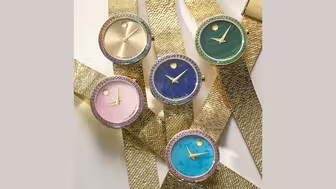
Stephanie Gottlieb’s New Movado Watches Are Made for Your Wrist StackMovado teamed up with the New York-based fine jewelry designer on a new collection of Movado Museum Velura watches.

SourcingOct 15, 2026
Signet Jewelers, Richemont May Join Bidder for De Beers, Report SaysThe two companies are reportedly in talks to join the Global Diamond Consortium, led by former De Beers CEO Gareth Penny, as per Bloomberg.

Brought to you by
Meet Gemology’s Next Generation Microscope: GIA® Gemolite® NXT Professional EditionExperience gemstones with greater precision and comfort than ever before.

CollectionsOct 15, 2026
Wolf x Marla Aaron's New Jewelry Box Is for Some (Not All) of Your ThingsThe “Some of the Things” box follows the two larger “Everything” box designs with the look and function of antique sewing and toolboxes.

Weekly QuizOct 15, 2026
This Week’s QuizTest your jewelry news knowledge by answering these questions.

IndependentsOct 14, 2026
Retailer Hall of Fame 2026: Coleman and Mitchell ClarkFourth-generation jewelers Coleman and Mitchell Clark exemplify the best qualities of their predecessors: humility, modesty, and confidence.

SourcingOct 14, 2026
Manuel Marcial de Gomar, ‘The Emerald Whisperer,’ Dies at 90The gem hunter, whose 70-year career was defined by adventure and exploration, is remembered for his steadfast faith and sense of wonder.
Brought to you by
Your Piece Could Be the One Editors Talk AboutSubmit your pieces for a chance to win in this year's competition.


FinancialsOct 14, 2026
LVMH’s Jewelry Brands Turn in ‘Very Good’ Performance in Q3 Tiffany & Co. continued its full-scale store renovation project while Bulgari’s high jewelry collection generated “record-breaking revenue.”


Events & AwardsOct 14, 2026
Chicago Responsible Jewelry Conference Releases 2026 ProgramThis year’s sessions feature leading voices from human rights, legal, and conservation organizations.

MajorsOct 13, 2026
David Webb Owner Purchases Lugano JewelryThe high-end jewelry retailer was sold to private investment firm Middle West Partners and a group of longtime clients.

Lab-GrownOct 13, 2026
Stephanie Gottlieb Takes Lab-Grown Diamond Collection WholesaleThe jewelry designer has partnered with Sofer Jewelry to distribute her 85-piece lab-grown diamond collection.

IndependentsOct 13, 2026
Retailer Hall of Fame 2026: Sean DunnDunn, this year’s Single-Store Independent inductee, is passionate about innovation and telling the story of natural diamonds.

AuctionsOct 13, 2026
Christie's Geneva To Auction 'Bulgari Pink' DiamondThe 24-carat fancy intense pink diamond ring could fetch up to $18 million at the November sale.

IndependentsOct 13, 2026
Greenwich St. Jewelers’ New Candle Smells Like HomeThe “Island Jewel” candle honors New York City and Puerto Rico and raises money for the island’s water relief efforts.
TechnologyOct 13, 2026
GemFind Is a New JA Member Benefit Partner The partnership will give JA members access to preferred pricing, exclusive benefits, technology solutions, education, and resources.

SurveysOct 09, 2026
These Will Be the 10 Busiest Days for In-Store Shopping This Holiday SeasonStores should expect to see the most customers on Nov. 27, and Christmas week is expected to be hectic too, as Dec. 25 falls on a Friday.

CollectionsOct 09, 2026
Elisa Solomon Collabs With Serendipity 3 on ‘Frozen Hot Chocolate’ CharmThe charm, our Piece of the Week, features brown diamond frozen hot chocolate topped with white diamond whipped cream and a ruby straw.

AuctionsOct 09, 2026
8-Carat Blue Diamond Goes Unsold at UK Jewelry Auction The top lot of Elmwood’s recent fine jewelry sale in London was a 1.84-carat, D color Tiffany & Co. solitaire diamond ring.

WatchesOct 09, 2026
Movado to Sell Majority Stake in Ebel for $66.5MThe watch company agreed to sell a 95 percent interest to a group comprised of F.P. Journe, Chanel, and Swiss watch exec Pierre Jacques.

Policies & IssuesOct 08, 2026
Third Wave of IEEPA Tariff Refunds Begins This round of tariff refunds is for importers that have sued over IEEPA tariffs in the Court of International Trade and won.

CollectionsOct 08, 2026
Brent Neale’s New Collection Goes ‘Back to Basics’It revisits the brand’s most requested silhouettes, from "Pillow"-set necklaces and bracelets to "Signature"-set rings and earrings.

SourcingOct 08, 2026
Ethical Gem Fair Heads Back to BrooklynThe trade-only event includes buying opportunities as well as educational sessions on artisanal mining, the new Paraíba source, and more.

Events & AwardsOct 08, 2026
Pattons Fine Jewelry Sweeps Local Design ContestAra Chanakian, a jeweler at Pattons, took home top honors in every category at Jewelers of Louisiana’s annual jewelry design competition.

AuctionsOct 08, 2026
Reba McEntire’s Jewelry, Watches Head to Julien’s AuctionsThe live charity benefit sale in Nashville will also feature gowns, boots, and other memorabilia from the country music legend.


Supplier BulletinOct 08, 2026
Overnight Mountings’ Bridal Builder Helps Jewelers Turn Custom Design into a Hands-On Selling ExperienceSponsored by Overnight Mountings

Policies & IssuesOct 07, 2026
The Plumb Club Amplifies Its Voice as Geopolitical Pressures MountThe supplier organization recently joined JA and JVC to have more input on political issues affecting the jewelry industry.