





EditorsApr 15, 2025
Q&A: Bogolo Joy Kenewendo on Making Deals, Marketing DiamondsEditorsJun 11, 2025
Q&A: Al Cook on Differentiating Natural Diamonds, Traceability, and Tariffs
The De Beers Group CEO discusses the company’s new “beacon” program, the likelihood diamonds will be exempt from tariffs, and “Origin.”


De Beers Group CEO Al Cook speaking Friday at a breakfast held during JCK Las Vegas. The diamond miner and marketer made a number of announcements at the show, including the introduction of its first “beacon” program in 16 years.
Last week during the Las Vegas shows, De Beers Group announced the launch of its first “beacon” program in 16 years.
Called “Ombré Desert Diamonds,” it will emphasize using off-white, champagne, and brown-colored diamonds of varying shades in jewelry.
The concept of setting jewelry with diamonds that exist in the space between colorless/near colorless and fancy colored is certainly not new, but this move by De Beers comes at a time when the natural diamond industry needs to distinguish itself from lab-grown diamonds, which are, by and large, D-F color and of high clarity.
It also comes at a time when De Beers needs to sell more diamonds, period.
On a personal level, I like the idea.
I think diamonds that have a “faint,” “very light,” or “light” tint (per the GIA color grading scale) bring warmth to pieces, particularly when set in yellow gold.
Generally speaking, I’ve always thought the industry put too much emphasis on “perfection” in gemstones, whether diamonds or colored gemstones. Flaws make everything more interesting.
In Las Vegas, De Beers also formally launched what it is calling “Origin, De Beers Group,” its branded loose polished diamond program that will allow retailers to tell consumers where their diamond was mined, cut, and polished, and whom it benefited along the way.
Following these announcements made at the company’s annual breakfast event on Friday, I had the chance to sit down with CEO Al Cook to talk “Desert Diamonds,” “Origin,” tariffs, and more.
This interview has been edited for length and clarity.
Michelle Graff: I was really interested when I saw the release come out this morning about the “Ombré Desert Diamonds” because I was just talking to a designer who said her clients now want a diamond with a little tint of color because they want people to know it’s a natural diamond.
Can you talk a little bit about the thought process behind the new beacon program?
Al Cook: I'll come on to your point on differentiating from lab grown. But it starts with a fundamental belief that people want to know the source of what they purchase. Whether it’s, where’s the cotton in the shirt from, or where’s my meat being bred, or my coffee being grown? People want that.
And it’s remarkable that when people go into a diamond store, their question is, where’s this diamond from? When we couple that with our pride in producing diamonds in South Africa, Botswana, Namibia, and Canada, it seems to us there’s a fantastic story to tell that hasn’t been told well enough.
We would like the customers of the future to ask the question, “Where is my diamond from? Is it ethical? Is it sustainable? And is it responsible?”
We’re incredibly fortunate that so many of our diamonds come from beautiful African deserts.
Our thinking then evolved to, how can we reflect the deserts in the jewelry itself and this rich array of colors, from brown through to cream?
[It] gave us this opportunity to tell the story of the desert, tell the story of the countries that it came from, the hand that crafted it, the land that grew it, the people who benefited [from it].
As we evolved our thinking and talked to Signet [Jewelers], which has been a wonderful partner, we developed this theme.
We discussed the point you made, which is that in a world where people want to be unique, in a world where people are rejecting commodities, in a world where people want something that’s real and reflects them, a “Desert Diamond” does exactly that.
Its color will be unique, and its origin will be unique, and it contrasts completely with the endless array of commoditized lab grown.
I think we’re already seeing the bifurcation [between natural and lab-grown diamonds] that we always talked about emerging. You can go down the corridor and get lab grown for $45 a carat now.
This is really a way of saying, look, we’re not really worrying about that. We’re about creating a new level of desire for diamonds.
The final point I’ll make is, De Beers has traditionally brought to the diamond industry what we call beacons, starting with the three-stone ring.
They’ve been wonderful, but they’ve always been about design.
This is going to be about design—we’re working to create the most beautiful designs out there—but it is also about the source.
[We think] that combination of a design that reflects the source is magical. In the early tests we’ve done, it has had very magical scores.
Called “Ombré Desert Diamonds,” it will emphasize using off-white, champagne, and brown-colored diamonds of varying shades in jewelry.
The concept of setting jewelry with diamonds that exist in the space between colorless/near colorless and fancy colored is certainly not new, but this move by De Beers comes at a time when the natural diamond industry needs to distinguish itself from lab-grown diamonds, which are, by and large, D-F color and of high clarity.
It also comes at a time when De Beers needs to sell more diamonds, period.
On a personal level, I like the idea.
I think diamonds that have a “faint,” “very light,” or “light” tint (per the GIA color grading scale) bring warmth to pieces, particularly when set in yellow gold.
Generally speaking, I’ve always thought the industry put too much emphasis on “perfection” in gemstones, whether diamonds or colored gemstones. Flaws make everything more interesting.
In Las Vegas, De Beers also formally launched what it is calling “Origin, De Beers Group,” its branded loose polished diamond program that will allow retailers to tell consumers where their diamond was mined, cut, and polished, and whom it benefited along the way.
Following these announcements made at the company’s annual breakfast event on Friday, I had the chance to sit down with CEO Al Cook to talk “Desert Diamonds,” “Origin,” tariffs, and more.
This interview has been edited for length and clarity.
Michelle Graff: I was really interested when I saw the release come out this morning about the “Ombré Desert Diamonds” because I was just talking to a designer who said her clients now want a diamond with a little tint of color because they want people to know it’s a natural diamond.
Can you talk a little bit about the thought process behind the new beacon program?
Al Cook: I'll come on to your point on differentiating from lab grown. But it starts with a fundamental belief that people want to know the source of what they purchase. Whether it’s, where’s the cotton in the shirt from, or where’s my meat being bred, or my coffee being grown? People want that.
And it’s remarkable that when people go into a diamond store, their question is, where’s this diamond from? When we couple that with our pride in producing diamonds in South Africa, Botswana, Namibia, and Canada, it seems to us there’s a fantastic story to tell that hasn’t been told well enough.
We would like the customers of the future to ask the question, “Where is my diamond from? Is it ethical? Is it sustainable? And is it responsible?”
We’re incredibly fortunate that so many of our diamonds come from beautiful African deserts.
Our thinking then evolved to, how can we reflect the deserts in the jewelry itself and this rich array of colors, from brown through to cream?
[It] gave us this opportunity to tell the story of the desert, tell the story of the countries that it came from, the hand that crafted it, the land that grew it, the people who benefited [from it].
As we evolved our thinking and talked to Signet [Jewelers], which has been a wonderful partner, we developed this theme.
We discussed the point you made, which is that in a world where people want to be unique, in a world where people are rejecting commodities, in a world where people want something that’s real and reflects them, a “Desert Diamond” does exactly that.
Its color will be unique, and its origin will be unique, and it contrasts completely with the endless array of commoditized lab grown.
I think we’re already seeing the bifurcation [between natural and lab-grown diamonds] that we always talked about emerging. You can go down the corridor and get lab grown for $45 a carat now.
This is really a way of saying, look, we’re not really worrying about that. We’re about creating a new level of desire for diamonds.
The final point I’ll make is, De Beers has traditionally brought to the diamond industry what we call beacons, starting with the three-stone ring.
They’ve been wonderful, but they’ve always been about design.
This is going to be about design—we’re working to create the most beautiful designs out there—but it is also about the source.
[We think] that combination of a design that reflects the source is magical. In the early tests we’ve done, it has had very magical scores.
“For a new generation that asks a lot of questions, there’s this extraordinary ability to tell the stories no one ever really asked about when we started advertising a hundred years ago.” — Al Cook, De Beers Group
MG: I also think the “Desert Diamonds” initiative is interesting because my long-term view of the industry is, everybody has been so focused on colorless, high clarity, we don’t want to see inclusions. This is such a departure, but I think it probably is going to work well on a younger generation who maybe didn’t grow up with that as much.
As a geologist, when you came into the industry, is that one of the observations you made—diamonds have this beautiful spectrum of color, spectrum of clarity; why are we putting such an emphasis on this perfect end when you could be selling it all? Was that something that struck you?
AC: It’s a really interesting question.
As a geologist … we could only get up to eight on the [Mohs hardness] scale because as geology students, we couldn’t afford to have diamonds in our labs.
But certainly, I find it absolutely fascinating how the forces of the earth and these little sources of other elements can completely change the color of a diamond.

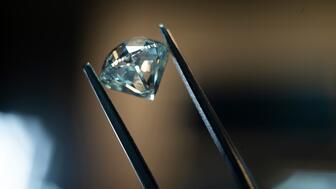
De Beers released this image of loose diamonds in conjunction with the launch of “Ombré Desert Diamonds,” its first industry-wide marketing push (also known as a “beacon” program) since “Everlon” in 2009.
Every D-E-F diamond is unique if you look deep enough inside it, but it just becomes incredible when you look at the array of colors out there and the causes of that, whether that’s a little bit of boron coming into the carbon lattice or it’s the bending of the lattice itself under pressure that gives deeper colors.
For a new generation that asks a lot of questions … there’s this extraordinary ability to tell the stories no one ever really asked about when we started advertising a hundred years ago.
MG: Tell me a little bit about how “Origin, De Beers Group” is going to work. If I’m a retailer, do I have to opt into the program? And does it cost money?
AC: Retailers have to participate with us in the program.
We’re working on the terms with them, but the idea is very much a win-win. So far, retailers’ interest in “Origin” has surpassed our highest expectations.
We want to work with the very finest quality of retailers; this isn’t a big-box play.
We’re going to focus it initially in the United States, where we know we’ve got very discerning clients and people who really care about this.
MG: Is there a set of diamonds in a showcase with the “Origin” label and does that retailer then explain to their customers, if you buy this diamond, you can trace it all the way to the mine? Is that how it’s going to work?
AC: We go further than that. What we provide, based on Tracr, is a digital experience available on mobile or on [desktop] computers. It enables us, for every single diamond, to tell a very unique story.
If you come into a store in California or Long Island, [New York], you’ll have a QR code that you scan, and that will tell you the complete story of the diamond.
It’ll start with where it was brought out of the ground, how it was cut, and you’ll get the stories of the people who were around the mine, whose lives were benefited by this, who contributed to the creation of your diamond.
We’ll take that story through the cutting and the polishing and all the benefits that are brought there.
We’ll show you the rough, and we’ll use our proprietary alpha technology to show you the rough with the polished together so you can see the complete story.
What you get, I think, are two things. Firstly, you get the guarantee that your diamond is ethical, sustainable, and responsible, but beyond that, you get this extraordinary story that no other producer of diamonds can match, and certainly lab grown could never match. It’s an amazing story of the good that the diamond has done.
So, when you’re buying a diamond to commemorate this special moment in your life, you’re also benefiting so many other people in their lives.
MG: When do you think this will be launched?
AC: We’ve actually been running pilots for the last 12 months, so quietly just testing the concept.
MG: When do you expect a wide rollout?
AC: Second half of this year.
“We’re confident that as the noise abates, there’s every justification and every reason that a product that cannot be created in America won’t be tariffed.” — Al Cook, De Beers Group
MG: I want to discuss a couple other topics outside of the new beacon program and “Origin, De Beers Group.”
In an interview you gave to CNBC recently, you said you felt confident diamonds entering the U.S. would be exempt from tariffs. Why do you feel that way?
AC: So, first and foremost, there are no commercial diamond deposits in the United States. There’s no kimberlite in the United States, and there never will be.
However many tariffs we put on diamonds, we can never create an American diamond mining job. There are no jobs to protect or jobs to grow and therefore, a tariff would simply become a consumption tax.
One thing that this American government has been very responsible about is protecting the American consumer. We’re confident that as things settle through, as the noise abates, there’s every justification and every reason that a product that cannot be created in America won’t be tariffed.
MG: I know De Beers has lobbyists in Washington, D.C. Is this the feedback you’re getting from them?
AC: We talk to a lot of governments. I speak regularly to the United States government but also to the United Kingdom and the Indian governments, which are doing trade negotiations with the United States. I think all of that gives us confidence that we’ll get to a very sensible outcome.
MG: I appreciate that, but I feel that the U.S. government right now is somewhat unpredictable; it seems like things change overnight. Do you ever worry that you think it’s going to go one way and then, at the last minute, it goes the other way?
AC: We look at the long term. Undoubtedly, the world is very volatile at the moment. We look through that volatility and that’s why I say ultimately, we think we’ll get to the right place in this.
MG: Where is De Beers regarding the pending separation from Anglo American?
AC: My sense is the first half of next year is likely to be the culmination of the separation process.
We’re quite fortunate that we’ve got two very responsible owners that both care a lot about De Beers. As a result of that, I feel like things are going in the right direction.
Having said that, the volatility of the last six months has just meant that we need to proceed in the right way and make sure that we get the right buyer rather than right now.
Editors' Picks
Sponsored by


More on Editors

The Latest

PodcastsOct 21, 2026
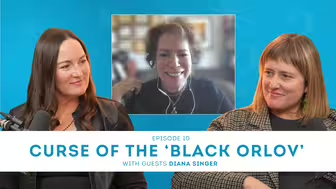
Episode 10: This Episode Is Haunted Diana Singer shared the stories of two “cursed” diamonds on this month’s podcast, which was inexplicably riddled with technical issues.

IndependentsOct 21, 2026
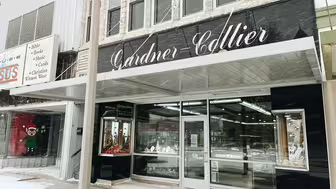
Gardner-Collier Jewelry to Close After 9 Decades in BusinessThe family-owned jeweler has three locations across Missouri and Iowa.


SourcingOct 21, 2026
Venetia Mines Final Carats Ahead of 2-Year ShutdownThe De Beers-owned diamond mine in South Africa is being put on ice as part of a round of previously announced cost-cutting measures.
Brought to you by
A Diamond Is Forever Launches 2026 Holiday Campaign Championing Natural DiamondsA Diamond Is Forever's holiday campaign reimagines natural diamond icons for a new generation celebrating individuality.


CollectionsOct 21, 2026
Helzberg, Nordstrom Carrying New Jewelry Collection From Off-WhiteThe collection centers designs with clean geometric lines, chunky sculptural pieces, and recognizable details from the luxury fashion brand.

Weekly QuizOct 15, 2026
This Week’s QuizTest your jewelry news knowledge by answering these questions.

SourcingOct 21, 2026
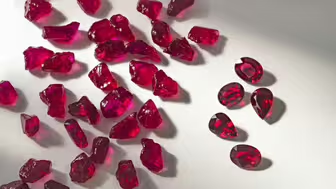
Gemfields’ Mixed-Quality Ruby Auction Earns $52MThe miner said it saw particularly strong prices for larger, fine-quality rubies at the sale.


CrimeOct 20, 2026
Security Guard Charged With Murder in Shooting at Texas MallThe guard opened fire on a man who was smashing a jewelry display case at La Gran Plaza in Fort Worth last week, police said.

Brought to you by
Open an Account, Get $50 Off Your First Order. No Code Needed.Built on Relationships. Refined by Craft.

IndependentsOct 20, 2026
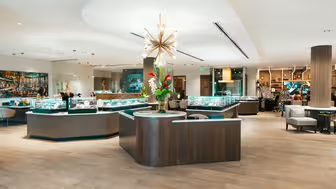
David Gardner’s Jewelers Unveils Newly Expanded, Revamped ShowroomThe Texas jeweler added 2,000 square feet to its reimagined showroom, complete with a new design studio and an event space.

SourcingOct 20, 2026
The $50M Victoria’s Secret ‘Fantasy Bra’ By The NumbersJacob & Co.'s diamond masterpiece is the most expensive Fantasy Bra ever worn on the Victoria’s Secret Fashion Show runway.

CollectionsOct 20, 2026
Mignon Faget’s Collection Chooses Handmade Over AIThe “Atelier” collection was inspired by the tools, rituals, and objects in an artist’s studio as a quiet rebuttal to an automated world.
MajorsOct 19, 2026
The Knot to Acquire Rival Wedding Planning Platform ZolaThe pending acquisition is an “exciting opportunity” for wedding vendors to grow their business, said The Knot Worldwide’s CEO.

SourcingOct 19, 2026
Jewelry Design Competition Show Airs in Thailand"The Secret Gems" features eight Thai jewelry brands paired with a team of young craftspeople who create jewelry together to win challenges.

CollectionsOct 19, 2026
John Hardy Enters the Medallion Chat With Talisman Collection The brand’s “Modern Talisman” capsule collection introduces pendants inspired by the mythology, natural world, and spiritual ethos of Bali.
IndependentsOct 19, 2026
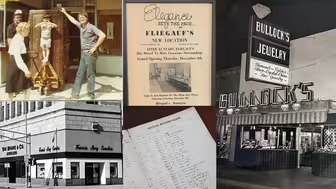
The Stories of 5 Jewelers Celebrating Their Centennials in 2026Independent jewelers from New Mexico to New Jersey answer the question: What has kept your store in business for 100 years?

SurveysOct 16, 2026
How Inflation, Gas Prices Will Affect Holiday Sales The NRF is expecting holiday sales to increase this year, but consumers and retailers alike are facing Grinch-like headwinds.
CollectionsOct 16, 2026
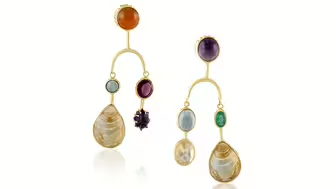
Christina Puchi’s Earrings Hold the UniverseOur Piece of the Week gathers the planets, represented by a variety of colored gemstones, in a pair of 14-karat yellow gold earrings.
IndependentsOct 16, 2026
Reeds Jewelers Expands, Relocates FlagshipThe New York-based jeweler is moving its Amherst flagship store to a larger location in nearby Snyder.

MajorsOct 16, 2026
Katy Chen Appointed Executive Vice President of Graff USA Chen, who worked at Cartier and Tiffany & Co., will lead retail sales and operations for the luxury jeweler’s 11 U.S. stores.
IndependentsOct 15, 2026
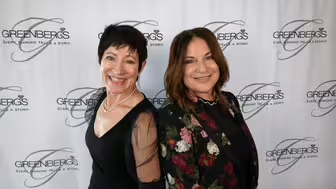
Retailer Hall of Fame 2026: Amy and Elise Greenberg For 40 years, sisters Amy and Elise Greenberg have helmed their 126-year-old family business, leading with appreciation and integrity.
ColumnistsOct 15, 2026
Peter Smith: What Is the Culture REP?It’s a term Smith coined and felt compelled to share following a bad experience with an aborted flight and an unfeeling flight attendant.

WatchesOct 15, 2026
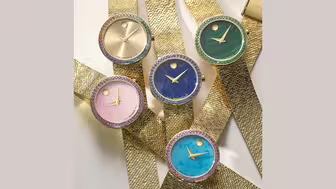
Stephanie Gottlieb’s New Movado Watches Are Made for Your Wrist StackMovado teamed up with the New York-based fine jewelry designer on a new collection of Movado Museum Velura watches.
SourcingOct 15, 2026
Signet Jewelers, Richemont May Join Bidder for De Beers, Report SaysThe two companies are reportedly in talks to join the Global Diamond Consortium, led by former De Beers CEO Gareth Penny, as per Bloomberg.
CollectionsOct 15, 2026
Wolf x Marla Aaron's New Jewelry Box Is for Some (Not All) of Your ThingsThe “Some of the Things” box follows the two larger “Everything” box designs with the look and function of antique sewing and toolboxes.
IndependentsOct 14, 2026
Retailer Hall of Fame 2026: Coleman and Mitchell ClarkFourth-generation jewelers Coleman and Mitchell Clark exemplify the best qualities of their predecessors: humility, modesty, and confidence.
SourcingOct 14, 2026
Manuel Marcial de Gomar, ‘The Emerald Whisperer,’ Dies at 90The gem hunter, whose 70-year career was defined by adventure and exploration, is remembered for his steadfast faith and sense of wonder.

FinancialsOct 14, 2026
LVMH’s Jewelry Brands Turn in ‘Very Good’ Performance in Q3 Tiffany & Co. continued its full-scale store renovation project while Bulgari’s high jewelry collection generated “record-breaking revenue.”