


IndependentsOct 15, 2026
Retailer Hall of Fame 2026: Amy and Elise Greenberg For 40 years, sisters Amy and Elise Greenberg have helmed their 126-year-old family business, leading with appreciation and integrity.




MVI Marketing asked 1,500 jewelry consumers about the knowledge that drives their purchasing decisions and where they put their trust. Here’s what they said.

New York—It’s not just gems and jewelry; consumers today are demanding to know more about the origin of all the products they buy and their paths to market.
Consumers are also increasingly putting their trust in independent third-party verification of product claims, a new survey shows.
MVI Marketing recently conducted a survey to understand the importance to jewelry buyers of independent third-party verification on claims of social and environmental impact or country of origin by diamond manufacturers, brands and retailers.
It polled 1,506 people in the United States and Canada, all of whom had purchased or received fine jewelry within the past year.
Here are four insights gleaned from the survey’s results.
1. Knowledge of social and environmental responsibility and country of origin claims affects purchasing decisions.
When asked how often they make a purchase because the product claims to be “environmentally friendly,” 42 percent of survey-takers said “very frequently,” while 45 percent said “somewhat frequently.”
A total of 40 percent indicated they make purchases “very frequently” when a product claims to be made with recycled material. Thirty-eight said the same for organic products while 29 percent buy “very frequently” when a product claims to be fair trade.
Those who purchase “somewhat frequently” are at 45 percent for recycled material, 38 percent for organic and 43 percent for fair trade.
Survey-takers were also asked to rank which information, other than price, is most important for them to know prior to purchasing diamond jewelry.
At No. 1, not surprisingly, was the 4Cs, followed by a grading report and the reputation of the diamond or jewelry brand.
Following at No. 4 is knowledge that a diamond has been mined using socially and environmentally responsible methods.
No. 5 is the retailer’s reputation, and at No. 6 is that a lab-grown diamond has been created using socially and environmentally sustainable methods.
Falling at No. 7 is whether the diamond is lab-grown or mined and at No. 8 is its country of origin.
What’s more, when asked if knowing that a lab or mine has an adverse social and/or environmental impact would affect their purchase, 47 percent said yes, they would not buy that product, while 30 percent said it would “somewhat affect” their decision.
On the flip side, survey-takers were asked if they would be swayed to buy a piece of diamond jewelry knowing the lab or mine has a

Fifty percent said yes while 34 percent said it would “somewhat affect” their decision.
2. Consumers value third-party verification of a diamond’s country of origin and of companies’ social and environmental compliance.
When asked about the importance of third-party verification of a natural diamond’s country of origin and of compliance through independently created standards, 48 percent said it’s “very important” and 41 said it’s “somewhat important.”
For lab-grown diamonds, 44 percent said it’s “very important” while 42 percent said it’s “somewhat important.”
Not surprisingly, consumer confidence increases with third-party verification.
Survey takers were asked to rate, on a scale of 1 to 5, their confidence in a set of standards.
The mean rating was 3.1 for a set of standards created and reported by the company selling the product, but rose to 3.8 when the standards were created by a cross-section of parties and verified by a third party.
Respondents indicated that the latter is important because it offers a higher credibility (21 percent) and transparency (20 percent), uses industry best practices (17 percent) and provides independent quality control (17 percent).
3. Consumers will exhibit brand loyalty for third-party verification.
The survey asked participants if they would be more loyal to a brand or retailer that sells diamonds certified by an independent, third-party verification company.
The answer: 89 percent of consumers said yes (67 percent) or maybe (22 percent).
4. Consumers will pay more to know where their diamond jewelry comes from and what impact it had along the way.
Thirty-four percent of survey-takers said they would pay retail plus 5 percent to know for certain their diamond has been responsibly mined or grown in a lab using sustainable methods, while 20 percent said they would pay retail plus 10 percent for that knowledge.
Country-of-origin claims prompted 32 percent of respondents to indicate they’d pay retail plus 5 percent, and 17 percent to say retail plus 10 percent.
Thirty-one percent would pay retail plus 5 percent for independent verification of claims, while 20 percent would pay retail plus 10 percent.
A total of 30 percent of survey-takers said they’d pay retail plus 5 percent to know their lab-grown diamonds were traced from lab to market and 20 percent indicated they’d pay retail plus 10 percent for this knowledge.

For 40 years, sisters Amy and Elise Greenberg have helmed their 126-year-old family business, leading with appreciation and integrity.

It’s a term Smith coined and felt compelled to share following a bad experience with an aborted flight and an unfeeling flight attendant.
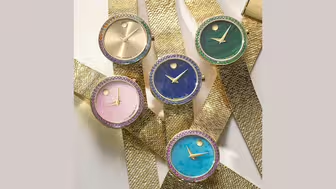
Movado teamed up with the New York-based fine jewelry designer on a new collection of Movado Museum Velura watches.

Experience gemstones with greater precision and comfort than ever before.

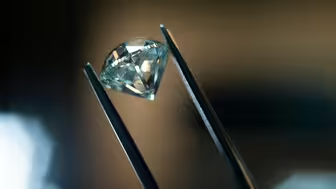
The two companies are reportedly in talks to join the Global Diamond Consortium, led by former De Beers CEO Gareth Penny, as per Bloomberg.

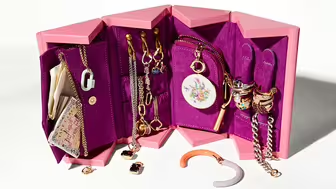
The “Some of the Things” box follows the two larger “Everything” box designs with the look and function of antique sewing and toolboxes.

Fourth-generation jewelers Coleman and Mitchell Clark exemplify the best qualities of their predecessors: humility, modesty, and confidence.
Submit your pieces for a chance to win in this year's competition.


The gem hunter, whose 70-year career was defined by adventure and exploration, is remembered for his steadfast faith and sense of wonder.

Tiffany & Co. continued its full-scale store renovation project while Bulgari’s high jewelry collection generated “record-breaking revenue.”

This year’s sessions feature leading voices from human rights, legal, and conservation organizations.

The high-end jewelry retailer was sold to private investment firm Middle West Partners and a group of longtime clients.

The jewelry designer has partnered with Sofer Jewelry to distribute her 85-piece lab-grown diamond collection.

Dunn, this year’s Single-Store Independent inductee, is passionate about innovation and telling the story of natural diamonds.

The 24-carat fancy intense pink diamond ring could fetch up to $18 million at the November sale.

The “Island Jewel” candle honors New York City and Puerto Rico and raises money for the island’s water relief efforts.
The partnership will give JA members access to preferred pricing, exclusive benefits, technology solutions, education, and resources.

The charm, our Piece of the Week, features brown diamond frozen hot chocolate topped with white diamond whipped cream and a ruby straw.

The top lot of Elmwood’s recent fine jewelry sale in London was a 1.84-carat, D color Tiffany & Co. solitaire diamond ring.

The watch company agreed to sell a 95 percent interest to a group comprised of F.P. Journe, Chanel, and Swiss watch exec Pierre Jacques.

This round of tariff refunds is for importers that have sued over IEEPA tariffs in the Court of International Trade and won.

It revisits the brand’s most requested silhouettes, from "Pillow"-set necklaces and bracelets to "Signature"-set rings and earrings.

The trade-only event includes buying opportunities as well as educational sessions on artisanal mining, the new Paraíba source, and more.

Ara Chanakian, a jeweler at Pattons, took home top honors in every category at Jewelers of Louisiana’s annual jewelry design competition.

The live charity benefit sale in Nashville will also feature gowns, boots, and other memorabilia from the country music legend.


Sponsored by Overnight Mountings

The supplier organization recently joined JA and JVC to have more input on political issues affecting the jewelry industry.



This site uses cookies to give you the best online experience. By continuing to use & browse this site, we assume you agree to our Privacy Policy