




In its annual report, Pinterest noted an increase in searches for brooches, heirloom jewelry, and ‘80s luxury.
Employees Say Jewelry Industry Has Work to Do on Diversity
National Jeweler breaks down the results of its recent employee-focused survey on diversity, which paints a different picture than the survey taken by employers.

Across the board, employees gave their companies lower marks than employers when it comes to addressing issues of racial justice and equity, and having racially diverse staffs.
Employees also expressed dissatisfaction with how their employers handled incidences of racial discrimination when they were reported.
And, some respondents reported overhearing racist remarks in the workplace or seeing racist content on social media.
RELATED CONTENT — Diversity, Equity and Inclusion: Why They Matter
It is not surprising, then, that a number of survey-takers described the fine jewelry industry in the United States as one that feels insular and closed off to “outsiders.”
For those “outsiders” who do make it in, there was a recurring theme among respondents—even at companies where there is diversity, there are very few, if any, people of color in higher-ranking positions.
All you have to do to understand the lack of diversity, respondents said, is look around the next time you’re at a trade show.
“There is so much bias in how our industry perceives people of color; I’ve experienced it at trade shows,” one respondent, who identified as multiracial or biracial, wrote. “Retailers may assume you can’t afford a piece or that you don’t have the proper knowledge. I constantly feel like I have to prove myself and I can’t be myself (talk or dress how I want) because I won’t be viewed as professional.”
She continued: “Also, almost every piece of material that is used in jewelry is first touched (from the moment it’s taken out of the ground) by a Black or Brown person and that’s not acknowledged. The times that it is, it is in relation to poor mining practices.”
The View Not From the Top
National Jeweler and Jewelers of America fielded the “Diversity in the Fine Jewelry Industry” survey in fall 2020 to better understand the experiences of people of color—particularly Black professionals—in the U.S. fine jewelry industry.
The survey had three segments: one for self-employed individuals, one for employees, and one for employers, the results of which National Jeweler published last month.
As with the employer-focused survey, the majority of respondents (66 percent) to the employee-directed survey were white.
Yet the employee results were more mixed than the employer survey and painted a picture of an industry
In the employer-directed survey, the mostly white field of respondents gave themselves high marks for diversity and inclusion.
Overall, 71 percent of employers ranked themselves as “very good” overall on matters of racial justice and equity. Only 6 percent said their company was doing a “poor” job in this area and less than 1 percent ranked their companies as “very poor.”
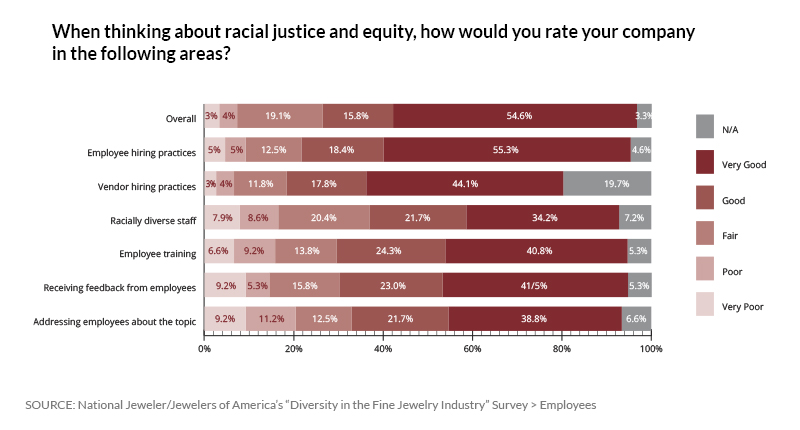
Employees, however, see things differently (see chart below).
When asked the same question, only about half (55 percent) of jewelry industry employees ranked their company as “very good” overall when it comes to racial justice and equity, and a quarter of respondents said their company was “fair” (19 percent), “poor” (4 percent), or “very poor” (3 percent).
Employees gave their companies the lowest marks for staff diversity, with 37 percent rating their company as “fair” (20 percent), “poor” (9 percent), or “very poor” (8 percent) in this area.
And even in companies where there is some diversity, a number of respondents said it does not extend to the upper ranks of the organization.
A couple survey-takers said their companies had Hispanic employees but they worked in gardening, housekeeping or in the factory.
One respondent said their company “completely lacks representation of people of color in the corporate offices, across all functions.”
Another wrote: “In a previous place of employment, I [heard] racist jokes and comments, and noticed that all employees of non-white racial backgrounds were relegated to lower-paying roles and never considered for promotions.”
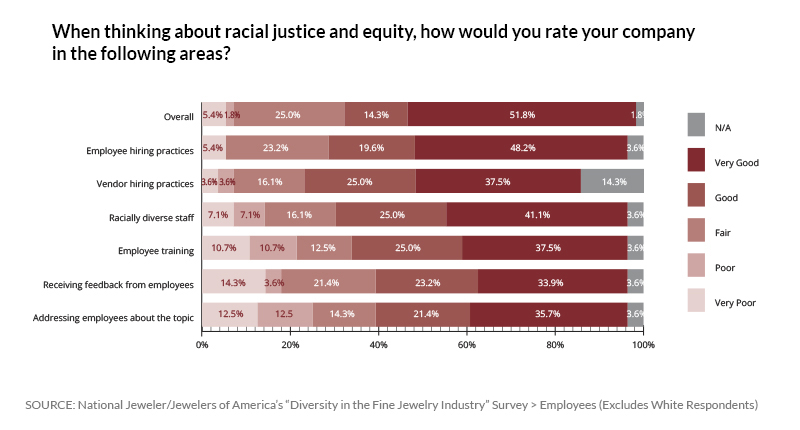
For survey-takers who identified as people of color, the percentage who ranked their company as “very good” in matters of race and equity dropped to 52 percent while 32 percent said their company is “fair” (25 percent), “poor” (2 percent) or “very poor” (5 percent).
One employee who rated their company as “fair” explained they chose that ranking “because we are now starting to be serious about diversity and inclusion though we have talked about it for years.”
Another wrote: “I think that there are very few, if any, companies that are doing a good job and are only looking to do so now because of optics.”
Employees of color in the fine jewelry industry gave their employers the lowest marks for having a diverse staff, with 46 percent of respondents ranking their company as fair, poor or very poor in this area, addressing employees about racial justice and equity (40 percent), and receiving employee feedback on racial issues (39 percent).
Employer Inaction
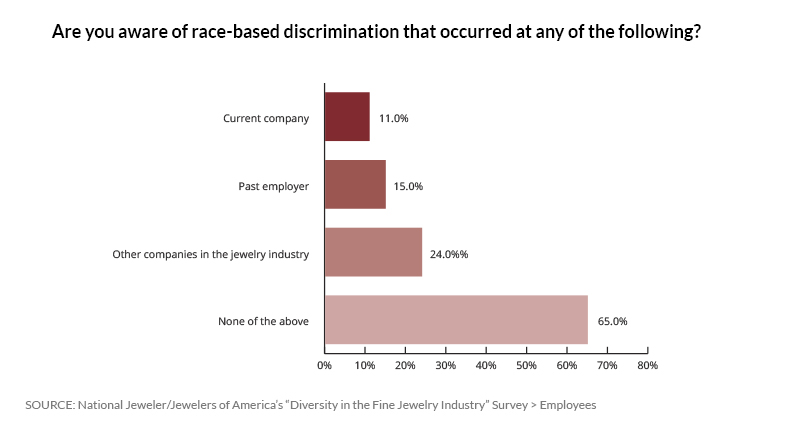
Half of survey-takers are aware of race-based discrimination in the jewelry industry—whether at their current company, a past company or other companies in the jewelry industry (see chart below)—and the vast majority said their employers did nothing to address the problem.
Among respondents of all races, 51 percent said they are aware of race-based discrimination at either the company they currently work for (22 percent), their past employer (15 percent) and/or other companies in the jewelry industry (25 percent).
For employees of color, that number is 58 percent: 22 percent at their current company, 11 percent at past employer, and/or 25 percent at other companies in the jewelry industry.
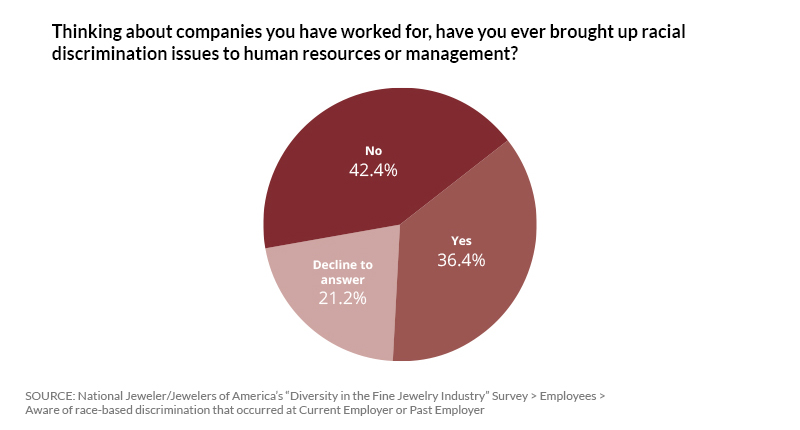
Employees of color were more likely to report issues of racial discrimination to higher-ups, with 75 percent of respondents of color saying they have made HR or upper management aware there were company issues, compared with just 36 percent of all employees (see chart above).
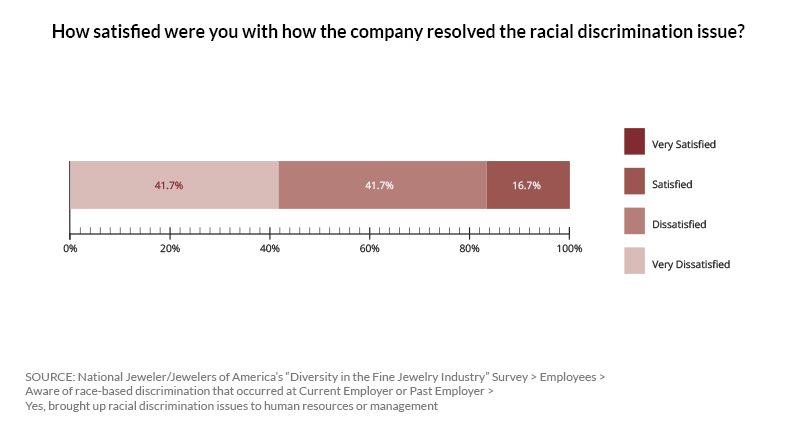
And almost nobody, whether a person of color or white, was satisfied with how the situation was handled.
Eighty-four percent of all respondents said they were dissatisfied (42 percent) or very dissatisfied (42 percent) with how management dealt with racial discrimination—mostly because it was not addressed at all, survey-takers said.
One Black respondent said their past employer simply paid employees to leave and never directly addressed racist behavior.
A few respondents noted that discrimination and racist behavior spills out from the workplace and onto social media, where racially insensitive—and even outright racist—comments are posted on sites like Facebook.
“I’ve overheard racially insensitive conversations, also witnessed (and screen-shotted) overtly racist comments on [a popular Facebook group for jewelers],” a survey-taker, who identified as Black, wrote.
Another respondent, who identified as white, put it bluntly: “Read the social media posts in many of the industry-focused groups. Lots of racists in our industry.”
Help Needed
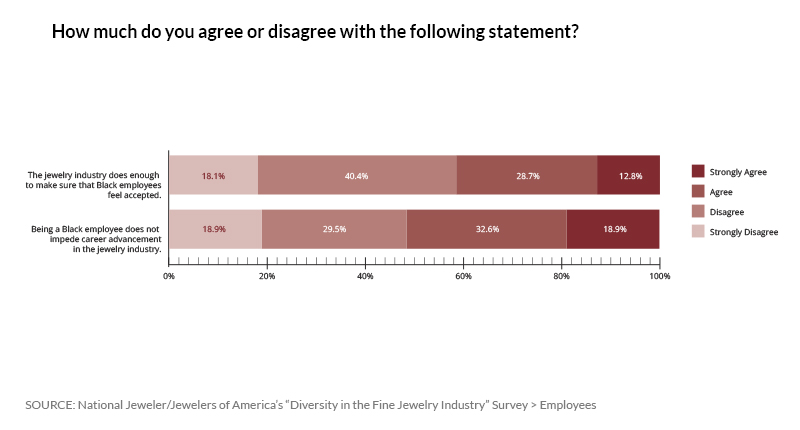
Nearly 60 percent of survey-takers, regardless of race, agree—the jewelry industry does not do enough to make Black employees feel accepted.
In addition, 77 percent said the jewelry industry is no better (43 percent), worse (24 percent) or much worse (10 percent) than other industries at supporting Black employees.
It was in response to this question that many survey-takers commented on the “insular” nature of the industry and how the lack of diversity is readily visible.
“There are hardly any people of color in the industry,” one white respondent wrote. “I look around at trade shows and see barely any people of color. It is so homogenous! We need to get more diverse!”
RELATED CONTENT: This New Group Aims to Support Black Jewelry Professionals
A handful of survey-takers offered suggestions when asked what resources were needed to better support Black employees.
They included: working with a diversity, equity and inclusion consultant; recognition of racist behavior by both employees and customers; mentors who can coach and guide; more diversity at the executive, senior and mid-level management positions; and recruitment and training so the jewelry industry better reflects the demographics of the nation.
One survey-taker wrote that there needs to be a “proper way for employees to voice their concerns and experience, where they are truly heard and seen.”
“I think oftentimes companies look at the demographics of where they are based to decide if they have enough ‘representation’, but they need to start looking at the nation’s demographics.”
Who Answered
National Jeweler and Jewelers of America’s “Diversity in the Fine Jewelry Industry” survey was made available to take between Sept. 23 and Oct. 14.
A total of 814 qualified individuals responded: 473 who were classified as employers, 200 who were classified as employees, and 141 self-employed individuals.
This story analyzed the results of the employee-directed survey. The results of the employer-directed survey were published on National Jeweler last month.
The vast majority of employees who took the survey (78 percent) said they work for retail stores (53 percent), wholesale jewelry companies (13 percent) or manufacturers (12 percent).
For the most part, these companies employ between 2 and 25 people (52 percent), 26 to 50 people (13 percent) or more than 2,500 people (10 percent).
About 64 percent of employee respondents said they are on the manager level at their respective firms (meaning they have direct reports) while the remaining 36 percent do not.
More women than men (74 percent vs. 24 percent) answered the employee-directed survey, with 2 percent choosing “other” when asked for their gender.
The full results of both surveys are available on Jewelers.org.
The Latest

Starting Jan. 1, customers can request the service for opal, peridot, and demantoid garnet.

The 111-year-old retailer celebrated the opening of its new location in Salem, New Hampshire, which is its third store in the state.

How Jewelers of America’s 20 Under 40 are leading to ensure a brighter future for the jewelry industry.

The new catalog features its most popular chains as well as new styles.


The filmmaker’s personal F.P. Journe “FFC” prototype was the star of Phillips’ recent record-setting watch auction in New York.

The new location in the Design District pays homage to Miami’s Art Deco heritage and its connection to the ocean.

Roseco’s 704-page catalog showcases new lab-grown diamonds, findings, tools & more—available in print or interactive digital editions.

“Longtime favorite” presenters, as well as first-time speakers, will lead talks and workshops at the annual event in Tucson next year.

Silas Smith of Meridian Metalworks won the challenge with his pendant that blends Australian and American landscapes.

The sale of the 31.68-carat, sunset-hued stone was part of Sotheby’s first series of events and auctions in Abu Dhabi.

Most customers who walk into your store this month have made up their minds. Your job is to validate their choice, Emmanuel Raheb writes.

The collection features characters and motifs from Ukrainian folklore, including an enchanted mirror and a magic egg.

MatrixGold 3.11, the newest version of the jewelry design program, offers more flexibility, precision, and creative control.

The pavilion will be part of the 2026 JA New York Spring show, scheduled for March 15 to 17.

Kadet, a 1994 National Jeweler Retailer Hall of Fame inductee, helped grow the family-owned retailer in the Chicago area and beyond.

Billed as the world’s smallest wearable, Lumia Health’s new smart earrings have a health tracker subtly embedded in the back.

Don’t let those with December birthdays feel blue. Help them celebrate their month with blue zircon, turquoise, and tanzanite.

The new pink sapphire version of the piece dances with its wearer in the brand’s “Icons After Dark” holiday campaign.

A choice that’s generated a lot of commentary, Pantone says “Cloud Dancer” marks a fresh start and encourages relaxation and creativity.

The manufacturer’s holiday campaign features a gift guide filled with trending designs and jewelry that can be personalized.

The man was charged with theft, accused of ingesting the necklace while in a jewelry store in Auckland, New Zealand.

The Florida independent expanded its store from 8,000 to 14,000 square feet, fulfilling the vision of its late co-founder, Jim Dunn.

Sponsored by De Beers Group

The classic 5600 series G-Shock has been scaled down to about a tenth of its size, becoming a fully functioning watch ring.

The association’s annual conference and gala will take place Feb. 4, 2026, during the Tucson gem shows.

The January show will include a workshop for jewelry retailers on implementing AI to strengthen their businesses.