Signet Jewelers-owned Kay Jewelers, Tiffany & Co., Sears and Diamonds International all made National Jeweler’s 2018 list of $100 Million Supersellers. Read our analysis of the list, including what it says about the current state of retail, below.
According to the U.S. Commerce Department’s Bureau of Economic Analysis, Americans spent some $76.85 billion on watches and jewelry last year, up 5 percent from the $73.2 billion spent in 2016.
Click here to read the full story in the State of the Majors issue.
However, a closer examination of the 2018 “$100 Million Supersellers” list—which includes all companies that sold $100 million or more in watches and jewelry in their most recent fiscal year—shows that it was not a better year for all retailers.
Compiled by Edahn Golan, owner at Edahn Golan Diamond Research & Data Ltd., the list totals 42 companies. Golan’s sales estimates show that a little more than half of those saw watch and jewelry revenue increase year-over-year while the remaining retailers experienced flat or declining sales.
Macroeconomic conditions and a firm grasp of digital marketing have boosted jewelry business for big brands that already enjoyed strong consumer recognition. Estimates show luxury conglomerates LVMH, Richemont and Kering, which together own the bulk of the world’s most well-known watch and fine jewelry brands, saw sales rise year-over-year, as did Swatch Group.
Also showing gains are retailers for which price is the main attraction—think Amazon and chains like T.J. Maxx, Kohl’s and Costco, whose biggest draw is not the luxurious nature of their stores but the fact that consumers perceive they are getting a good deal.
According to Golan’s estimates, T.J. Maxx parent company TJX Companies Inc. recorded watch and jewelry sales of $252 million last year, up from $239 million the prior year. The company ranks as the 29th largest seller of watches and jewelry in North America, directly behind another bargain hunter’s delight, Kohl’s Corp., which also saw a year-over-year increase in watch and jewelry sales.
“[Amazon has] invested heavily in jewelry, and hit a sweet spot—a combination of price point and designs.” — Edahn Golan, Edahn Golan Diamond Research & Data Ltd.
The performances of Costco and Amazon were even more impressive.
Costco Wholesale Corp. leapfrogged Macy’s Inc. to become the third largest seller of fine jewelry and watches in North America, with 2017 sales estimated at $1.52 billion to Macy’s $1.47 billion.
While the retailer, which declined National Jeweler’s request for an interview for this issue, has been embroiled in two well-publicized lawsuits over its watch and jewelry inventory—battling Swatch Group over gray market Omegas and Tiffany & Co. over the use of “Tiffany setting”—consumers ultimately still buy a lot of watches and diamonds there.
“The whole experience of Costco is price,” which is attractive to an American middle class that is both shrinking and feeling strapped, says Reid Sherard, associate director of European research at L2 Inc., a business intelligence and research firm. “The product is fine and you’re going to get a good deal on it.”
Walmart Inc. also saw watch and jewelry sales increase year-over-year and maintained its spot at No. 2 on the 2018 $100 Million Supersellers list, with an estimated $3.21 billion in jewelry sales.
(Signet Jewelers Ltd. landed at No. 1 with $5.62 billion in sales last fiscal year. For more on Signet, please see the Snapshot in the full print edition of this story.)
Walmart will be one to watch, however, as the retail giant is reportedly shrinking its watch and jewelry departments. Golan says he expects to see “a large drop” in jewelry sales for Walmart on next year’s list.
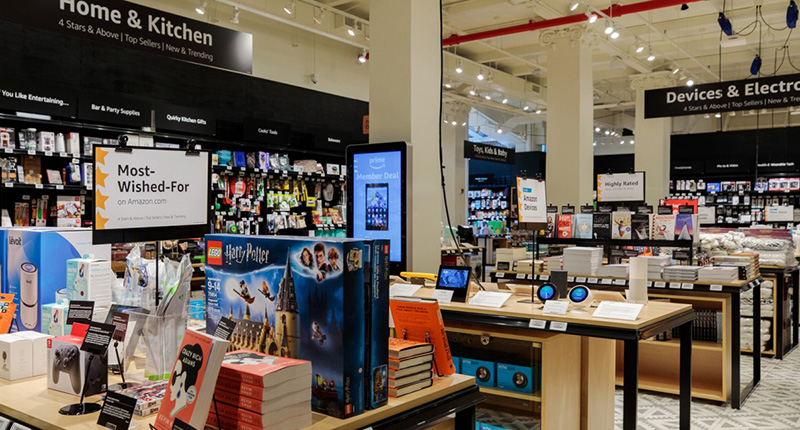
In addition to dominating online sales, Amazon.com Inc. (No. 6 on the 2018 list of $100 Million Supersellers) has been expanding its retail footprint as well. This is a shot of “Amazon 4-Star,” its new store in New York City’ SoHo neighborhood that carries only best-selling products.
Amazon, meanwhile, broke the billion-dollar mark in jewelry sales for the first time in 2017.
The online giant’s 2017 jewelry and watch sales are estimated at $1.06 billion, catapulting them from No. 8 on last year’s list to No. 6 this year. Amazon is now within striking distance of Tiffany & Co., which ranks No. 5 with $1.25 billion in sales in North America. (For more on Tiffany, please see the Snapshot in the full print edition of this story.)
The Seattle-based retailer has “invested heavily in jewelry,” Golan said, “and hit a sweet spot—a combination of [the right] price points and design.”
And while putting “Tiffany” in the same sentence as “Amazon” might seem like retail blasphemy, Sherard says the e-tailer is competition for the American jeweler.
Tiffany is a retail operation normally equated with luxury—Audrey Hepburn in that incredible black Givenchy dress, lusting after what’s in the windows at the Fifth Avenue flagship—but what the specialty jeweler mostly sells is lower-priced silver jewelry and gift items, he points out.
While success can be found at the top and the bottom of the market, many of the companies with estimated sales declines are those stuck in the middle. They are neither high-end brands that are top-of-mind or aspirational for consumers, nor do they boast the low prices and unbelievable convenience of an Amazon, or the thrill-of-the-hunt experience consumers enjoy at a T.J. Maxx.
A prime example is Sears Holdings Corp., which posted a nearly $200 million year-over-year drop in watch and jewelry sales and slid from No. 10 to No. 17 on the $100 Million Supersellers list, with Blue Nile, Ross-Simons and Target among the chains leapfrogging it.
The company is not in a position to compete with Amazon on price, and there is not one item sold in a Sears or Kmart store that cannot be found either on Amazon or in Home Depot, Lowe’s, Target, Macy’s, Walmart, etc.
In short, nothing sets Sears apart and the retailer finds itself adrift in this no man’s land—between best price and best product/service/experience—which is a dangerous place to be, as is evidenced by the company’s recent Chapter 11 filing.
Struggle in the Middle The large brands with big marketing budgets and high levels of consumer recognition are doing well, yes, but so are some smaller-scale companies—single-store operations that differentiate themselves by carrying unique brands or doing top-notch custom work, local artisans making one-of-a-kind products, or entrepreneurs with a compelling backstory and a command of social media.
As an example, Sherard brought up beauty mogul Anastasia Soare. Soare is a Romanian immigrant who built a reputation in Beverly Hills as the “Eyebrow Queen” and, from there, grew her cosmetics company into a multimillion-dollar business by being an early adopter of Instagram, where she shows followers not just new product but also how to apply it.
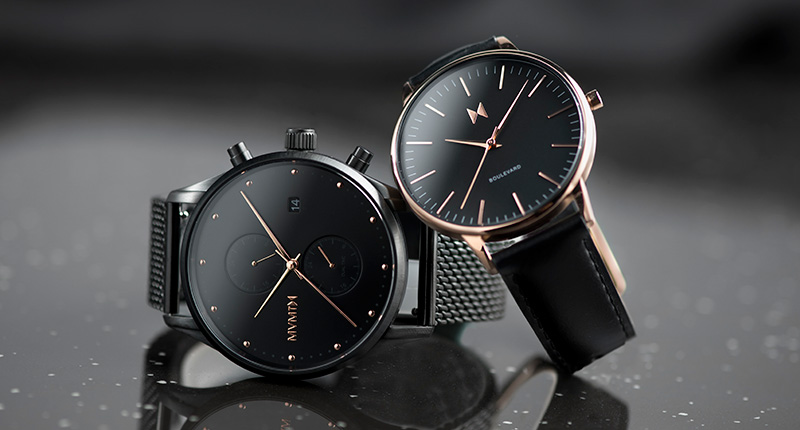
The quartz women’s 38 mm Boulevard Santa Monica watch (right, $115 retail) and the men’s 42 mm Voyager Slate Black Rose ($150 retail) from MVMT, the millennial-focused brand acquired by Movado Group this year. (Photo credit: @laya.gerlock)
Another case in point with closer ties to the jewelry industry is MVMT, the watch and accessories company Movado Group Inc. just acquired.
Two college dropouts, Jacob Kassan and Kramer LaPlante, started the company after raising $300,000 from a pair of crowdfunding campaigns. In just five years, they have turned MVMT into a $70 million a year business by employing an effective digital strategy that includes a strong social media following.
Movado announced in August that it would pay $100 million-plus to acquire the company, and the deal closed in October. Kassan turned 27 in June and his business partner LaPlante is 26.
It used to be, Sherard observes, that retail was a Catch-22. Companies could only get retail distribution if they had a proven track record of selling in retail, which, obviously, is difficult to obtain if a company can’t get in in the first place. But the internet—or, more specifically, the direct access to consumers that it provides—has changed that.
“You have a platform now with some of these e-commerce websites. If you can get on Net-a-Porter or a local jeweler’s website … It’s never been a better time to be trying to build one of those small brands,” he says, while acknowledging that starting a small business is by no means easy. But, the internet has created possibilities for startups that didn’t exist before, he believes.
“The middle is a dead zone. It is the place that makes the customers work too hard to figure out what your store stands for and it is not a sustainable market position in the rapidly changing retail landscape.” — Peter Smith
The changes in retail brought about by technology have left some retailers stranded in a sea of sameness, unable to cling to being the lowest priced while, at the same time, lacking a compelling brand story or differentiated product to buoy their business.
Sherard says jewelers that are selling “general sapphire rings” that are not particularly well-made or connected to a popular designer find themselves in a tough spot.
It’s the same mantra National Jeweler columnist Peter Smith has been repeating for months. In his August 2018 column titled “Who’s Driving the Bus in Your Business?” Smith wrote that the jewelry industry is “overloaded with retailers who live in the middle.”
“They are neither clearly defined as quality product/experience/having a clear sense of self, nor competing solely on price. The middle is a dead zone. It is the place that makes the customers work too hard to figure out what your store stands for and it is not a sustainable market position in the rapidly changing retail landscape.”
Smith went on to talk about the need for retailers today to increase their average ticket in the face of declining sales traffic, noting that, “Increasing your average ticket is best accomplished by having products and brands that are differentiated and elevated beyond the mass of stuff that can historically be found in many retail jewelry stores.”
The “mass of stuff” includes those “general sapphire rings” the L2 analyst Sherard was railing against.
“In an age of digital where everything has to be unique and exciting … it can be hard to convince someone why they should spend [money] on your product rather than the product of a local artisan to whom they’ve formed an emotional attachment,” he says.
By the (Store) Numbers In addition to sales, National Jeweler’s “State of the Majors” issue includes the “Top 50 Specialty Jewelers” list, which ranks chains that sell just jewelry and watches by store count.
The retailers on the 2018 Top 50 list have 6,007 locations total, compared with 5,844 on the 2017 list, a 163-store difference.
However, this year’s total includes 130-store chain Diamonds International, which erroneously was left off last year’s list. If you exclude those 130 stores, then the margin narrows to 33. That’s an average of less than one additional store for each retailer.
The openings that did take place were concentrated among singular brands—Swarovski, Pandora, the companies under the Richemont umbrella—rather than multi-brand retailers.
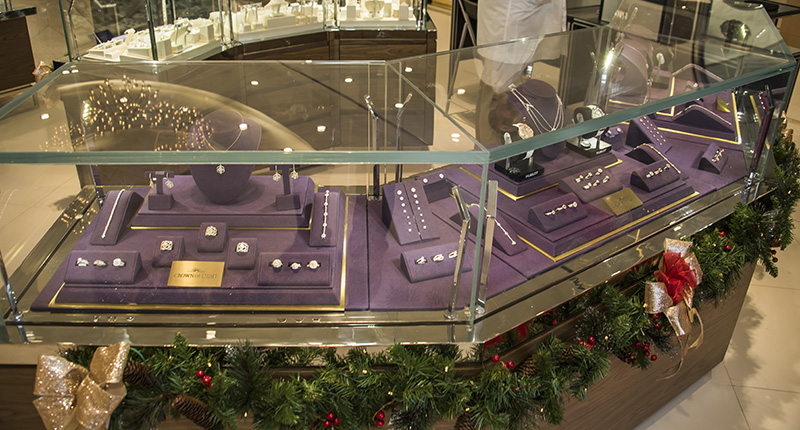
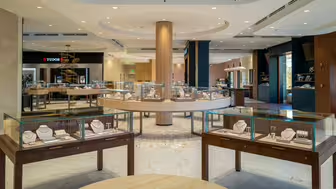
A display of “Crown of Light” diamonds inside a Diamonds International store. The retail chain was included on the 2018 “State of the Majors” list, ranking No. 31 on the “$100 Million Supersellers” list and No. 7 on the list of specialty jewelers with the most stores in North America.
According to National Jeweler’s analysis of the list, Pandora netted the most store openings in 2017.
The Danish bead and jewelry brand ended the year with 134 stores, 83 more than it had in 2016. Of those, 58 were concept stores the company bought back from franchisees (50 in the United States and eight in Canada); a Pandora spokesperson declined to disclose the names of the jewelers from which stores were repurchased.
Also adding a significant number of stores were Swatch Group (+66), Swarovski (+13) and Richemont (+10).
Sherard, the L2 associate director, says brands and luxury conglomerates like Richemont, Swarovski and, to a lesser extent, Pandora, are growing their vertical retail presences because having their own stores is more advantageous.
They control the product, the marketing and the in-store associates who sell their jewelry and watches. Having stores allows them to form relationships with consumers, building on the bonds formed by e-commerce sales and on platforms like Instagram and Facebook.
Brands also make more money operating their own stores, which is a compelling reason to continue to do so, particularly for public companies with shareholders to satiate.
“It definitely [displeases] some of [their] longtime [retail] partners,” Sherard says, “but a lot of brands have made the calculation that it is better for them in the long run.”
Michelle Graffis the editor-in-chief at National Jeweler, directing the publication’s coverage both online and in print.