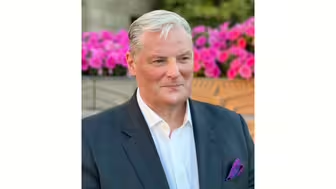
Bruce Cleaver became CEO of De Beers Group in July 2016. He has been with the company since 2005.
London—Late last month, leaders of the gem and jewelry industry in India called on their members to pause rough diamond imports for 30 days, starting today, as the world continues to grapple with COVID-19.
Chaim Even-Zohar echoed those calls in a column published on IDEX April 22 in which the longtime industry analyst and journalist made the case for an even longer ban on rough imports in the world’s No. 1 cutting and polishing center.
De Beers responded with an open letter from CEO Bruce Cleaver on May 1 that made clear the company’s position on a rough-diamond-buying ban while not expressly mentioning the Indian trade groups’ appeal.
“We mine a valuable, finite and depleting resource,” Cleaver wrote in his letter. “We will only sell it when the demand is such that it can create sustainable value for all of us. However, just as we are not compelling our clients to purchase, we strongly believe it is counterproductive for any part of the industry to compel them not to purchase.”
Last week, the De Beers boss sat down for a remote interview with National Jeweler to elaborate on the company’s position.
He also talked about what consumers will expect from brands after COVID-19, marketing diamonds in a post-pandemic world, and why he thinks the U.S. will remain the No. 1 market for the stones despite the severity of the crisis here.
This interview has been edited for length and clarity.
National Jeweler: First, I want to start with the main issue you addressed in your letter, of keeping the rough supply flowing as the crisis subsides.
I would assume your letter was in part a response to Chaim Even-Zohar’s recent column in IDEX calling for India to institute a three-month moratorium on rough diamond imports.
In his article, Chaim makes some good points: India has plenty of rough inventory for the foreseeable future—particularly given how murky that future is—and that selling from inventory can help reduce debt and, perhaps, shore up banks’ confidence in the industry. But in your letter, you make the point that De Beers also has a responsibility to the countries where it mines and the people who live there to keep mining and selling rough to maintain their livelihoods.
Can you elaborate on De Beers’ position on the suggestion of a rough diamond ban in India?
Bruce Cleaver: Sure. Let me say in the beginning that I recognize, and we recognize, this is not an easy situation for anybody. It’s tough at the moment in India, but it’s tough at the moment everywhere and we are of course in completely unprecedented times.
Our position is that global supply chains, especially at times like this, are very important. And any artificial changing of a global supply chain can probably have consequences that are even worse for us and may have much longer-term consequences than the problem that the GJPEC and/or Chaim are talking about [and] trying to solve.
After all, the diamond industry consists of a whole series of interconnected players in the value chain. I feel strongly that if you cut off one part of that supply chain … you’re doing yourselves and the industry a disservice, but you may also be creating unintended consequences.
NJ: What sort of unintended consequences?
BC: Well, our response to the crisis has been firstly around the health and safety of everybody who works for us and all the communities around us.
We’ve spent a lot of time and effort and money, as you would expect, around our mining communities in southern African in particular, and in Canada, trying to find a way within reason—and that’s an important point, this “within reason” point—to keep those mines open, albeit at a lower production rate because those mines in themselves are complicated ecosystems.
All kind of supplies get provided to those mines, often by small business that have no other business than supplying, whether it’s food or some kind of parts, etc., to the mine.
If you stop somewhere in the value chain where there is demand—and I do stress that—then you may have an unintended consequence of stopping a mine or stopping a value chain into a mine. And the people in the communities around our mines depend on us, and they depend on us particularly when their economies are shutting down.
They are, in general, less well-off people and they need money to put food on the table and, at a time like this as well, to provide hygiene and clean and fresh water for their families.
We are not in favor of a sort of artificial ban that cuts the value chain. Our solution is more two-fold.
One is to offer our clients unprecedented flexibility. And you’ve seen that in sight 3, we’ve said to them they can defer 100 percent of their purchases. We’re definitely not forcing anybody to buy. And we’ve done the same in sight 4.
And we’ve also reduced the amount that we’re going to produce … for 2020 by about 25 percent.
Our analysis is, it’s better to keep the value chains going, even if we do it on a lower basis where there is demand, because I think the consequences of shutting mines long-term are very, very severe and I think right now all of us in the industry owe it to everybody else in the industry to do the best we can … to keep the supply chains open.
We do recognize it’s a difficult time, and I recognize it’s a legitimate suggestion but our view is it’s better not to tinker with global supply chains where there are pockets of demand.
NJ: I want to switch gears and talk about something I think our readers will be particularly interested in—consumer behavior post-crisis. There are seemingly two schools of thought on consumer behavior post-crisis.
One is that there will be a lot of pent-up demand, or “revenge buying,” and people will be rushing out to shop again as soon as this is over. The other is that this health crisis is going to tip us into a deep recession, possibly worse than what we witnessed in 2008. To which school do you subscribe?
BC: (Laughs) I guess like everything, it’s complicated.
On the deep recession point, the answer to that is going to depend how long this goes and it’s going to depend on how quickly people come back to their old patterns, and the jury’s out on that at this point.
What I think is important for the diamond industry, even to the extent we do come out of this into a recession, which is possible for sure, is: how do we position the diamond as the kind of important product of choice here.
What I think is different about this recession to 2008 [is] that it’s a health crisis and there’s no one in the world who is not affected in one way or another by COVID.
It seems to us that what people are really thinking about at a time like this is, again and again, what really matters to them. And I guess that’s where the diamond has a really strong possibility going forward because what really matters to people are meaningful personal relationships.
So if we, as the industry, can tailor the marketing as we come out of this to what diamonds really are—an amazing product that people buy for emotional reasons and around great moments in life in order to remember meaningful things or to celebrate relationships—I think we have a decent opportunity to come out of this quite well.
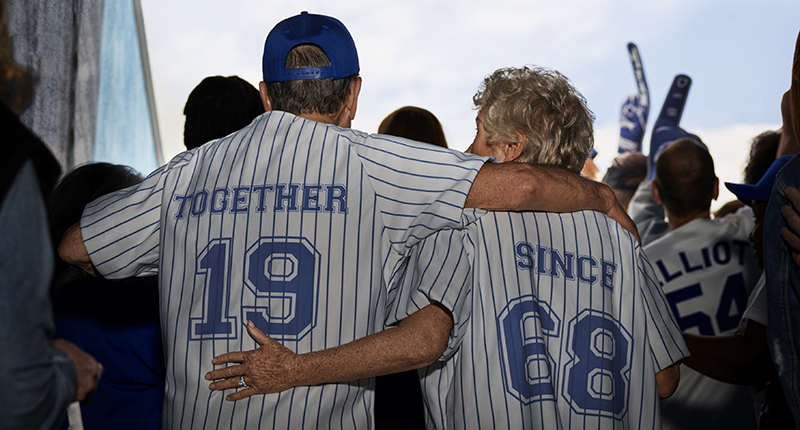
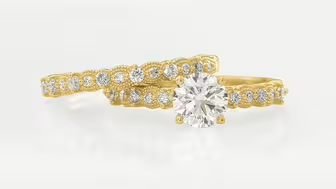
A shot from “I Take You, Until Forever,” the marketing campaign De Beers launched last year to support its new, lower-priced line of engagement rings
NJ: As more countries begin to emerge from lockdown, what tone do you think diamond jewelry marketing needs to take? And what role will the DPA play in that?
BC: We’ll obviously, with our brands, play a very strong role in that.
So Forevermark, the campaign from last year, “I Take You, Until Forever,” is as meaningful now as it ever was, probably even more so.
I know the DPA is working on various plans so you’ll see more from them as time goes forward.
Certainly from De Beers’ point of view, brands are going to play a key role in this and, more than ever, I think consumers are going to be watching what the brands have been doing through this period.
And I think we know—data is clear—that consumers will buy brands whose social values are the same as theirs.
We as De Beers and Forevermark are tremendously well-positioned there because we’ve been doing quite extraordinary stuff in all our communities in southern Africa and Canada, helping our government partners, etc.
The first response of De Beers throughout this crisis has been the health of our people.
We’ve donated about $5.5 million to COVID-19 relief around southern Africa but we’ve spent considerably more money than that making our mines safe—providing masks, testing equipment, screening equipment, making buses safe, social distancing, etc.
Working with UN Women, we’ve made donations across the mining communities in which we operate to help women who are victims of abuse and who can’t find help in the traditional places because shelters are closed or police aren’t available.
Funny enough, even in London we’ve been helping. We’ve got a whole series of flats that we normally use when people come to visit us from around the world. And we’ve made those all available to the front-line workers in the National Health Service so they don’t have to travel on public transport and risk getting infected.
We’ve done a tremendous amount there and that’s because we want to and we care to do that, but I think brands that do and are seen by consumers to be taking a lead in helping throughout the crisis, I think those brands will resonate well with consumers.
I think the tone with which people market coming out of this will have to be very carefully thought through, but I do think there’s opportunities around brands and there’s opportunity around this concept of the whole personal connection that’s going to come to everybody whose been locked down and started to think about things that really matter.
NJ: When we come out of this crisis what do you see as the main competitor to diamond jewelry? We know there’s going to be a lot more unemployment, and less discretionary income to go around.
Do you think it’s going to continue to be travel that diamond jewelry is up against, that people are going to be eager get out back there and hit the road?
BC: It’s a good question and I must say, I think, if you look at the at the way the airlines are talking about travel and about how long it will take before travel gets back to normal, I wonder whether we [diamond jewelry] won’t have an opportunity there.
Clearly, as you say, luxury travel has been a competitor, and a large competitor, of the diamond industry.
But I wonder whether people will be less keen to jump on a plane and go somewhere exotic and thereby potentially be more inclined to spend on something that means something, like a diamond. It’s hard to know.
All these airlines that talk about the future, say it’s going to be years before demand gets back to where it is now. And I do think that there will be probably also restrictions on people traveling from one country to another, but less so on people traveling within a country.
So in a country like the U.S., which is such a big market for us, potentially that’s good for diamond jewelry.
NJ: So, let me ask you this then: Do you think the United States will remain the No. 1 market for diamond jewelry after this crisis?
BC: You know, if I had a crystal ball that’s accurate, I’d be a wealthy man.
I do think the U.S. coming out of this will be the biggest market. I think it’s so far and away the biggest market that that’s not going to change. The U.S economy is tremendously resilient. It’s certainly not a market we think is going to become less important for diamond jewelry at all.
NJ: We know people who are very wealthy are back out there buying $40,000 handbags, but what about the middle of the market, which was, by all accounts, already shrinking?
BC: Yeah, look, I think there’s no question that people in the middle of the market are going to come out of this crisis probably feeling less affluent than when they went into it.
I think the question will be, is the jewelry industry able to persuade them that they should spend what they were going to spend on diamond jewelry rather than on something else?
And that’s where I come back to that we have a product, and a positioning of our product, that should allow us to be something that people will be interested in, even in an environment where they have less disposable income.
If you look back at the recessions in the U.S.—the financial crisis, 9/11, etc.—actually diamond jewelry’s come out of those quite well at all tiers of the market, not only at the higher end.
It certainly has been a resilient product and a resilient industry, and if we can market and position the product correctly, I do think we have a much bigger opportunity over comparable products in the mid-market.
NJ: When do you see the market coming back?
BC: I think a lot of this will ride on two things. One is when the States comes back more fully, and the other one is India, which we spoke about earlier.
We would hope to see a recovery in the second half of the year and obviously in our world, that’s as much selling rough as polished, and rough takes a while to turn into polished.
Assuming we have a decent season, we would expect that rough would start to move earlier than that, so perhaps toward the end of the first half of the year. But it’s really difficult to say. I think one has to keep watching how these lockdowns work, and whether they actually work.
I think if you see a few countries come out of lockdown on a sustainable basis, you’re likely to see quite a lot more confidence in consumers. And I think once you get some confidence in the ability to come out of this in a sustainable way, we’ll see more purchasing.
NJ: Thank you, Bruce. Anything else you want to add?
BC: I guess the only thing to end with is really, it’s not an easy time, it’s not an easy time for anybody. But it is at times like this that you have to think a lot about the future, you have to position your business to be ready for the future.
We will come through this and those businesses that have positioned themselves well will come through this well.
It’s easy at time like this to be gloomy but I do think, medium to long term, the prospects for the industry remain very good. We’re very positive about the future.
Michelle Graffis the editor-in-chief at National Jeweler, directing the publication’s coverage both online and in print.