





Executive Chairman Richard Baker will take over the role as rumors swirl that a bankruptcy filing is imminent for the troubled retailer.
What Diamonds Tell Us About Deep Earth
The mineral, which is an allotrope of carbon, recently made the cover of “Science” magazine. Here’s why.

Diamonds--or rather, one very large diamond from the Lulo mine in Angola--recently made the cover of “Science” magazine thanks to breakthrough research led by a gentleman who is a postdoctoral research fellow at the Gemological Institute of America specializing in diamond geology.
Evan Smith led a team of researchers who studied inclusions in more than 50 Type IIa diamonds to uncover clues about Earth’s geology and back up a theory that geologists have been working with for more than a decade.
So, what was the theory and why is it important?
I recently had the chance to chat with the lead researcher, who started his postdoctoral work at the GIA in 2015, to find out.
First, though, a little bit of background on Mr. Smith so you can better understand how he came to be studying diamonds at the GIA.
He grew up in Canada and holds a bachelor’s degree in applied science and a master’s in engineering from Queen’s University in Kingston, Ontario.
One day when he was an undergraduate, one of his classes had a guest speaker who gave a lecture on “the wonder behind diamonds,” and what they tell us about the Earth.
After that, Smith said, he was hooked.
“You start to understand more and more the things that diamonds can tell us,” he said. “They’re really unique minerals. No other mineral really has this ability to document the Earth and play the role of such a storyteller.”
Smith earned his master’s at Queen’s and then went on to get his Ph.D. in geology from the University of British Columbia.
Today, he’s at the GIA in New York where his post-doctoral work focuses on systematically characterizing the inclusions seen in rare types of diamonds to help us better understand how diamonds form and what they mean for the evolution of the planet.
The article recently published in “Science” magazine detailed a study that Smith, along with other scientists including the GIA’s Wuyi Wang, did on the unique properties of Type IIa diamonds, stones that are similar to well-known diamonds like the Cullinan, the Koh-i-Noor and the more recently discovered 812.77-carat “Constellation.” The purpose behind the research was to better understand Earth’s mantle, which is beneath tectonic plates and, as such, largely inaccessible for scientific observation.
As you may already know, Type IIa diamonds
Smith also pointed out something that I had never thought about before but should have been obvious after years of writing articles about diamonds like this--that the big rough diamonds that make headlines tend to be irregular in shape, not a nice, symmetrical octahedron like so many smaller stones. They often have a surface that’s rounded and somewhat dissolved, “almost like a lollipop after someone’s been after it for a while,” Smith said.
The fact that these big, beautiful diamonds are different has not escaped the attention of earth scientists, who have wondered for years if they form in a different way, in a different part of Earth’s mantle, and thus tell us something different about our planet.
In order to conduct the study, though, Smith and the other researchers did not, and could not, limit themselves to these kind of outsized and exceedingly rare diamonds.
Instead, they studied Type IIa diamonds of all sizes that came through the GIA lab, including some that were smaller than a carat.
Particularly helpful in the study were chunks of diamonds that were cut off larger stones and picked up from the cutting room floor, so to speak.
These offcuts--many of which came from Letšeng in Lesotho, the same mine that produced the rough diamond cut to create the incredible 118.78-carat “Graff Venus”--were key to the study because the researchers could polish them to get a better look at the inclusions, something that they, obviously, could not do with the other diamonds.
“If we didn’t have the off-cuts,” Smith noted, “we might not be having this conversation.”
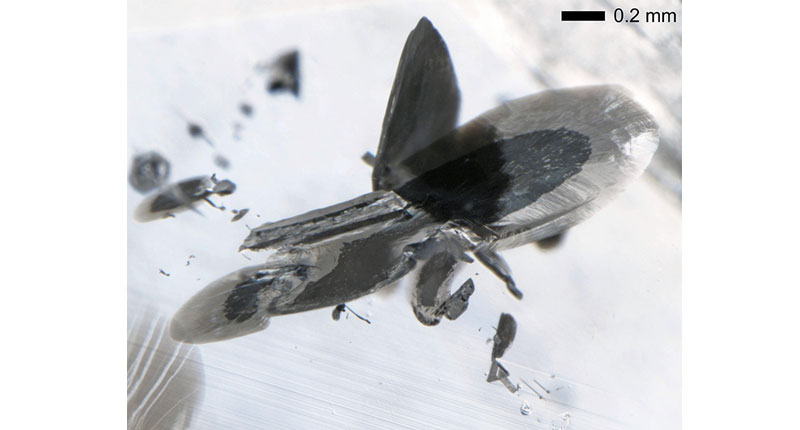
What Smith and the other researchers found after examining 52 Type IIa stones (and one Type Iab) is that in nearly three-quarters of the diamonds (38 out of 53), the inclusions weren’t, as long believed, graphite but metallic, a solidified mixture of iron, nickel, carbon and sulfur.
Smith said that this verifies what geologists have been theorizing for 10 or more years: that the Earth’s deeper mantle environment has a “light peppering” (up to 1 percent) of metallic iron.
This understanding is important because it changes the way scientists think about how different elements, like carbon, nitrogen and sulfur, are distributed. It also has broad implications for understanding the behavior of the deep Earth, including the recycling of surface rocks into the convecting mantle.
You can read a synopsis of Smith’s article on the “Science” website, though the full article is not available online for free to everyone.
In addition to Smith and Wang, the research team included Steven Shirey, Emma Bullock and Jianhua Wang from the Carnegie Institution for Sciences; Fabrizio Nestola from the Department of Geosciences at the University of Padova; and Stephen Richardson from the Department of Geological Sciences at the University of Cape Town in South Africa.
The Latest

Mohr had just retired in June after more than two decades as Couture’s retailer liaison.

Shekhar Shah of Real Gems Inc. will serve as president of the Indian Diamond & Colorstone Association in 2026.

How Jewelers of America’s 20 Under 40 are leading to ensure a brighter future for the jewelry industry.

This year’s good luck charm features the mythical horse Pegasus, and is our first Piece of the Week of the new year.


As part of the leadership transition, Sherry Smith will take on the role of vice president of coaching strategy and development.

It marks the third time the country has headed the Kimberley Process. Ghana will serve as vice chair.

Roseco’s 704-page catalog showcases new lab-grown diamonds, findings, tools & more—available in print or interactive digital editions.

The new Bulova x Stetson designs highlight two animals often associated with the American West—the bison and the Texas Longhorn.

Its residency at Yamron Jewelers will run through May 2026.

From influential executives to innovative designers, we pay tribute to the people we said goodbye to this year.

The retailer is expanding into areas with large Indian and South Asian populations.

The Italian brand has opened its first flagship amid the peaks of the Dolomites in Madonna di Campiglio, Italy.

The new curation at the Natural History Museum of Los Angeles County showcases rare gem and mineral specimens in their uncut, natural state.

The couple pleaded guilty to concealing at least $127 million in cash transactions at its precious metals businesses.

Consumers shared concerns about prices, inflation, tariffs, trade, and politics in the survey’s write-in response section.

In February 2026, the auction house will move its headquarters to the former Steinway Hall, a neoclassical landmark on Billionaires’ Row.

The new show will take place Jan. 23-25, 2026.

The former BHP Billiton leader and Gemfields chairman is remembered for his influential leadership throughout his 50-year mining career.

The LVMH-owned brand has partnered with the costume design union to revamp its award for 2026.

The luxury titan inked a deal to acquire an initial minority stake in the jewelry manufacturer with a pathway to full ownership by 2032.

The company’s curation of unsigned vintage and estate jewelry debuted at the Bloomingdale’s in Costa Mesa, California.

In the recent multi-shipment seizure, CBP also found counterfeit Audemars Piguet, Moncler, and Chrome Hearts items.

Jewelers of America execs and National Jeweler editors discuss tariffs, the sky-high gold price, and the engagement that broke the internet.

The luxury goods company said founder Ippolita Rostagno will remain at the brand’s helm.

Laura Burdese, who joined the Italian luxury brand in 2022, will take on the role in July.

The National Jeweler editors revisit the most noteworthy industry happenings and design trends from 2025.