







AuctionsFeb 03, 2021
Buyers Went Crazy for Hester Diamond’s Mineral CollectionEditorsMar 25, 2021
5 Things to Know About … Rhodochrosite
Learn about one relatively new project bringing more material from a storied site.


A rhodochrosite mineral specimen from the Zacks pocket at the Detroit City Portal in Colorado (Photo courtesy of Collector’s Edge Minerals Inc.)
I am a gemstone lover, no question. But over the past few years, I’ve also really come to appreciate a good mineral specimen.
There’s something about specimens that crystallize in perfect cubic shapes that is so alluring, especially when they’re in matrix. This is probably where my interest in rhodochrosite grew from.
In its purest (and best, in my opinion) form, the manganese carbonate is a vibrant red color, and the fine mineral specimens are stunning.
The rhodochrosite market has plenty of interest for faceted or polished goods and mineral specimens, though both are rare. With some new activity in the space, this interest is likely to continue.
Here are five things you should know about the mineral.
1. Its looks can take a few different forms.
Rhodochrosite gets its color from manganese, but because the mineral has a variable chemical composition, the manganese can be replaced in small amounts by iron, magnesium and/or calcium.
These substitutions alter the specific gravity, hardness, and color of the mineral.
In fact, its color can range from light pink to bright red, and can even become grayish, yellowish, or brownish as the chemical composition varies.
Additionally, the environment during rhodochrosite’s formation can have a major effect on the way it looks.
There’s something about specimens that crystallize in perfect cubic shapes that is so alluring, especially when they’re in matrix. This is probably where my interest in rhodochrosite grew from.
In its purest (and best, in my opinion) form, the manganese carbonate is a vibrant red color, and the fine mineral specimens are stunning.
The rhodochrosite market has plenty of interest for faceted or polished goods and mineral specimens, though both are rare. With some new activity in the space, this interest is likely to continue.
Here are five things you should know about the mineral.
1. Its looks can take a few different forms.
Rhodochrosite gets its color from manganese, but because the mineral has a variable chemical composition, the manganese can be replaced in small amounts by iron, magnesium and/or calcium.
These substitutions alter the specific gravity, hardness, and color of the mineral.
In fact, its color can range from light pink to bright red, and can even become grayish, yellowish, or brownish as the chemical composition varies.
Additionally, the environment during rhodochrosite’s formation can have a major effect on the way it looks.
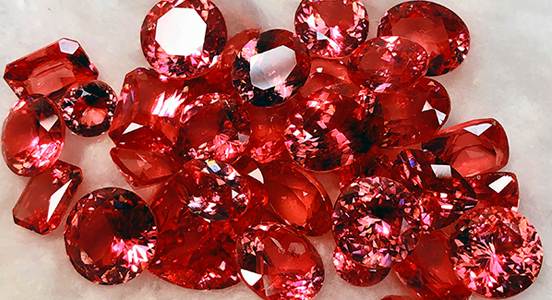
A selection of faceted rhodochrosite gemstones from the Detroit City Portal in Colorado (Photo courtesy of Iteco Inc.)
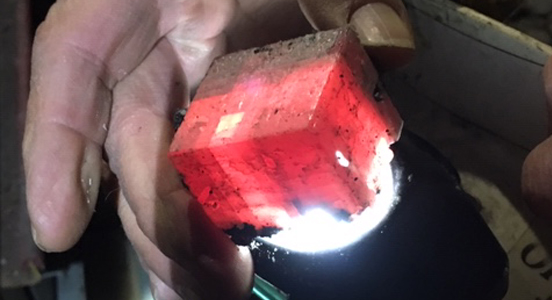
A large rhodochrosite crystal (Photo courtesy of Collector’s Edge Minerals Inc.)

Rough rhodochrosite for faceting (Photo courtesy of Collector’s Edge Minerals Inc.)
When it forms along mineral veins in pockets, rhodochrosite crystals can take shape.
It can also form as stalactites when water drips from manganese-rich rocks, creating banded material; that is often cut as slabs or used for ornamental objects, cabochons, beads, and more.
2. It’s found at a handful of sources, but supply of fine goods is low.
The list of sources for rhodochrosite doesn’t seem insignificant when you line them up, especially when compared to some other gemstones.
But the reality is that, like most colored gems, supply is limited.
“Rhodochrosite was the first stone in my cutting career where I realized you should buy things when they’re available and not when you need them. Because when you need them, they won’t be available,” gemstone cutter and wholesaler John Bradshaw said in a recent interview.
Rhodochrosite used for lapidary and mineral specimens has been found in Argentina, South Africa, Peru, Montana, Russia, China, Gabon, Mexico, and Japan, among others, according to several gemological and geological sources.
Argentina is a large source of the banded material, where stalagmites form in long-abandoned Incan silver mines, the International Gem Society said. (The mineral is often associated with silver deposits.)
The material from South Africa, meanwhile, is known for being rich in color but more of a darker hue, which some call blood red.
That material is “probably the oldest and most well-known … or was the most well-known,” Bradshaw said, noting there is virtually no production anymore; he sources South African rhodochrosite from old inventories.
In the United States, sources have been found in Montana and Colorado, the latter of which is known for the red material that comes from the Sweet Home Mine on Mount Bross.
Sweet Home started as a silver mine in the 1870s, at which time the rhodochrosite was just seen as waste rock, according to Steve Behling, the sales manager at Collector’s Edge Minerals.
The mine wasn’t very productive, failing to make a profit for the first few decades, according to the Gemmological Association of Great Britain, and also faced an onslaught of competition in the late 1800s as more and more mines opened.
Soon enough, though, those red crystals were recognized for their worth and started gaining value, becoming the mine’s sole focus.
Sweet Home produces some of the finest rhodochrosite in the world—vibrant, cherry red crystals—and helped it gain its status as the Colorado state mineral in 2002.
The mine has also been known to turn out some large pieces.
In 1992, it produced its largest yet, the Alma King—a rhodochrosite crystal measuring 14.25 centimeters on one side sitting on a quartz matrix more than 2 feet long, according to GIA’s Gems & Gemology.
The Alma King is currently in the collection of the Denver Museum of Natural History.
Modern production at the site has been handled by Bryan Lees and his two companies: Colorado Calumet Co. does the mining and Collector’s Edge Minerals markets and sells the mineral specimens. (The facetable rough is sent to Ohio-based Iteco Inc. for cutting.)
Active mining ceased at Sweet Home in 2004, but there’s been some activity nearby that should excite rhodochrosite lovers.
3. There’s new production at a storied source.
Lees initially leased the Sweet Home Mine but bought it outright in 1991. He operated the mine for more than a decade, pulling out collectable crystal specimens and facetable rough material.
In 2004, realizing they had reached the end of mining at that level of Mount Bross, Lees and his companies ceased operations at Sweet Home.
Between 1991-2004, Colorado Calumet/Collector’s Edge pulled out about $100 million dollars’ worth of mineral specimens in current dollar value, sales manager Behling said.
But Lees always wanted to go back, he added, knowing there were more red stones to be found in the mountain. So, he studied its geology and in 2016 received government approval to start mining again.
The new project is 200 feet above where they had been mining prior. Their first task was to drill and blast a 400-foot tunnel into the side of the mountain to get to the mineralized veins.
Sweet Home started as a silver mine in the 1870s, at which time the rhodochrosite was just seen as waste rock, according to Steve Behling, the sales manager at Collector’s Edge Minerals.
The mine wasn’t very productive, failing to make a profit for the first few decades, according to the Gemmological Association of Great Britain, and also faced an onslaught of competition in the late 1800s as more and more mines opened.
Soon enough, though, those red crystals were recognized for their worth and started gaining value, becoming the mine’s sole focus.
Sweet Home produces some of the finest rhodochrosite in the world—vibrant, cherry red crystals—and helped it gain its status as the Colorado state mineral in 2002.
The mine has also been known to turn out some large pieces.
In 1992, it produced its largest yet, the Alma King—a rhodochrosite crystal measuring 14.25 centimeters on one side sitting on a quartz matrix more than 2 feet long, according to GIA’s Gems & Gemology.
The Alma King is currently in the collection of the Denver Museum of Natural History.
Modern production at the site has been handled by Bryan Lees and his two companies: Colorado Calumet Co. does the mining and Collector’s Edge Minerals markets and sells the mineral specimens. (The facetable rough is sent to Ohio-based Iteco Inc. for cutting.)
Active mining ceased at Sweet Home in 2004, but there’s been some activity nearby that should excite rhodochrosite lovers.
3. There’s new production at a storied source.
Lees initially leased the Sweet Home Mine but bought it outright in 1991. He operated the mine for more than a decade, pulling out collectable crystal specimens and facetable rough material.
In 2004, realizing they had reached the end of mining at that level of Mount Bross, Lees and his companies ceased operations at Sweet Home.
Between 1991-2004, Colorado Calumet/Collector’s Edge pulled out about $100 million dollars’ worth of mineral specimens in current dollar value, sales manager Behling said.
But Lees always wanted to go back, he added, knowing there were more red stones to be found in the mountain. So, he studied its geology and in 2016 received government approval to start mining again.
The new project is 200 feet above where they had been mining prior. Their first task was to drill and blast a 400-foot tunnel into the side of the mountain to get to the mineralized veins.
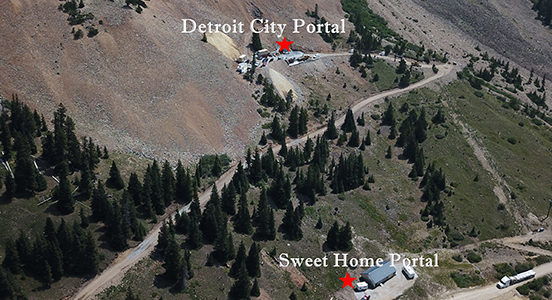
This image shows where the new Detroit City Portal is compared with the original Sweet Home Mine site. (Photo courtesy of Collector’s Edge Minerals Inc.)
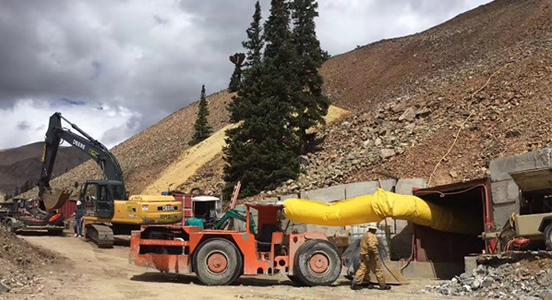
Mining activity at the Detroit City Portal (Photo courtesy of Collector’s Edge Minerals Inc.)
They started to find pockets in late 2018, Behling said, and mineral specimens started hitting the market that year.
Facetable rough took longer to find, and cut stones from the new project just started coming out last summer, Iteco’s Paul Cory confirmed.
The two working areas are not connected underground—just located on the same mining site—so they gave the new one a different name but retained Sweet Home for marketing reasons; it’s been dubbed the Detroit City Portal at the Sweet Home Mine.
So far, production hasn’t quite been at the level of Sweet Home, Behling said, but noted it can be scattershot anyway.
“I can tell you for a fact that even in the original mine, it sometimes would be six months to a year in between major pockets. You’d move a lot of rock and once in a while, nature would give you a gift where you had this beautiful pocket of crystals. It’s a very feast-or-famine kind of mining.”
When speaking to facetable material from Detroit City, Cory said Sweet Home produced more rough per season than the new working area.
Part of that does have to do with the mining company’s increased ability to get crystals out undamaged, meaning they will be kept as mineral specimens rather than being cut.
But he put it this way: “To give you a scale of the supply, probably all of [National Jeweler’s] readers could carry the entire gem rough supply in a single box from the vault to their car parked nearby.”
4. Rhodochrosite mineral specimens can go for much more than faceted material.
Mineral collectors love when the specimens feature a crystal in matrix, rather than isolated or broken fragments, Behling said.
These kinds of pieces are rare, and when they do find them, collectors gobble them up.
Some of the specimens from Sweet Home sold for $500 or $1,000 per piece, Behling said. But it’s also not unusual, he added, for Collector’s Edge to sell individual pieces for six figures.
“You may have a 3-inch-by-3-inch piece of matrix with several crystals on it, and it’ll be $100,000 or it’ll be $150,000.”
5. But faceted material is still highly coveted.
Sources also rarely turn out transparent material that can be faceted, and these pieces, too, are in high demand from buyers.
Gemstone cutter and wholesaler Bradshaw said when he recently held a virtual Tucson event, he sold out of several stones, and rhodochrosite was one of them.
Iteco’s Cory said, “The demand far exceeds the supply, and the market grows every year. The demand is worldwide, focused primarily on Japan, India, and the U.S. market. As more people become aware of the beauty of faceted rhodochrosite, the market becomes even larger.”
But rhodochrosite is not only low in supply; it also contains a few gemological characteristics that present a challenge for faceting.
First, it has perfect cleavage in three directions, so cutters must make sure they don’t put a large facet parallel to a cleavage plane, Cory said, which makes it more difficult to polish.
It also has a hardness of only 3.5-4 on the Mohs scale, so the stone is best set in earrings or necklaces, pieces that tends to take less abuse than rings or bracelets.
“You may have a 3-inch-by-3-inch piece of matrix with several crystals on it, and it’ll be $100,000 or it’ll be $150,000.”
5. But faceted material is still highly coveted.
Sources also rarely turn out transparent material that can be faceted, and these pieces, too, are in high demand from buyers.
Gemstone cutter and wholesaler Bradshaw said when he recently held a virtual Tucson event, he sold out of several stones, and rhodochrosite was one of them.
Iteco’s Cory said, “The demand far exceeds the supply, and the market grows every year. The demand is worldwide, focused primarily on Japan, India, and the U.S. market. As more people become aware of the beauty of faceted rhodochrosite, the market becomes even larger.”
But rhodochrosite is not only low in supply; it also contains a few gemological characteristics that present a challenge for faceting.
First, it has perfect cleavage in three directions, so cutters must make sure they don’t put a large facet parallel to a cleavage plane, Cory said, which makes it more difficult to polish.
It also has a hardness of only 3.5-4 on the Mohs scale, so the stone is best set in earrings or necklaces, pieces that tends to take less abuse than rings or bracelets.
Additionally, rhodochrosite is strongly doubly refractive—light enters it and splits into two—so cutters must orient the rough to avoid making a stone look “sleepy” if pavilion facets appear doubled, Cory said.
Even with this extra care required, cutters definitely will roll the dice on rhodochrosite when given the chance.
“In previous years, I would never consider cutting melee rhodochrosite, but I do now,” Bradshaw said. “Because it sells.”
Cory said stones bigger than 3 carats have about doubled in price over the last five years, while those weighing more than 10 carats have risen even more, perhaps triple from when the original Sweet Home Mine project closed in 2004.
Even with this extra care required, cutters definitely will roll the dice on rhodochrosite when given the chance.
“In previous years, I would never consider cutting melee rhodochrosite, but I do now,” Bradshaw said. “Because it sells.”
Cory said stones bigger than 3 carats have about doubled in price over the last five years, while those weighing more than 10 carats have risen even more, perhaps triple from when the original Sweet Home Mine project closed in 2004.
Editors' Picks
Sponsored by


EditorsSep 15, 2020
5 Things to Know About … Red Beryl
EditorsMar 16, 2020
5 Things to Know About … ForditeMore on Editors



The Latest


PodcastsOct 21, 2026
Episode 10: This Episode Is Haunted Diana Singer shared the stories of two “cursed” diamonds on this month’s podcast, which was inexplicably riddled with technical issues.


IndependentsOct 21, 2026
Gardner-Collier Jewelry to Close After 9 Decades in BusinessThe family-owned jeweler has three locations across Missouri and Iowa.


SourcingOct 21, 2026
Venetia Mines Final Carats Ahead of 2-Year ShutdownThe De Beers-owned diamond mine in South Africa is being put on ice as part of a round of previously announced cost-cutting measures.


Brought to you by
A Diamond Is Forever Launches 2026 Holiday Campaign Championing Natural DiamondsA Diamond Is Forever's holiday campaign reimagines natural diamond icons for a new generation celebrating individuality.


CollectionsOct 21, 2026
Helzberg, Nordstrom Carrying New Jewelry Collection From Off-WhiteThe collection centers designs with clean geometric lines, chunky sculptural pieces, and recognizable details from the luxury fashion brand.

Weekly QuizOct 15, 2026
This Week’s QuizTest your jewelry news knowledge by answering these questions.

SourcingOct 21, 2026
Gemfields’ Mixed-Quality Ruby Auction Earns $52MThe miner said it saw particularly strong prices for larger, fine-quality rubies at the sale.


CrimeOct 20, 2026
Security Guard Charged With Murder in Shooting at Texas MallThe guard opened fire on a man who was smashing a jewelry display case at La Gran Plaza in Fort Worth last week, police said.

Brought to you by
Open an Account, Get $50 Off Your First Order. No Code Needed.Built on Relationships. Refined by Craft.


IndependentsOct 20, 2026
David Gardner’s Jewelers Unveils Newly Expanded, Revamped ShowroomThe Texas jeweler added 2,000 square feet to its reimagined showroom, complete with a new design studio and an event space.

SourcingOct 20, 2026
The $50M Victoria’s Secret ‘Fantasy Bra’ By The NumbersJacob & Co.'s diamond masterpiece is the most expensive Fantasy Bra ever worn on the Victoria’s Secret Fashion Show runway.

CollectionsOct 20, 2026
Mignon Faget’s Collection Chooses Handmade Over AIThe “Atelier” collection was inspired by the tools, rituals, and objects in an artist’s studio as a quiet rebuttal to an automated world.
MajorsOct 19, 2026
The Knot to Acquire Rival Wedding Planning Platform ZolaThe pending acquisition is an “exciting opportunity” for wedding vendors to grow their business, said The Knot Worldwide’s CEO.

SourcingOct 19, 2026
Jewelry Design Competition Show Airs in Thailand"The Secret Gems" features eight Thai jewelry brands paired with a team of young craftspeople who create jewelry together to win challenges.

CollectionsOct 19, 2026
John Hardy Enters the Medallion Chat With Talisman Collection The brand’s “Modern Talisman” capsule collection introduces pendants inspired by the mythology, natural world, and spiritual ethos of Bali.

IndependentsOct 19, 2026
The Stories of 5 Jewelers Celebrating Their Centennials in 2026Independent jewelers from New Mexico to New Jersey answer the question: What has kept your store in business for 100 years?

SurveysOct 16, 2026
How Inflation, Gas Prices Will Affect Holiday Sales The NRF is expecting holiday sales to increase this year, but consumers and retailers alike are facing Grinch-like headwinds.
CollectionsOct 16, 2026
Christina Puchi’s Earrings Hold the UniverseOur Piece of the Week gathers the planets, represented by a variety of colored gemstones, in a pair of 14-karat yellow gold earrings.
IndependentsOct 16, 2026
Reeds Jewelers Expands, Relocates FlagshipThe New York-based jeweler is moving its Amherst flagship store to a larger location in nearby Snyder.

MajorsOct 16, 2026
Katy Chen Appointed Executive Vice President of Graff USA Chen, who worked at Cartier and Tiffany & Co., will lead retail sales and operations for the luxury jeweler’s 11 U.S. stores.

IndependentsOct 15, 2026
Retailer Hall of Fame 2026: Amy and Elise Greenberg For 40 years, sisters Amy and Elise Greenberg have helmed their 126-year-old family business, leading with appreciation and integrity.

ColumnistsOct 15, 2026
Peter Smith: What Is the Culture REP?It’s a term Smith coined and felt compelled to share following a bad experience with an aborted flight and an unfeeling flight attendant.

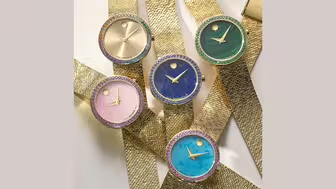
WatchesOct 15, 2026
Stephanie Gottlieb’s New Movado Watches Are Made for Your Wrist StackMovado teamed up with the New York-based fine jewelry designer on a new collection of Movado Museum Velura watches.
SourcingOct 15, 2026
Signet Jewelers, Richemont May Join Bidder for De Beers, Report SaysThe two companies are reportedly in talks to join the Global Diamond Consortium, led by former De Beers CEO Gareth Penny, as per Bloomberg.
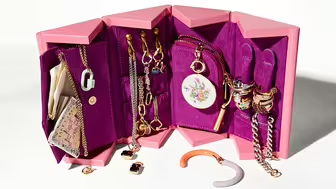
CollectionsOct 15, 2026
Wolf x Marla Aaron's New Jewelry Box Is for Some (Not All) of Your ThingsThe “Some of the Things” box follows the two larger “Everything” box designs with the look and function of antique sewing and toolboxes.

IndependentsOct 14, 2026
Retailer Hall of Fame 2026: Coleman and Mitchell ClarkFourth-generation jewelers Coleman and Mitchell Clark exemplify the best qualities of their predecessors: humility, modesty, and confidence.

SourcingOct 14, 2026
Manuel Marcial de Gomar, ‘The Emerald Whisperer,’ Dies at 90The gem hunter, whose 70-year career was defined by adventure and exploration, is remembered for his steadfast faith and sense of wonder.

FinancialsOct 14, 2026
LVMH’s Jewelry Brands Turn in ‘Very Good’ Performance in Q3 Tiffany & Co. continued its full-scale store renovation project while Bulgari’s high jewelry collection generated “record-breaking revenue.”