






TrendsFeb 07, 2018
The History Behind … The Squash Blossom NecklaceEditorsMay 11, 2020
A Look at Protective Jewelry Through the Ages
From Native American turtle amulets to the Italian cornicello, Associate Editor Lenore Fedow delves into the history of pieces of jewelry believed to shield the wearer.


Native American children were given turtle amulets to protect themselves from illness and promote longevity. It is one of four examples of protective jewelry Associate Editor Lenore Fedow explores in this blog post. (Image courtesy of Wikimedia Commons/Science Museum, London. Wellcome Images)
I am a bit superstitious, to say the least.
I’d say it’s a mix of my nervous nature and my Italian-American upbringing, a culture steeped in old-world tradition with no shortage of superstitions.
Everything from placing a hat on the bed to putting new shoes on the table was a way to bring bad luck.
But for as long as we’ve believed in bad luck and curses, we’ve also believed there were ways to protect ourselves, and those included wearing jewelry.
Across cultures, jewelry has served as both adornment and protection for centuries, its beauty doubling as a safeguard for the wearer.
Join me as I take a look through some notable protective amulets throughout jewelry history.
The Cornicello
I’d say it’s a mix of my nervous nature and my Italian-American upbringing, a culture steeped in old-world tradition with no shortage of superstitions.
Everything from placing a hat on the bed to putting new shoes on the table was a way to bring bad luck.
But for as long as we’ve believed in bad luck and curses, we’ve also believed there were ways to protect ourselves, and those included wearing jewelry.
Across cultures, jewelry has served as both adornment and protection for centuries, its beauty doubling as a safeguard for the wearer.
Join me as I take a look through some notable protective amulets throughout jewelry history.
The Cornicello
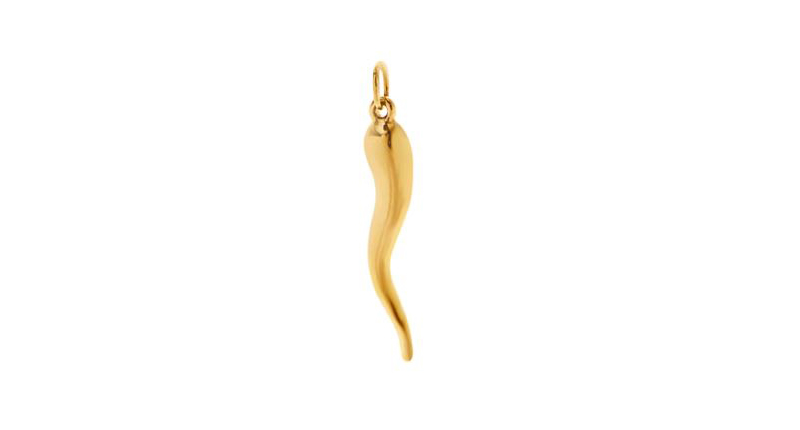
A 14-karat gold cornicello pendant by Ariel Gordon ($95). The horn-shaped pendant is believed to ward off bad intentions. (Image courtesy of Ariel Gordon website)
My mother was a fervent believer in “il malocchio,” or the evil eye, the belief that someone could be so jealous of you that the envy would manifest into a curse on you.
One way to protect yourself and repel the curse was to wear the cornicello, or “little horn,” a small pendant that looks like a red chili pepper.
Once made of red coral, it’s taken various forms through the years and has been embraced by jewelry designers many times over; check out these modern cornicello charms from Ariel Gordon and Loren Stewart.
In addition to protecting oneself, the symbol is thought to promote fertility and virility.
You can still find the charms today, hanging off necklaces, keychains, and rearview mirrors, particularly in southern Italy, where my family is from, and in Italian-American neighborhoods, where my family is now.
Similar to the superstitions surrounding pearls and opals, it’s considered bad luck to buy a cornicello for yourself.
Tau Cross
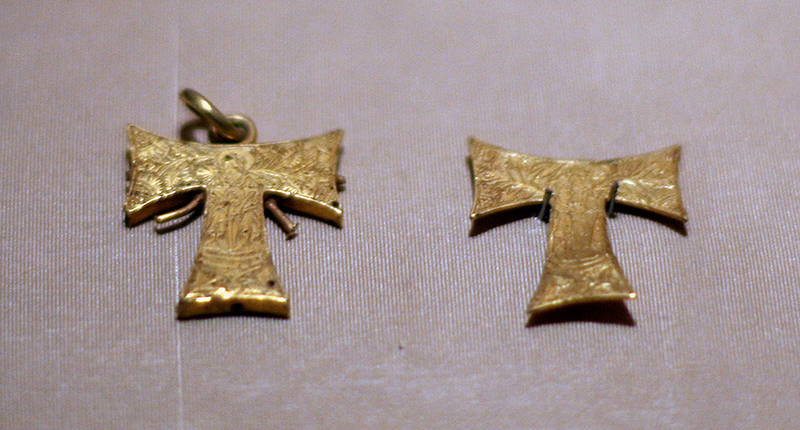
Cast and engraved gold Tau Cross pendants circa 1485 England from the Cloisters Collection at The Metropolitan Museum of Art in New York (Image courtesy of Wikimedia Commons/shooting_Brooklyn)
We’re taking it back to the first millennium to talk about the Tau Cross.
Religious jewelry as protection stretches back thousands of years, but the Tau Cross has a particularly interesting backstory.
The story has monks, poison, and demonic visions, so buckle up.
The t-shaped cross is named after the Greek letter “T” and was known to the Romans as “crux commissa,” or “connected cross” in Latin.
Also known as Saint Anthony’s Cross, it is linked to Saint Anthony of Egypt, 251-356 AD, one of the earliest monks and a founder of organized Christian monasticism.
Anthony gave up his worldly possessions and went into the desert to live a life of fasting and solitude.
He was depicted wearing a Tau cross on his cloak and his followers did the same, adopting a black religious habit marked with a blue version of the symbol.
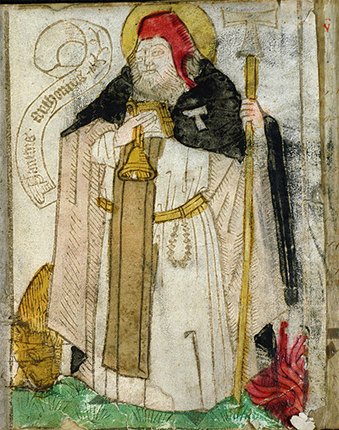
Saint Anthony in his cloak depicted in a 1460s woodcut (Image courtesy of Wikimedia Commons)
Anthony was said to experience visions brought on by the devil, taking the form of a fellow monk bringing him bread during his fasts or wild beasts attacking him.
It was believed that Anthony’s devotion to God is what helped him to repel the visions.
You know what else can make a person see visions? Ergotism, a type of poisoning caused by a fungus on grains, like rye or wheat, used to make bread.
It can lead to convulsions, as well as muscle spasms, delusions, hallucinations, and crawling sensations on the skin, all similar to what Anthony was described to have experienced. Ergotism can also cause a burning sensation in the limbs, giving it the nickname “Saint Anthony’s Fire.”
While it later became clear that bad bread was the cause of Saint Anthony’s Fire, it was long believed that wearing the Tau cross, as he had done, was a way to protect against his eponymous disease.
Tau cross pendants were worn around the neck and on clothing, but also formed into sculptures and incorporated into church window designs.
There are still followers of Saint Anthony in the Middle East, particularly in Lebanon, who wear Tau crosses on their black habits.
Today, the symbol is more widely associated with the Franciscan Order.
St. Francis of Assisi adopted the Tau symbol after hearing Pope Innocent III speak of its symbolism and power.
Turtle Amulets
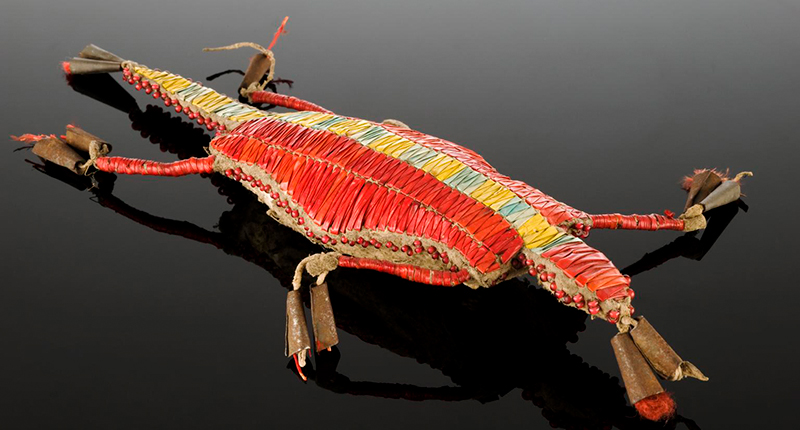
Native American children received turtle amulets as tokens of protection. This one dates to between 1880 and 1920. (Image credit: Science Museum, London. Wellcome Images)
Symbolism coupled with beautiful, intricate craftsmanship is a hallmark of Native American jewelry.
In the Lakota tradition, babies were gifted turtle-shaped amulets to protect against illness and ensure a long life.
The spirit of the turtle, or keya, represented life, longevity and strength.
When the baby’s umbilical cord fell off, it was sewed into a buckskin bag, usually shaped like a turtle, and the bag was attached to the baby’s cradle to be used as a toy.
The keya was thought to protect newborns from “mni watu,” or bacteria and germs that cause illness.
The turtle was also used as a teaching tool related to the tribe’s 13-month calendar.
Upon observing changes in the moon and stars, the tribe counted 13 new moons, each with 28 days between them. The turtle mirrors this, with 13 scales on its back and 28 small scales around its shell.
For the turtle charm to work, the child would have to keep it for a lifetime. But kids will be kids, so the turtle amulet was taken away from them for a number of years so they wouldn’t lose it.
The child would get it back when she or he was older and it could then be worn on a costume or a ceremonial dress.
The cord the amulet was held on was symbolic of a tie between the child’s existence before birth and life afterward.
Hematite
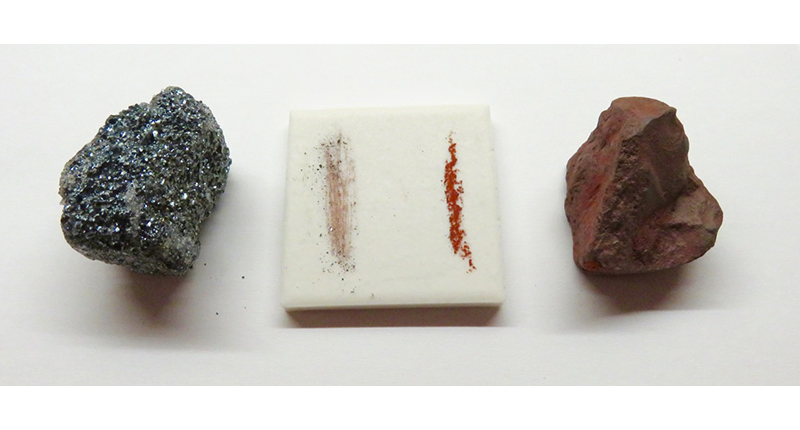
Greek warriors used the red residue left behind by hematite as protective war paint. (Image courtesy of Wikimedia Commons/KarlaPanchuk)
It wouldn’t be a historical jewelry blog without input from Isabelle Corvin, staff gemologist at Panowicz Jewelers in Olympia, Washington.
Corvin has contributed to my blogs about gemstone legends and cursed gemstones, so I had to bug her again for this one.
Hematite, a gray-to-black iron ore, is one of the most interesting protective amulets, said Corvin.
Derived from the Greek word for blood, “haima,”hematite was known as the “bleeding stone” because of the reddish streak of iron oxide it leaves behind, which Greek warriors once used as war paint.
“They would use oils or heated water on the stone so that when they pressed it on the skin, the iron staining would be applied,” Corvin said.
Historical evidence about folklore can be hard to find, but “Crystal Enchantments,” by author and occult researcher D.J. Conway, had some interesting information to share about hematite.
Roman soldiers believed in its protective properties, too, as hematite was thought to be sacred to Mars, the god of war.
When scraped against something, hematite produces a red powder, and that powder was rubbed against the skin before battle.
The stone itself was also worn for protection against battle wounds.
Lawyers suiting up for a courtroom battle may also want to wear hematite, since it’s known as the “lawyer’s stone.”
Conway’s book shares the story of a Babylonian gem treaty written on behalf of Mithridates the Great (63 B.C.) that states hematite could be used “to gain favorable hearings during judgments and lawsuits, to win positive petitions before all those in authority.”
Is any of this real?
I hold onto some superstitions I grew up with, partly out of fondness and partly out of fear.
I don’t know that I wholeheartedly believe in all of them but as I write this a few months into the coronavirus pandemic, I can understand why you would want to believe that a piece of jewelry can protect you.
In times of uncertainty, when misfortune feels wide-reaching and unescapable, I understand the desire to look for a way to take control of the situation.
When the real safety measures are isolating and feel scary, it’s comforting to believe we can protect ourselves just by wearing a pendant, or rubbing some rock dirt on our skin.
Rather than searching for a magical amulet, I’ll be looking for comfort where I’ve always found it: my family, my friends, my faith, and my fuzzy companions.
All that being said, does anyone have a spare cornicello?

More on Editors



The Latest
MajorsOct 19, 2026
The Knot to Acquire Rival Wedding Planning Platform ZolaThe pending acquisition is an “exciting opportunity” for wedding vendors to grow their business, said The Knot Worldwide’s CEO.

SourcingOct 19, 2026
Jewelry Design Competition Show Airs in Thailand"The Secret Gems" features eight Thai jewelry brands paired with a team of young craftspeople who create jewelry together to win challenges.


CollectionsOct 19, 2026
John Hardy Enters the Medallion Chat With Talisman Collection The brand’s “Modern Talisman” capsule collection introduces pendants inspired by the mythology, natural world, and spiritual ethos of Bali.


Brought to you by
Open an Account, Get $50 Off Your First Order. No Code Needed.Built on Relationships. Refined by Craft.


IndependentsOct 19, 2026
The Stories of 5 Jewelers Celebrating Their Centennials in 2026Independent jewelers from New Mexico to New Jersey answer the question: What has kept your store in business for 100 years?

Weekly QuizOct 15, 2026
This Week’s QuizTest your jewelry news knowledge by answering these questions.


SurveysOct 16, 2026
How Inflation, Gas Prices Will Affect Holiday Sales The NRF is expecting holiday sales to increase this year, but consumers and retailers alike are facing Grinch-like headwinds.
CollectionsOct 16, 2026
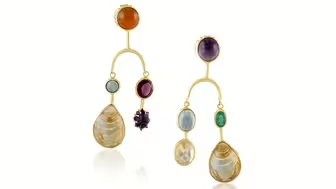
Christina Puchi’s Earrings Hold the UniverseOur Piece of the Week gathers the planets, represented by a variety of colored gemstones, in a pair of 14-karat yellow gold earrings.

Brought to you by
Meet Gemology’s Next Generation Microscope: GIA® Gemolite® NXT Professional EditionExperience gemstones with greater precision and comfort than ever before.

IndependentsOct 16, 2026
Reeds Jewelers Expands, Relocates FlagshipThe New York-based jeweler is moving its Amherst flagship store to a larger location in nearby Snyder.

MajorsOct 16, 2026
Katy Chen Appointed Executive Vice President of Graff USA Chen, who worked at Cartier and Tiffany & Co., will lead retail sales and operations for the luxury jeweler’s 11 U.S. stores.

IndependentsOct 15, 2026
Retailer Hall of Fame 2026: Amy and Elise Greenberg For 40 years, sisters Amy and Elise Greenberg have helmed their 126-year-old family business, leading with appreciation and integrity.

ColumnistsOct 15, 2026
Peter Smith: What Is the Culture REP?It’s a term Smith coined and felt compelled to share following a bad experience with an aborted flight and an unfeeling flight attendant.

WatchesOct 15, 2026
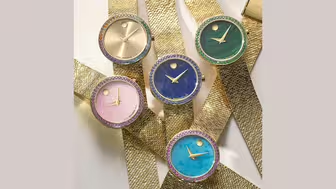
Stephanie Gottlieb’s New Movado Watches Are Made for Your Wrist StackMovado teamed up with the New York-based fine jewelry designer on a new collection of Movado Museum Velura watches.
SourcingOct 15, 2026
Signet Jewelers, Richemont May Join Bidder for De Beers, Report SaysThe two companies are reportedly in talks to join the Global Diamond Consortium, led by former De Beers CEO Gareth Penny, as per Bloomberg.
CollectionsOct 15, 2026
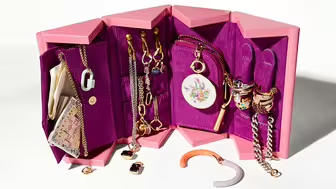
Wolf x Marla Aaron's New Jewelry Box Is for Some (Not All) of Your ThingsThe “Some of the Things” box follows the two larger “Everything” box designs with the look and function of antique sewing and toolboxes.

IndependentsOct 14, 2026
Retailer Hall of Fame 2026: Coleman and Mitchell ClarkFourth-generation jewelers Coleman and Mitchell Clark exemplify the best qualities of their predecessors: humility, modesty, and confidence.

SourcingOct 14, 2026
Manuel Marcial de Gomar, ‘The Emerald Whisperer,’ Dies at 90The gem hunter, whose 70-year career was defined by adventure and exploration, is remembered for his steadfast faith and sense of wonder.

FinancialsOct 14, 2026
LVMH’s Jewelry Brands Turn in ‘Very Good’ Performance in Q3 Tiffany & Co. continued its full-scale store renovation project while Bulgari’s high jewelry collection generated “record-breaking revenue.”

Events & AwardsOct 14, 2026
Chicago Responsible Jewelry Conference Releases 2026 ProgramThis year’s sessions feature leading voices from human rights, legal, and conservation organizations.

MajorsOct 13, 2026
David Webb Owner Purchases Lugano JewelryThe high-end jewelry retailer was sold to private investment firm Middle West Partners and a group of longtime clients.

Lab-GrownOct 13, 2026
Stephanie Gottlieb Takes Lab-Grown Diamond Collection WholesaleThe jewelry designer has partnered with Sofer Jewelry to distribute her 85-piece lab-grown diamond collection.

IndependentsOct 13, 2026
Retailer Hall of Fame 2026: Sean DunnDunn, this year’s Single-Store Independent inductee, is passionate about innovation and telling the story of natural diamonds.

AuctionsOct 13, 2026
Christie's Geneva To Auction 'Bulgari Pink' DiamondThe 24-carat fancy intense pink diamond ring could fetch up to $18 million at the November sale.

IndependentsOct 13, 2026
Greenwich St. Jewelers’ New Candle Smells Like HomeThe “Island Jewel” candle honors New York City and Puerto Rico and raises money for the island’s water relief efforts.
TechnologyOct 13, 2026
GemFind Is a New JA Member Benefit Partner The partnership will give JA members access to preferred pricing, exclusive benefits, technology solutions, education, and resources.

SurveysOct 09, 2026
These Will Be the 10 Busiest Days for In-Store Shopping This Holiday SeasonStores should expect to see the most customers on Nov. 27, and Christmas week is expected to be hectic too, as Dec. 25 falls on a Friday.

CollectionsOct 09, 2026
Elisa Solomon Collabs With Serendipity 3 on ‘Frozen Hot Chocolate’ CharmThe charm, our Piece of the Week, features brown diamond frozen hot chocolate topped with white diamond whipped cream and a ruby straw.