




CollectionsOct 26, 2026
Bliss Lau’s ‘Vantage’ Point Is the Hawaiian HorizonIn her “Vantage” collection, Lau explores heritage, identity, and inner strength through designs featuring blue-green Guatemalan jade.






How to schedule your day, make sure you don’t burn out and other recommendations from those who’ve done it before.


New York—Shelter-in-place orders have nonessential employees across the globe adjusting to a new normal way of working—from home.
For many who aren’t used to making their home their office too, it’s a time of trial and error as they try different routines to figure out what works for them.
To help, National Jeweler has assembled a list of tips from members of the jewelry trade who have experience working from home.
1. Stick to a schedule.
This is one of the most suggested and repeated tips from experts and work-from-home veterans alike, who vouch that the best way to adapt to the new work environment is to keep a routine.
Brilliant Earth Senior Vice President of Human Resources Jaime Yas recommends practicing the normal morning routine, including showering, taking time to make coffee, meditating, getting dressed—including putting on jewelry—and getting to the home “office” at the same time as the traditional office.
Lydia McConnell, founder and creative director of costume jewelry brand Le Chic Miami, said she works best when she makes time management a focus.
She starts the day by going over the to-do list she made the previous day. From there, she assigns times to do each task during the day, giving herself 10 to 20 minutes more than she thinks she’ll need for each.
“This way I am able to finish all my important tasks first and leave the less important ones for later in the day or for the next day,” she told National Jeweler.
The routine also includes making sure the day’s start and stop times are defined as much as possible.
Becky Stone of Diamonds in the Library said this: “If you don't differentiate your work and non-work hours, your work and play will merge together into a guilt-ridden miasma of obligation that prevents you from ever truly relaxing. You need to be on the clock so that you can be off the clock.”
She added the right way to do this is “highly individual and takes practice.”
Stone said sometimes she does it by task—setting a certain number of goals for the day and when those tasks are finished, she stops working—and other days, when work is “too nebulous for clear tasks,” she gives herself a time-based end of the day.
“It’ll take a little while to figure out the right way for you to define your workday, but it’s extremely
“If you don't differentiate your work and non-work hours, your work and play will merge together into a guilt-ridden miasma of obligation that prevents you from ever truly relaxing.”—Becky Stone, Diamonds in the LibraryWhile a silver lining of the work-from-home situation might seem to be the chance to work and lounge at the same time, working in your bed or on the couch isn’t the best idea for long-term situations.
“Just as you would take a few minutes to clear your mind in the office, schedule breaks at home so that you don’t get too bogged down. Regular breaks also ensure you’re able to tackle your tasks with a clear mind.”—Jaime Yas, Brilliant EarthFor many, taking care of themselves includes maintaining relationships and getting social by reaching out to the important people in their lives—check in on loved ones, message friends or take advantage of the many apps that allow people to connect remotely, like Zoom or House Party.

In her “Vantage” collection, Lau explores heritage, identity, and inner strength through designs featuring blue-green Guatemalan jade.

The jeweler gave the public backstage tours of its flagship store and its design and innovation workshop as part of LVMH’s open house.

Vote for which jewelry professional should dress up as a monster to support Jewelers for Children’s annual Halloween fundraiser.

A Diamond Is Forever's holiday campaign reimagines natural diamond icons for a new generation celebrating individuality.


The closure is part of a global restructuring that also includes PGI winding down its operations in Japan, South Korea, and Hong Kong.


The ring, our Piece of the Week, was designed by eight-year breast cancer survivor Rachel Chalchinsky of Color Source Gems.

The website offers enhanced member benefit access, industry directories, educational resources, a job board, and access to the MJSA Journal.

Built on Relationships. Refined by Craft.


Boucheron and Pomellato had a strong third quarter, with Kering looking at jewelry as an increasingly important part of its portfolio.

Tara Sinchuri was the owner of Everest Jewels in Fairfield, Ohio, and a father of three. He was found dead in his store on Tuesday.

Bespoke experiences from Buccellati and Verdura are on the retailer’s 2026 “Fantasy Gifts” list.

The number of participants at the fall show was up 12 percent.

The Academy and Grammy award-winning siblings have collaborated with John Hardy on a new jewelry line inspired by their personal style.


Diana Singer shared the stories of two “cursed” diamonds on this month’s podcast, which was inexplicably riddled with technical issues.


The De Beers-owned diamond mine in South Africa is being put on ice as part of a round of previously announced cost-cutting measures.

The collection centers designs with clean geometric lines, chunky sculptural pieces, and recognizable details from the luxury fashion brand.
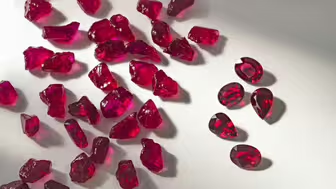
The miner said it saw particularly strong prices for larger, fine-quality rubies at the sale.

The guard opened fire on a man who was smashing a jewelry display case at La Gran Plaza in Fort Worth last week, police said.

Jacob & Co.'s diamond masterpiece is the most expensive Fantasy Bra ever worn on the Victoria’s Secret Fashion Show runway.

The “Atelier” collection was inspired by the tools, rituals, and objects in an artist’s studio as a quiet rebuttal to an automated world.
The pending acquisition is an “exciting opportunity” for wedding vendors to grow their business, said The Knot Worldwide’s CEO.

"The Secret Gems" features eight Thai jewelry brands paired with a team of young craftspeople who create jewelry together to win challenges.

The brand’s “Modern Talisman” capsule collection introduces pendants inspired by the mythology, natural world, and spiritual ethos of Bali.

Independent jewelers from New Mexico to New Jersey answer the question: What has kept your store in business for 100 years?

The NRF is expecting holiday sales to increase this year, but consumers and retailers alike are facing Grinch-like headwinds.

Our Piece of the Week gathers the planets, represented by a variety of colored gemstones, in a pair of 14-karat yellow gold earrings.
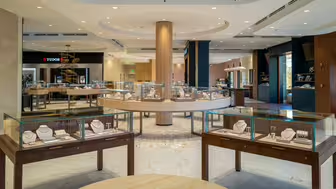
The New York-based jeweler is moving its Amherst flagship store to a larger location in nearby Snyder.



This site uses cookies to give you the best online experience. By continuing to use & browse this site, we assume you agree to our Privacy Policy