Piercing Pagoda’s “Be More You” marketing campaign uses models of different races and ages, and adheres to less traditional concepts of gender. “We get very rooted in men/women; that’s how we talk about our product. We’re walking away from that language,” Piercing Pagoda Vice President Kecia Caffie says.
The death of George Floyd was the final drop that broke a dam long primed to burst.
His murder released a torrent of protests nationwide against police treatment of Black people and racial inequities in America, a resurgence of the Black Lives Matter movement that started in 2013.
Click here to read the full story in the State of the Majors issue.
The images of former Minneapolis police officer Derek Chauvin kneeling on Floyd’s neck for nearly nine minutes “taught everyone that things are not as ideal as they might have thought they were in terms of race relations in this country,” says Kecia Caffie, the Dallas-based senior vice president and general manager of Signet Jewelers-owned Piercing Pagoda.
“It was very much in black and white for 8 minutes and 46 seconds.”
In the weeks following Floyd’s May 25 murder, social media was flooded with messages of support, and black squares filled the Instagram grid on June 2 for the later-maligned “Blackout Tuesday.”
Companies, from the smallest mom-and-pop shop to the retailers large enough to land a spot on National Jeweler’s “$100 Million Supersellers” list, found themselves swept up in the current.
After years of trying to stay middle-of-the-road when it came to hot-button social or political issues, many retailers today are realizing that, to paraphrase the title of Black journalist Don Lemon’s recently launched podcast, silence isn’t necessarily the best option anymore.
But neither is speaking out if a company has no intention of examining and taking the needed steps to increase diversity among its top-level executives, in-store staff and/or in its advertising.
Companies have to be willing to make fundamental changes to their entire culture, says Simon Tam, an author, activist and musician who organizes workshops for Fortune 500 companies on developing more inclusive workplaces.
It can’t start and end with one conference or a single training session on diversity.
“If people want to [increase diversity]—and I think they ought to—they need to realize it’s a journey. It’s not just one step,” he says. “The expectation is that you’re going to overhaul your company culture, and for a lot of people, that can be a very scary thing.”
The Majority, Silent For this article, National Jeweler reached out to the some of the largest specialty jewelers on the $100 Million Supersellers list—Signet Jewelers Ltd., Tiffany & Co., Richemont, Jewelry Television, Bucherer Group-owned Tourneau, Luxury Brand Holdings (parent company of Ross-Simons and Sidney Thomas), and Blue Nile (Nos. 1, 3, 6, 9, 10, 11, and 12 on the list)—to request interviews on how they are working to increase diversity and how they’ve responded to the current civil rights movement.
Signet, Tiffany and Tourneau replied. Tourneau declined to participate in the story. After repeated requests, Tiffany agreed to an email interview with its chief sustainability officer, Anisa Kamadoli Costa, but then the company changed its mind and ultimately also declined to allow Costa to participate.
Kecia Caffie
Signet granted National Jeweler’s request for an interview, with Piercing Pagoda’s Caffie, and provided a quote from CEO Gina Drosos, who’s been more vocal than any other major U.S. jewelry executive on matters of racial injustice.
Drosos spoke out publicly in the immediate wake of Floyd’s death, posting a statement on the Signet LinkedIn page and pledging a $100,000 donation from Signet to the NAACP Legal Defense and Educational Fund.
On the company’s June 9 earnings call, she started by addressing the social unrest. She decried racism, discrimination and violence against people of color, and announced she would be hosting a town hall-style meeting on race for Signet employees the following week.
“‘Signet Speaks Out’ was hosted with the intention that a frank discussion on race will give us new and meaningful actions we can take to improve within our four walls,” Drosos said in the statement emailed to National Jeweler.
“We are continuing this open dialogue throughout the year and look to leverage our actions and insights to also help lead change in our industry and communities. Our mission is to celebrate life and express love, and we are committed to making this true for all people.”
Caffie says one of the ideas that emerged from the town hall is the Black Employee Network, which is open to all employees and has the goal of ensuring Signet’s employees of color have ample opportunity to move up in the company—something that is often missing for people of color in retail.
A New Jersey native, Caffie moved west after college to take a job at the headquarters of Gap Inc. in San Francisco.
Throughout her 25-year career as a retail executive, she’s often been “the only brown person in the room,” she says, something she would like to see change.
Under Drosos’ leadership, Signet—which once had a reputation as an old boys’ club and is still fighting a now-decade-old gender discrimination lawsuit—has made substantial strides when it comes to gender diversity.
“The same energy we put into gender equality is the same energy and fervor that we put into ethnic diversity and equity, so that we can create opportunities, so that we can recruit.” — Reginald Johnson, Signet Jewelers
Among Signet’s eight C-suite executives, women outnumber men by a margin of five to three.
Women also make up half of Signet’s 10-member board of directors, more than 75 percent of field leadership (store managers, district managers and above) and 42 percent of all executives at the vice president level and above.
Twenty-five percent of its employees are Black (13 percent) or Hispanic or Latino (12 percent), data provided by the company shows.
But there are no people of color on the Signet board or among its top eight executives.
The retailer has done “amazing things” when it comes to gender diversity, Reginald Johnson, Signet’s senior vice president of human resources and chief diversity officer, said during a July 30 webinar on diversity in the industry organized by Jewelers of America.
“The same energy we put into gender equality is the same energy and fervor that we put into ethnic diversity and equity, so that we can create opportunities, so that we can recruit,” he said.
“We run away from this issue. We put our heads in the sand. We have to lift them. We have to teach people how to be allies. We have to sometimes move away from our sensitivities on having the discussion.”
Retailers can start by fostering more talent at the store level, finding salespeople who are talented and helping them move up in the company, Caffie says.
There also could be more recruitment of young people of color at the high school and college levels, many of whom probably aren’t aware there are lifelong, fulfilling careers available in retail and in jewelry.
The need for reaching a more diverse crowd at an earlier age was one of the issues raised in the open letter a group of BIPOC—Black, indigenous, and people of color—jewelry designers penned to the jewelry industry in July, and it came up in the July 30 diversity webinar as well.
“There’s a lack of awareness around the whole jewelry industry within some Black communities. They don’t even know there are jobs in here. They don’t know there’s a school like GIA where they can be trained professionals in a different trade,” said the Gemological Institute of America’s John Hall, the lab’s chief information officer, who is Black.
“There’s an outreach that needs to happen that just creates awareness that there are careers in this business, in areas where typically that’s not been done.”
Retailers need to do more to find more diverse candidates, keep them, and keep them moving up in the company, all agree.
But that can only happen if they’ve laid the proper groundwork.
Equality Vs. Equity The terms “equity” and “equality” are only two letters off, but they have vastly different meanings.
Consult Merriam-Webster and it will tell you equity is justice according to natural law or right—specifically, freedom from bias or favoritism—while equality is defined as the quality or state of being equal.
Nicole Taylor, a diversity, equity and inclusion (DEI) consultant, defined these terms for a virtual audience at this year’s Women’s Jewelry Association’s gala, and, later, explained them more fully in an interview with National Jeweler.
Nicole Taylor
Equality, she says, means everyone is getting equal resources, but it doesn’t account for the fact that everyone is coming from a different starting point. Some people might have had certain advantages, or privileges, that others didn’t.
Equity, on the other hand, is giving proportional resources by taking into account everyone’s starting point and differences—gender, race, religion, etc.—including those who have been disadvantaged or underserved.
“Equity is something companies have to consider because their workforce is not a monolith,” Taylor says. “Every individual comes with specific wants and needs to not only do their job well, but to be able to grow and contribute more to the company.”
She says learning and development programs are a great way to practice equity over equality, like the mentorship program for Black and Brown employees currently under development at the company where she works, General Assembly.
The need for mentorship in the jewelry industry was also one of the key components of the aforementioned open letter from BIPOC designers. The letter’s author, Angely Martinez, brought it up in the JA diversity webinar as well.
The emerging jewelry designer used the example of a line of credit.
She said on the webinar that until recently, she didn’t understand how to get one or how to spend it wisely once she did, both topics a mentor could advise on.
“I think mentorship is a very important, key thing that needs to be in the business. Across the board, as an emerging talent, everyone needs a support system. There are a lot of people who are completely lost, very talented but they have no business skills or they just don’t have a support system.”
Now to define the other two terms in DEI: diversity and inclusion.
Diversity is simple. The term refers to the inclusion of different types of people in a group or organization. It can also refer to diversity of thought, meaning differing ideas and opinions.
Tam, the activist who helps companies increase diversity, says the process for hiring new employees is “very traditional.”
Employers are unconsciously biased toward people most like themselves. They tend to look in the same places and are attracted to individuals with similar backgrounds, like someone who attended the same college.
“Whether we realize it or not, we tend to hire and favor people who are just like us. This is just the habit of people,” he says.
Companies can diversify their employee base by changing up their hiring practices.
Simon Tam
Tam says many employers today require four-year degrees, even when higher education isn’t necessarily needed and on-the-job experience can mean just as much, if not more. Requiring a college degree excludes many lower-income people from applying, including many people of color.
He also suggests trying a “blind interview” process, in which the employer removes the names from all resumes and judges candidates based on qualifications alone, eliminating any potential bias, whether conscious or unconscious.
(This is known as name discrimination, and numerous studies have shown it’s a problem, as applicants with “ethnic-sounding” names get fewer calls for interviews.)
The “I” in DEI, which stands for inclusion, is where things can get sticky.
It is, in DEI consultant Taylor’s opinion, the hardest part of all because it’s dealing with the emotional, nuanced parts of a society or organization.
Creating a culture of inclusion requires a white male employer, for example, to listen and to understand that his experience in the workplace might not be the same as that of a Black woman, starting with the fact that white men only infrequently experience the feeling of being the only one of their race and/or gender in a room at work.
“The solution isn’t telling someone they’re wrong or asking them to validate or justify their experience. Stop. Believe them. Then start finding ways to make sure that doesn’t continue.” — Nicole Taylor, DEI consultant
Taylor, who is a Black woman, says she’s had plenty of jobs where “no one looked like her”—meaning there were no other Black people at the company—and she ultimately left because she felt like she got pushback every time she tried to speak up.
“If my co-workers make me feel othered, or if I’m a constant victim of microaggressions, then you need to listen [when I tell you about it],” she says.
“The solution isn’t telling someone they’re wrong or asking them to validate or justify their experience. Stop. Believe them. Then start finding ways to make sure that doesn’t continue.”
(The term microaggression refers to a statement or action that was not intentionally offensive but was perceived to be so by the person on the receiving end.)
Employers should not even bother with diversity, Taylor says, until they have a culture of inclusion that’s going to support it or are actively working to create one.
“A company can do both simultaneously, but if they aren’t addressing inclusion then diversity is a moot point.”
For those interested in understanding more about their company’s culture, there are firms—Taylor mentioned Denison Consulting—that survey employees to give employers a better understanding of the company’s culture at the ground level.
“What leadership usually thinks is the problem is not the problem,” she notes.
Beyond People Diversity isn’t just about having more people of color working in jewelry stores, exhibiting at trade shows or climbing the ranks at the industry’s biggest companies, although all those things should happen.
It’s also, points out Caffie, the Signet executive, about diversifying the marketing of jewelry.
There is a definite “sameness” that dominates jewelry marketing—that is to say: it depicts people who are young, white, thin, cisgender and heterosexual.
“We get very rooted in men/women, ladies/gents; that’s how we talk about our product. I don’t think we should dictate to customers whether something’s for a man or for a woman. And we’ve got to be aware of that in this industry.” — Kecia Caffie, Signet Jewelers
In Caffie’s division, Piercing Pagoda—which arguably caters to Signet’s youngest and most diverse customer base—the current marketing campaign is called “Be More You.”
Launched in 2019 to mark the chain’s 50th anniversary, the campaign centers on individuality and uniqueness and is not just racially diverse but also features people of different ages—a rarity in any kind of advertising—and body shapes and sizes while adhering to less rigid, traditional concepts of gender, a societal evolution to which the jewelry industry has been slow to respond.
“We get very rooted in men/women, ladies/gents; that’s how we talk about our product,” Caffie observes. “[At Piercing Pagoda], we’ve walked away from saying men’s, women’s. We’re walking away from that language. We want customers to be themselves. I don’t think we should dictate to customers whether something’s for a man or for a woman. And we’ve got to be aware of that in this industry.”
There’s also a push to ensure the online experience is welcoming for all guests.
They’re working toward this by including models of different races and ages in the “see it on” tools on Pagoda.com so women of all colors can judge if rose gold works for their skin tone, for example, or how an amethyst pendant is going to look against their skin.
This is America today: A population that’s growing increasingly diverse and evolving its views on gender norms and roles. It’s also welcoming younger consumers who are living these changes and expect the companies they do business with to do the same.
“We are changing as a country; we are changing rapidly. We [as a country] need to be responsive to that change,” Caffie says. “The moment is upon us and we need to embrace it, or we will be run over by it.”
What Rihanna Taught Us Ultimately, increasing diversity—among executives and staff, as well as in the supply chain and advertising—isn’t just about jumping on the bandwagon to avoid public backlash or checking a box before plowing ahead with business as usual.
It’s about making real change—creating companies that are more fair, inclusive and, ultimately, successful.
McKinsey & Company, The Wall Street Journal and Boston Consulting Group are among the organizations that have published studies showing the link between diversity and increased revenue and profitability.
“There are certainly a lot of business benefits to [increasing diversity] but, at the end of the day, it’s doing the right thing because it’s the right thing [to do],” says Tam.
Diversity of experience helps to eliminate, or at least reduce, blind spots.
Taylor points to one fairly recent PR disaster as an example: H&M’s 2018 ad featuring a young Black boy wearing a sweatshirt reading “Coolest Monkey in the Jungle.”
There was also Pepsi’s infamous 2017 ad starring Kendall Jenner, which was seen as trivializing the Black Lives Matter movement.
“Who was in the room that no one flagged this? No one else in the room saw this being problematic because there was no diversity of thought in the room,” she says.
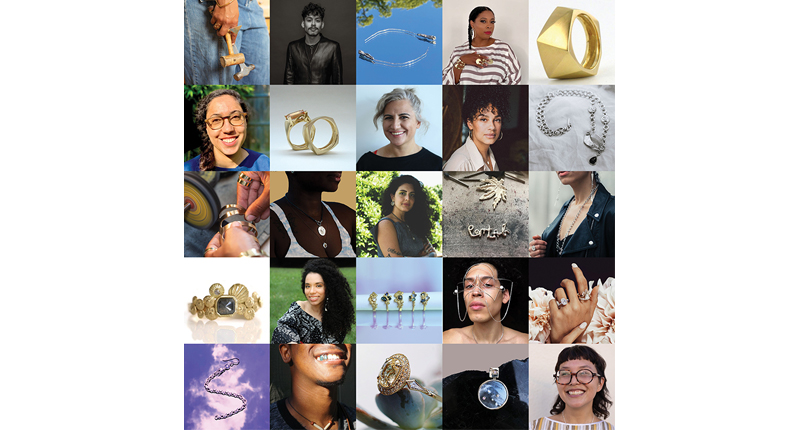
These are some of the BIPOC jewelry designers who signed the open letter to the industry. Starting top left, they are: Soelia, Lorraine West, Melanie Eddy, Merva Afshar, Maggi Simpkins, Julia de Souza, Robin Erfe and Peggy Portals. (Images courtesy of Angely Martinez/Collage by Shantell Batista)
Diversity also breeds innovation and helps retailers reach a broader audience—people who, in the past, might have felt left out because they don’t see themselves in a company’s advertising, staff or products, as well as those consumers who support the ideals of diversity and inclusion.
Just ask Rihanna.
In 2017, the singer and entrepreneur launched Fenty Beauty with the idea of offering “foundation for all”—makeup foundation in 40 shades (since expanded to 50) that matches every skin tone, from the fairest to the deepest.
The following year, the millennial mogul expanded her inclusionary ethos to a lingerie line, Savage x Fenty, which filled a void deliberately left unattended by the struggling dinosaur in that space, Victoria’s Secret.
With Savage x Fenty, Rihanna gave so many women what they had long wanted but could not find—lingerie modeled by women who looked like them and available in shades of “nude” that matched their skin tone.
Women of all shapes, sizes, colors and physical abilities appear in Savage x Fenty ads, and they strut around the stage at the brand’s fashion shows, a stark contrast to Victoria Secret’s parade of ultra-thin, mostly white women at its now-defunct annual fashion show.
Fenty Beauty and Savage x Fenty have both exploded in popularity, raking in millions in sales and helping to make Rihanna one of the richest self-made women in America, according to Forbes.
“She’s mastered inclusion. She’s mastered celebrating differences and not putting one characteristic above the others,” Taylor says. Rihanna’s emphasis on inclusion and diversity is a lesson for any industry.
“Read the room,” Taylor concludes. “What you personally think might not really matter when you’re running a business.”
Michelle Graffis the editor-in-chief at National Jeweler, directing the publication’s coverage both online and in print.