
Once the property of an Egyptian queen, the necklace was part of a larger exhibition of VCA jewelry at the Museum of Applied Arts (MAK).
Greenland Rubies: What We Know At This Point
A chat with Hayley Henning, of Greenland Ruby, about what the mining company’s discovered so far and what still needs to be done.

The rubies and pink sapphires coming out of Greenland are about ready to make their debut.
Greenland Ruby officially announced the start of production at Aappaluttoq in May, making headway on a project that stalled after the former owner of the license to mine the site, True North Gems, ran into financial troubles.
Aappaluttoq is Greenland’s first corundum mine, located about 155 miles south of Greenland’s capital, Nuuk. The deposit is primary type, meaning that the rubies are extracted from hard rock.
While scale and production numbers are still to be determined, the site could prove to be an important one, offering a consistent supply of gem-quality rubies and pink sapphires.
In effort to keep up with the project, I recently had a chat with Hayley Henning, vice president of sales and marketing at Greenland Ruby, about the company’s progress.
Greenland Ruby recently launched a new website, and Henning told me that the company also is working on the branding behind Greenland rubies and pink sapphires.
And now that the stones are coming out of the ground, a number of labs have and continue to get involved, Henning said, to look at both the material and the site.
Perhaps most importantly, though, Greenland Ruby is getting ready to bring some of its first stones to market, specifically as the gem and jewelry world converges in Hong Kong this week.
Read on for more of what Henning had to say.
National Jeweler: Since you started production earlier this year, what have you guys discovered about the stones themselves?
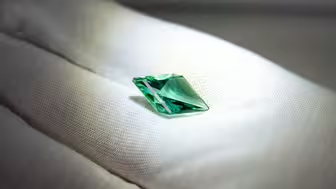
Hayley Henning: What’s coming out of the ground here is rubies and pink sapphires. Very often, in the colored gemstone world, it’s the origin that is so important and, of course, with these gems, the Greenland story is so special. With so many people, you get a reaction when they find out that Greenland produces gems, let alone that they’re rubies. From a product point of view, we know that the colors are excellent, deep, beautiful, saturated reds and then of course running the full gamut all the way down to the line of icy pinks, which of course would be the pink sapphires.
NJ: Will you be selling the gems as rough?
HH: Yes, we will be selling the rough. Greenland Ruby is, after all, a mining operation. We will be promoting the material in way that is meant to be
NJ: Now that you’re getting ready to launch the product, how will you be positioning it in the market and making it stand out from other rubies?
HH: That’s the million-dollar question. It really is all about the origin with these gems. It is ruby after all, and there is intrinsic value with ruby and with sapphire. But when we start talking about the origin, we really are talking about this pure, new, untouched environment. It is, in fact, the people of Greenland who have authorized the exploration of the site, as well as the sales and marketing of the material, because it is their material and we have their permission to go ahead and introduce the world to the Greenland ruby. And we’re really going to be talking about that because that is the point of differentiation, in the end.
NJ: Will you be launching marketing campaigns around them?
HH: We will. We’re not quite there yet, but we will eventually be doing that. We’re still in the process of selecting our preferred partners, and these are going to be people who are interested in telling the story along with us, interested in following that route to market, which everybody is so concerned about at the moment, being able to literally track the material from the moment it comes out of the ground. But, we have to do this anyway for export reasons--the Greenland government requires it--so that’s a tracking system we have in place.
Our partners will basically be on the same page as us. We don’t want to sell through an auction system and then (have) the material disappear into a factory in India or somewhere in Thailand. We will partner with these people who will be buying the rough and personally seeing it through so that we can follow that story. And we want them to tell the story as well.
At that point, after we have established partners, we will start working on marketing campaigns, depending on who those partners are. We are not at this stage saying, ‘This is how we’re doing it,’ because different manufacturers and different brands will have different ideas with how they want to do that. And we want to be a part of all of those processes.
“People who have seen the Greenland rubies say, ‘Oh it’s very fractured and it’s really not that great.’ But they haven’t seen anything that’s been properly produced, which is what we’re going to show now.” – Hayley Henning, Greenland RubyNJ: What exactly will your presence in Hong Kong entail?

HH: We don’t have a booth, but we have a series of meetings set up with potential customers where they can actually see what the material is and what it looks like. And we’ll be able to explain a little bit better, depending on what their needs are, how much of this material we’ll be able to provide over X amount of time. That’s also the goal with the Greenland material; because we’re a modern, mechanized mining operation, we will be able to know how much material we can produce.
This is something very unique in the colored gemstone industry, especially with rubies and pink sapphires, because there really isn’t much consistent supply of material where we can say--we could produce this material for the next nine years, and this is how it looks and this is what it’s going to cost. Because of that, people will be able to plan their collections.
NJ: So has nine years been established as the life of the mine?
HH: For this particular deposit, we’re looking at nine years, and exploration has identified two other sites that we will be able to go into after that.
NJ: Is there any idea what production will be in terms of number of carats?
HH: No. That’s a little difficult to determine at this stage. We don’t know that yet.
NJ: Have you started planning when the other deposits might be in production?
HH: Our geologists have mapped those projects, but we’re not really there yet. We still have to perfect what we’re doing here first. It is a hard rock deposit, so we’re fine tuning our processing plant so that we end up with a very rich concentrate and, of course, that’s what’s going to be key for our customers--trying to match the best customer with the best product.
NJ: How do you think that these rubies will compare in pricing in the market?
HH: Well that’s another big question. From a price point of view, while I never want to answer a question with ‘I don’t know,’ this series of meetings in Hong Kong is also just to sort of determine our place in the market. We want to get a feel for how people respond to the material. The prices will certainly be market-driven. We have to see exactly what people’s expectations are, balancing that with, of course, what happens at the mine. And then we want to determine, over time, how that will work for everybody’s business.
NJ: So Hong Kong will act as a kind of launching pad for figuring all of that out?
HH: Yes. Exactly. It’s so difficult to put prices on anything because you don’t really know what people are willing to pay. And it depends on what the contract entails and how much they’re interested in buying. There are a lot of different things that come into actual pricing. We’ll see. But certainly the very unusual and exclusive location is what makes this material so different from anything else.
Of course what’s key, too, is all of this talk about responsible sourcing and the responsibility of Greenland Ruby as a company, not only to the people of Greenland but within the industry. We’re actually producing something that is responsible and something that people will really be able to identify from other sources of ruby or pink sapphire because our intention is to keep it separate.
And tracking mine to market is a pretty big part of what it’s all about. This is really the first time that the Greenland government has ever done anything like this. This is really the first big sort of licensing permit that they’ve issued, so it’s unique, and we will, for that reason, be able to keep it separate for a fair amount of time. Then, as I said, it will go into the hands of our partners, who will have agreed to treat the material in the same way and follow the story through to the brands and manufacturers.
NJ: I know you said it’s too early to know exactly what form the marketing will take, but do you think it will include consumer-facing campaigns as well?
HH: Absolutely. It’s much easier today with all the social media that we do; we’re going to be hitting all of those marks with our social media and, obviously, wherever we can as best we can just to drive awareness, and to create pull and desirability and interest. It’s still very early days with this project, so we’ll see how it all rolls out. But we’re very excited.
People do seem to be interested beyond our industry. Everybody, for a start, knows what a ruby is; there’s no explanation needed there. But then they get excited when they hear about Greenland. It’s really not on people’s radars, so they’re fascinated by this idea of finding something red and very precious and rare in this sort of white iciness. It conjures up something very interesting.
People who have seen the materials so far seem to be pleasantly surprised. I think in the past there have been some rumors (about the quality). It’s a hard rock deposit, so it’s tough mining environment there, and because it’s a primary deposit in hard rock, much of the material is fractured. That is the nature of the material. It’s very normal in a primary deposit. It’s been buried under ice and glaciers, and there’s been a huge amount of pressure for millions of years.
There has been some artisanal mining there, which is definitely not easy. It has been done since the 1960s, so some people who have seen the Greenland rubies say, ‘Oh it’s very fractured and it’s really not that great.’ But they haven’t seen anything that’s been properly produced and properly processed, which is what we’re going to show now.
NJ: So with it being so fractured, does that mean it comes in smaller sizes, needs treatment, etc.?
HH: It does come in smaller sizes and does mostly need treatment, which is quite normal for most corundum material. We will be showing the results of some of those treatments and how this material really is, or can be sold commercially as a new and different source.
The Latest

The labs’ separate investigations each determined that the East African country is producing copper-bearing tourmaline.

“Chicago Collects: Jewelry in Perspective” at the Oshkosh Public Museum will feature works by Fabergé, Lalique, and Louis Comfort Tiffany.

Submit your pieces for a chance to win in this year's competition.

The “Worn Well” collection is Catbird's take on classic men's jewelry.


This Buddha Mama butterfly is our Piece of the Week honoring the legend, who embraced the beautiful insect as her symbol.

The former De Beers CEO, and perhaps its next owner, will be a featured speaker at the event, slated for Sept. 4-7 in Italy.

Retailers are seeking new ways to attract customers, increase traffic, and create revenue – Estate buying events are a popular solution.

The employee-owned jeweler was named a “Best Place to Work” in Maine, New Hampshire, and for women.

The second iteration of the jewelry collection was inspired by the zodiac and the four elements: earth, water, air and fire.

General License 104B supersedes General License 104A, which was set to expire on Sept. 1.

The package, intercepted in Indianapolis, contained fake Cartier, Tiffany & Co., and Van Cleef and Arpels jewelry.

The new location in Costa Mesa, California, marks the brand’s second store in the United States and fourth standalone location worldwide.

The fashion watch category was once threatened by the Apple Watch, but consumers are now opting for new wearables, said Movado’s CEO.

The report delves into trending styles, the most popular jewelry brands by city, and why Belle Époque jewelry could be the next big thing.

The association added the requirement to its revised "Code of Ethics" and released the 17th edition of its “Gemstone Information Manual.”

Respondents were concerned about the future of the labor market and their income as well as the rising prices of gas and groceries.

The campaign highlights the asymmetrical high jewelry necklace style that the jeweler first created in 1879.

It will explore the life of “The King of Diamonds” and showcase more than 165 creations from the brand.

Two suspects have been arrested in connection with the complex phone scam.

In her first column for National Jeweler, Jennifer Shaheen asks jewelers if they know how to connect with the next generation of consumers.

The annual awards cover tuition for an on-site educational course at the Swiss lab, as well as flights and lodging.

The jeweler partnered with the Tennessee resort to honor its 50th anniversary with limited-edition blackberry pendants and earrings.

The class, led by renowned metalsmith Cynthia Eid, highlighted Argentium silver as an alternative to gold amid high prices.

The show is slated for Oct. 16-19 at the Miami Beach Convention Center.

The “Empresses” capsule uses 19th-century medals depicting Napoleon, Joséphine, and Marie-Louise across five one-of-a-kind pieces.

The retailers at the top of the list offer affordable products and fun, discovery-fueled experiences.