

Editors

Where Victoria’s Secret Went Wrong

EditorsFeb 28, 2020

Where Victoria’s Secret Went Wrong

The once-mighty retailer’s recent struggles are a testament to the importance of listening to your customers, Associate Editor Lenore Fedow writes.

20200228_Victorias_Secret.jpg
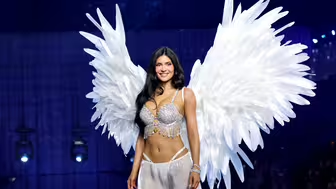
Victoria’s Secret has been called out for a lack of diversity in its advertising and offerings, and it may be too little, too late for the retailer to make a meaningful change. (Image courtesy of Victoria’s Secret)

The last time I entered a Victoria’s Secret store was a few years ago. My direct deposit had just hit my bank account, and I was ready to shop.

I bypassed a row of sequined bustiers and piles of frilly things to head into the more casual section of the store, where I found myself flipping through hanger after hanger, searching in vain for my size.

I knew I was at the very limit of the retailer’s size range and that not all styles were available in my size, but surely, I thought, there was something for me somewhere in the store.

Finally, I asked an employee where I could find something in my size. She pursed her lips and gave me a judgmental once-over.

“Online,” she spat.

I suppose my face gave away my disappointment, and she offered to check in the back for me.

You could’ve blown dust off the beige grandma-looking bra she brought back, and it had a $50 price tag hanging off it. I thanked her for trying and left empty-handed.

All of this is why when I heard last week that parent company L Brands was selling Victoria’s Secret amid declining sales, I was not surprised and, truthfully, a little giddy.

Putting my pettiness provoked by past experiences aside, here’s where Victoria’s Secret went wrong, and why all retailers should consider the comedown of this once-mighty retailer a cautionary tale.

It offered limited options.

After I parted ways with Victoria’s Secret, I began scoping out a new place to buy bras, and I found myself in Lane Bryant, a retailer that focuses on plus-sized clothing and, interestingly enough, once was owned by L Brands.

At a size 14, I’m at the low end of the store’s clothing offerings, but its in-store Cacique intimates brand was a treasure trove.

There was no boring beige here. Every color, print, size and style I could imagine was there for the taking, hung up neatly on a rack, not buried beneath a tower of extra-smalls or hidden away in the back, collecting dust.

The bras were beautiful and comfortable, and after seeing what the experience could be, I happily handed over my money, walked out with a full bag and never looked back.

The moral of the above bra-shopping anecdote is one retailers should already know: If you’re not providing me with what I want, I will go elsewhere.

Whether we’re talking about lingerie or jewelry, consumers are demanding more options.

In

fine jewelry, customization is a growing trend with an increasing number of customers looking to add personal touches, particularly in the engagement ring space.

A survey The Knot released late last year found that nearly half of new rings purchased for an engagement included some custom details.

With a slew of retailer options available to shoppers, the “take-it-or-leave-it” attitude toward customers just isn’t going to cut it anymore.

It refused to evolve, even in the face of increasing competition.

It seems I was not the only Victoria’s Secret shopper who went elsewhere.

The lingerie brand had a rough holiday season, with in-store sales down 8 percent year-over-year and same-store sales for both the in-store and online channels slipping 1 percent.

Parallel to the jewelry world, there were a ton of online brands, like Adore Me and ThirdLove, ready and willing to scoop up the customers Victoria’s Secret was leaving out by limiting its sizes and not stocking enough larger sizes in store.

Understandably, not every brand can cater to every shopper, but plus-size customers are not a niche.

The average American woman wears a size 16 to 18, according to data from Coresight Research, and the U.S. plus-size market is expected to grow to $24 billion in by 2020 with an annual growth rate nearly double that of the total clothing market.

In malls, where the vast majority of the retailer’s stores are located, foot traffic has been slowing, prompting retailers to think up creative ways to bring in customers and keep them coming back.

Victoria’s Secret is lacking in innovation at a time when it is needed most, offering customers only the occasional coupon and promotion.

New competitors, meanwhile, are thinking outside of the box.

Adore Me, an online lingerie brand, offers sizing from petite to plus, with the option to join a subscription service and receive a new bra and panty set every month, as well as a rewards program to earn free bras.

Victoria’s Secret has a rewards program, but it is available only to those who sign up for its store-brand credit card.

Even when the brand got it right, it found a way to go wrong.

The Victoria’s Secret swimsuit line, a noted favorite among fans of the brand, was discontinued in 2016, prompting an outcry for its return.

It was brought back in 2019, at a higher price point and in a narrow range of generic sizes—sizes XS to L rather than its previous sizing by bra size—and only available online, shutting out customers who prefer to try a swimsuit on in person, which could be an opportunity to boost foot traffic in its stores.

In terms of fashion trends, while Victoria’s Secret continued to push sex appeal, athleisure continued to grow in popularity, with more shoppers opting for comfort over sexiness.

Comfort and support, in fact, are the top priorities for U.S. women buying a bra for themselves while sexiness comes in eighth place, as per The Bra Evolution, a 2019 report from The NPD Group.

ThirdLove, another online intimates company, put the focus on comfort and offers 78 sizes, including half-cup sizes.

The company also answered the growing call for diversity in both representation and selection, offering its “nude” bras in a variety of earth tones to match a wide array of skin tones.

Victoria’s Secret, however, remained unbending in the face of change and committed a cardinal sin of retail—not listening to your customers.

It has a ‘you-can’t-sit-with-us’ problem.

While other brands were welcoming in more customers, Victoria’s Secret was giving off a less-than-friendly vibe.

Ed Razek, the brand’s former chief marketing officer, came under fire following a 2018 interview with Vogue in which he said that “no one had any interest” in plus-size models and that the brand’s annual fashion show would not include transgender models because “the show is a fantasy.”

For blogger Alysse Dalessandro Santiago of Ready to Stare, which shares her experience of being plus-size and a member of the LGBTQ community, the comments told everyone else what her communities had known for a while.


The unspoken message from the brand’s limited sizing and posters plastered with thin models had made it clear: You’re not welcome here.

Razek’s comments insulting consumers who couldn’t shop there anyway likely wouldn’t have hurt the retailer’s bottom line, Dalessandro Santiago observed, but the impact was greater than that.

It was standard-sized customers, who have many shopping options available to them, that were pushed away, she said. They became uncomfortable when the brand’s long-time exclusionary message—heard loud and clear by others a long time ago—was finally spoken out loud.

Competitor ThirdLove hit back at the retailer via a full-page ad in the Sunday New York Times, signed by co-founder and co-CEO Heidi Zak.

“How in 2018 can the CMO of any public company—let alone one that claims to be for women—make such shocking, derogatory statements?” the letter stated, while criticizing the retailer for pushing an outdated narrative on what “sexy” should be.

At a time when retailers across industries were promoting inclusion and feeling good about who you are and how you look, Victoria’s Secret continued to shut out potential customers.

A December 2018 article in The Atlantic by Amanda Mull titled “Victoria’s Secret Has a Mean-Girl Problem,” summed up the retailer’s vibe perfectly.

“For years, Victoria’s Secret has been the brand equivalent of the stereotypical cool-girls’ table in a high-school cafeteria: hot, unfriendly, and definitely not interested in bolstering your self-worth,” Mull wrote.

It failed to act when aspirational became exclusionary.

Most shoppers still want to sit with the cool girls, but they want to see some new faces at the table.

“There’s this ongoing idea that the beauty we see in advertising should be aspirational,” blogger Dalessandro Santiago said.

“If brands really listened to consumers, they would see that customers want advertising that is relational.”

To her point, my experiences at Victoria’s Secret and Lane Bryant were like night and day, and feeling welcomed made all the difference.

The models on the in-store branding looked beautifully normal and the mannequins curved at more than the waist.

I could see myself in its products, not how I’d look in a fantasy or after I dropped 20 pounds, but right there and now, just as I was.

“Having an ad that is representative of your customer is the most important thing in advertising,” Dalessandro Santiago said.

Victoria’s Secret built its business model on aspirational beauty, she added, and when the tides turned away from that ideal, instead of taking that opportunity to be inclusive, they doubled down.

When it did change it was too little, too late.

Retailers striving for diversity and inclusivity should be mindful of looking like they’re just riding the wave.

“As consumers, it’s easy to tell when a brand is being diverse or inclusive for the purpose of just looking diverse or inclusive,” Dalessandro Santiago said.

People in underrepresented communities are wary of pandering, and it’s easy to suss out, she added.

This was arguably the case when Victoria’s Secret hired its first transgender model, Valentina Sampaio, and its first size 14 model, Ali Tate Cutler, only after public outcry.

When you compare Victoria’s Secret model lineup to, for example, Rihanna’s Savage X Fenty lingerie runway show last year, which featured women of all sizes, races, ethnicities as well as transwomen and disabled women, there is no comparison.

Victoria’s Secret’s annual televised fashion show, known for featuring almost exclusively thin, white models, was cancelled in 2019 due to dwindling audiences and growing public criticism while Rihanna’s show was well-received by critics and social media.

The lesson here, for all retailers: There is a difference between throwing one or two diverse models into a campaign and making a concerted effort to do better, and consumers can tell who means it.

How Independent Retailers Can Get Onboard

Small businesses are better at authenticity, Dalessandro Santiago said, and there’s less overhead in the way of projecting a message of inclusivity and diversity.

In addition to her blog, Dalessandro Santiago has experience as a small business owner, previously selling her own designs on her website.

“I was the CMO, CEO, CFO, I was everything. It’s not that hard to put a casting call out and find hundreds of people.”

For retailers looking to avoid pandering, she said, it’s crucial to make an ongoing effort to be more inclusive.

Show through action how you are investing in the communities, such as by casting LGBTQ models or hiring plus-size workers, she said.

In terms of diversity, it’s usually smaller businesses that set the tone, with larger businesses taking notice and following suit, she added.

Victoria’s Secret squandered that opportunity, remaining loyal to an outdated beauty ideal instead of to its customers.

With strong name recognition and a global presence, it was Victoria’s Secret’s market to lose, and it did indeed cede a huge chunk of business due to its unwillingness to change.

Though the brand still holds the largest slice of the $13 billion U.S. lingerie market, its share fell to 24 percent in 2018 compared with 32 percent in 2013, as per Euromonitor data.

Meanwhile, American Eagle’s Aerie brand, which is known for not retouching its models, doubled its piece of the pie during that same time period.

Victoria’s Secret fell to No. 13 on investment firm Piper Jaffray’s semi-annual Taking Stock with Teens survey in fall 2019 from its No. 5 spot in spring 2018, while American Eagle was in second place.

The lesson to be learned by retailers in any industry—remaining stubborn in the face of change will cost you market share and customers.
Lenore Fedowis the senior editor, news at National Jeweler, covering the retail beat and the business side of jewelry.

The Latest

Deutsch & Deutsch jewelers team
MajorsJan 23, 2026
Watches of Switzerland Acquires 4-Store Jewelry Chain in Texas

Family-owned jewelry and watch retailer Deutsch & Deutsch has stores in El Paso, Laredo, McAllen, and Victoria.

Baume & Mercier Riviera 10812 pink watch
WatchesJan 23, 2026
Damiani Group to Acquire Baume & Mercier

The Italian luxury company purchased the nearly 200-year-old Swiss watch brand from Richemont.

Martin Katz snowflake earrings
TrendsJan 23, 2026
Martin Katz’s Earrings Call to Mind Wintry Weather

Micro-set with hundreds of diamonds, these snowflake earrings recreate “winter’s most elegant silhouette,” and are our Piece of the Week.

JamAlert 1872x1052.png
Brought to you by
How Jewelers Can Fight Back Against Cell Jammers

Criminals are using cell jammers to disable alarms, but new technology like JamAlert™ can stop them.

Ella Blum
MajorsJan 23, 2026
Rembrandt Charms Names New Director of Creative, Brand Strategy

Ella Blum was appointed to the newly created role.

Weekly QuizJan 22, 2026
This Week’s Quiz
Test your jewelry news knowledge by answering these questions.
Take the Quiz
National-Jeweler_1872x1502_B copy.png
Supplier BulletinJan 22, 2026
The Rise of Centralized Sourcing in the Colored Gemstone Market

Sponsored by RapNet

Lugano Diamonds Greenwich Connecticut store
MajorsJan 22, 2026
Lugano Diamonds Finds a Buyer

Investment firm Enhanced Retail Funding, a division of Gordon Brothers, was the successful bidder.

Recipients Collage 2025 - NJ (1872 x 1050 px) (1872 x 1052 px).png
Brought to you by
Impacting Tomorrow Today

How Jewelers of America’s 20 Under 40 are leading to ensure a brighter future for the jewelry industry.

A Diamond Is Forever book
SourcingJan 22, 2026
De Beers To Release ‘A Diamond Is Forever’ Book

It explores the history of the iconic tagline and the company’s strategy to redefine the role of diamonds in society.

Sindhu Culas
MajorsJan 22, 2026
Swarovski Appoints New North America President

Retail veteran Sindhu Culas has stepped into the role.

Taylor Burgess
MajorsJan 22, 2026
Stuller Names New Chief Merchandising, Marketing, Sales Officer

Taylor Burgess, who has been at Stuller since 2013, was promoted to the newly created role.

My Next Question podcast with Sherry Smith and Edahn Golan
PodcastsJan 21, 2026
Episode 1: High Gold Prices, the Diamond Dilemma, & What’s Next

Was 2025 a good year for jewelers? Did lab-grown diamonds outsell natural? Find out on the first episode of the “My Next Question” podcast.

Columbia Gem House celestial shapes
SourcingJan 21, 2026
Tucson Preview 2026: Earthy Tones and Innovative Shapes

Buyers are expected to gravitate toward gemstones that have a little something special, just like last year.

Gavel and books stock image
CrimeJan 21, 2026
4 Men Charged in $1.7M California Smash-and-Grab Jewelry Store Robbery

Plus, JSA’s Scott Guginsky discusses the need for jewelers to take more precautions as the gold price continues to climb.

Felice Korr Morris
IndependentsJan 21, 2026
Delaware Jeweler Felice Morris Dies at 91

Morris’ most cherished role was being a mother and grandmother, her family said.

Bulgari Vimini Collection Campaign
CollectionsJan 21, 2026
Bulgari Weaves New Collection of ‘Vimini’ Creations

“Vimini” is the first chapter of the “Bulgari Eternal” collection that merges archival pieces with modern creations.

The Ritz-Carlton Half Moon Bay California
Events & AwardsJan 21, 2026
Jewelers Mutual’s ‘Conversations’ Retreat Returns to Discuss AI

The third edition will be held in Half Moon Bay, California, in April.

Hiba Husayni, Jules Kim, Johnny Nelson, Dorian Webb, Lorraine West
Events & AwardsJan 20, 2026
These Are the 5 Finalists for the David Yurman Gem Awards Grant

The grant is in its first year and was created to recognize an exceptional fine jewelry designer whose star is on the rise.

Emmanuel Raheb, National Jeweler columnist and CEO of Smart Age Solutions
ColumnistsJan 20, 2026
First-Party Data Is the Most Valuable Asset Jewelers Have in 2026

Data built on trust, not tracking, will be key to success going forward, as the era of “borrowed attention” ends, Emmanuel Raheb writes.

Heath Yarges
MajorsJan 20, 2026
Borsheims Hires New Assistant Facilities Manager

Heath Yarges brings two decades of experience to the role.

Buccellati Opera Tulle ring
FinancialsJan 16, 2026
Richemont’s Jewelry Brands Shine in Q3

Cartier, Van Cleef & Arpels, Buccellati, and Vhernier had another successful holiday season, Richemont reported this week.

Lagos SML High Jewelry Bee Brooch
TrendsJan 16, 2026
Diane Lane's Brooch Buzzes at the 2026 Golden Globes

Our Piece of the Week is Lagos’ “Bee” brooch that was seen on the red carpet for the first time on Sunday.

Gavel
CrimeJan 15, 2026
D.C. Rapper ‘Taliban Glizzy’ Sentenced to 18+ Years for Jewelry Store Robberies

Trevor Jonathan Wright led a crew in a string of armed robberies targeting South Asian-owned jewelry stores on the East Coast.

Jewelers of America 20 Under 40 Program
Events & AwardsJan 15, 2026
Jewelers of Americas’ ‘20 Under 40’ Nominations Now Open

The program recognizes rising professionals in the jewelry industry.

The Venetian Expo Las Vegas
Events & AwardsJan 15, 2026
Registration for JCK Las Vegas 2026 Is Now Open

A new lifestyle section and a watch showcase have been added to this year’s event.

Avocados From Mexico Golden Double Dip Chip
TrendsJan 15, 2026
Don’t Double-Dip With This Golden Chip

Avocados From Mexico is celebrating those who love to double-dip in game day guacamole with a 14-karat yellow gold tortilla chip necklace.

41.82-carat rough blue diamond recovered from the Cullinan Mine
SourcingJan 15, 2026
Nearly 42-Carat Blue Diamond Discovered in South Africa

Petra Diamonds unearthed the 41.82-carat, Type IIb blue diamond at the Cullinan Mine.

×

This site uses cookies to give you the best online experience. By continuing to use & browse this site, we assume you agree to our Privacy Policy