









CrimeJun 30, 2022
What JSA’s Annual Report Tells Us About Jewelry Crime in 2021TechnologyJul 12, 2022
Graff’s Ransomware Payment Not an Unusual Move, Expert Says
The high-end jeweler reportedly paid a $7.5 million ransom to a group of hackers and is suing its insurance company to cover the loss.


London—Graff Diamonds reportedly paid a $7.5 million ransom in Bitcoin to the hackers responsible for a ransomware attack on its systems last fall, a decision that is not unusual for large companies today, one expert says.
Ransomware is malware that uses encryption to hold a victim’s system or personal data hostage, basically, and demands payment to get them back.
Following the attack on Graff, Conti, the group that took credit for it, leaked data about the brand’s clients, such as their names and, potentially, their home addresses.
Graff counts many high-end clients and celebrities as customers, and the data breach included leaked data about the royal families in Saudi Arabia, the United Arab Emirates, and Qatar, prompting Conti to issue an apology to the families involved, an unusual move for the group.
Conti threatened to leak more of Graff’s data if the ransom wasn’t paid.
Though it tried to avoid paying, the high-end jeweler eventually offered $7.5 million, half the original ransom amount, and Conti accepted, according to Bloomberg, which broke the story. The jeweler paid in Bitcoin.
Graff is also suing its insurance company, The Travelers Companies Inc., in a London court for the losses, arguing that its policy should cover the ransom payment.
“The criminals threatened targeted publication of our customers’ private purchases. We were determined to take all possible steps to protect their interests and so negotiated a payment that successfully neutralized that threat,” a Graff spokesperson told National Jeweler.
“Regrettably, these commercial decisions are all too common these days. Insurers know this, which is why we are extremely frustrated and disappointed by Travelers’ attempt to avoid settlement of this insured risk. They have left us with no option but to bring these recovery proceedings at the High Court.”
The Travelers Companies did not respond to a request for comment by press time.
Related stories will be right here …
Ransomware is malware that uses encryption to hold a victim’s system or personal data hostage, basically, and demands payment to get them back.
Following the attack on Graff, Conti, the group that took credit for it, leaked data about the brand’s clients, such as their names and, potentially, their home addresses.
Graff counts many high-end clients and celebrities as customers, and the data breach included leaked data about the royal families in Saudi Arabia, the United Arab Emirates, and Qatar, prompting Conti to issue an apology to the families involved, an unusual move for the group.
Conti threatened to leak more of Graff’s data if the ransom wasn’t paid.
Though it tried to avoid paying, the high-end jeweler eventually offered $7.5 million, half the original ransom amount, and Conti accepted, according to Bloomberg, which broke the story. The jeweler paid in Bitcoin.
Graff is also suing its insurance company, The Travelers Companies Inc., in a London court for the losses, arguing that its policy should cover the ransom payment.
“The criminals threatened targeted publication of our customers’ private purchases. We were determined to take all possible steps to protect their interests and so negotiated a payment that successfully neutralized that threat,” a Graff spokesperson told National Jeweler.
“Regrettably, these commercial decisions are all too common these days. Insurers know this, which is why we are extremely frustrated and disappointed by Travelers’ attempt to avoid settlement of this insured risk. They have left us with no option but to bring these recovery proceedings at the High Court.”
The Travelers Companies did not respond to a request for comment by press time.
Shayne Caffrey, marketing manager and cybersecurity awareness training lead for LeeShanok Network Solutions, echoed what Graff Diamonds said it its statement—ransom payouts like this are fairly common today.
“Deciding whether to pay the ransom is a cost/benefit analysis. It can make a lot of sense to pay up when you can’t safely restore from a backup,” he said in an email to National Jeweler.
Once a business does decide to pay, it becomes a negotiation, going back and forth on price like in any deal until it becomes worth it for both sides.
“In this case, the initial $15 million demand may not have been worth it, but $7.5 million was,” Caffrey said. “Hackers would rather get something than nothing. This calculated approach means ransoms get paid more often than any of us would like.”
He also noted there’s rarely a guarantee that hackers will unencrypt the data even once the ransom is paid.
Caffey offered businesses two recommendations to reduce the chances of becoming a victim of cybercrime.
The first is to require every employee to undergo cybersecurity awareness training annually, with a particular focus on phishing prevention.
According to IBM, 95 percent of breaches result from human error, and the only way to fix that is through education, he noted.
But rather than using the common online training modules, Caffrey suggested bringing in a cybersecurity expert to deliver a live training, either in-person or virtually.
“In my experience, those trainings are much stickier.”
The second tip is to create a strong Backup and Disaster Recovery (BCDR) Strategy.
“Implementing these strategies can seem expensive on the surface, but they are often a fraction of the cost of paying a ransom, or even paying increased insurance premiums after a breach,” Caffrey said.
“Plus, it feels a lot better to restore your environment to a pre-ransomware instance than to reward the hackers by paying a ransom.”
More tips businesses can use to protect themselves from the Jewelers Security Alliance can be found in National Jeweler’s original story reporting on the Graff attack.


More on Technology

The Latest

SourcingOct 27, 2026
De Beers Celebrates the Holidays With New ‘Desert Diamonds’ CampaignThe “Icons” holiday campaign spotlights four classic diamond jewelry styles reimagined in “Desert Diamond” tones.


IndependentsOct 27, 2026
Solomon Brothers Acquires Mervis Diamond ImportersSolomon Brothers, which has three stores in the Metro Atlanta area, said it may continue to acquire other independent jewelers.


IndependentsOct 27, 2026
Gabriel & Co. Supports Charity Partner DKMS With Gala, New JewelsThe fine jewelry brand raised $2.3 million at its annual gala that supports the nonprofit’s fight against blood cancer and blood disorders.

Brought to you by
A Diamond Is Forever Launches 2026 Holiday Campaign Championing Natural DiamondsA Diamond Is Forever's holiday campaign reimagines natural diamond icons for a new generation celebrating individuality.


Events & AwardsOct 27, 2026
JFC Announces 2027 ‘Facets’ HonoreesThe annual fundraising event is slated for June 6, 2027, at The Venetian Resort in Las Vegas.
Weekly QuizOct 22, 2026
This Week’s QuizTest your jewelry news knowledge by answering these questions.


CollectionsOct 26, 2026
Bliss Lau’s ‘Vantage’ Point Is the Hawaiian HorizonIn her “Vantage” collection, Lau explores heritage, identity, and inner strength through designs featuring blue-green Guatemalan jade.

MajorsOct 26, 2026
Tiffany & Co. Takes Consumers Behind the ScenesThe jeweler gave the public backstage tours of its flagship store and its design and innovation workshop as part of LVMH’s open house.


Brought to you by
Open an Account, Get $50 Off Your First Order. No Code Needed.Built on Relationships. Refined by Craft.


Events & AwardsOct 26, 2026
Support JFC’s ‘Monster Mash Challenge,’ If You DareVote for which jewelry professional should dress up as a monster to support Jewelers for Children’s annual Halloween fundraiser.

MajorsOct 23, 2026
PGI USA Set to Close at Year’s EndThe closure is part of a global restructuring that also includes PGI winding down its operations in Japan, South Korea, and Hong Kong.

SourcingOct 23, 2026
Rachel Chalchinsky’s ‘Survivor Tribute’ RingThe ring, our Piece of the Week, was designed by eight-year breast cancer survivor Rachel Chalchinsky of Color Source Gems.

FinancialsOct 23, 2026
Kering’s Jewelry Sales Up Double Digits in Q3Boucheron and Pomellato had a strong third quarter, with Kering looking at jewelry as an increasingly important part of its portfolio.

CrimeOct 22, 2026
Jeweler Shot and Killed in His Suburban Cincinnati Store Tara Sinchuri was the owner of Everest Jewels in Fairfield, Ohio, and a father of three. He was found dead in his store on Tuesday.

MajorsOct 22, 2026
Neiman Marcus Has Gifts for the Jewelry Lover Who Has EverythingBespoke experiences from Buccellati and Verdura are on the retailer’s 2026 “Fantasy Gifts” list.

Events & AwardsOct 22, 2026
JIS Fall 2026 Reports Record-Breaking Attendance The number of participants at the fall show was up 12 percent.


CollectionsOct 22, 2026
Billie Eilish, Finneas Co-Design Collection for John HardyThe Academy and Grammy award-winning siblings have collaborated with John Hardy on a new jewelry line inspired by their personal style.


PodcastsOct 21, 2026
Episode 10: This Episode Is Haunted Diana Singer shared the stories of two “cursed” diamonds on this month’s podcast, which was inexplicably riddled with technical issues.

IndependentsOct 21, 2026
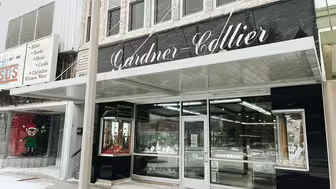
Gardner-Collier Jewelry to Close After 9 Decades in BusinessThe family-owned jeweler has three locations across Missouri and Iowa.

SourcingOct 21, 2026
Venetia Mines Final Carats Ahead of 2-Year ShutdownThe De Beers-owned diamond mine in South Africa is being put on ice as part of a round of previously announced cost-cutting measures.

CollectionsOct 21, 2026
Helzberg, Nordstrom Carrying New Jewelry Collection From Off-WhiteThe collection centers designs with clean geometric lines, chunky sculptural pieces, and recognizable details from the luxury fashion brand.
SourcingOct 21, 2026
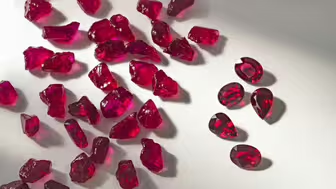
Gemfields’ Mixed-Quality Ruby Auction Earns $52MThe miner said it saw particularly strong prices for larger, fine-quality rubies at the sale.

CrimeOct 20, 2026
Security Guard Charged With Murder in Shooting at Texas MallThe guard opened fire on a man who was smashing a jewelry display case at La Gran Plaza in Fort Worth last week, police said.

IndependentsOct 20, 2026
David Gardner’s Jewelers Unveils Newly Expanded, Revamped ShowroomThe Texas jeweler added 2,000 square feet to its reimagined showroom, complete with a new design studio and an event space.

SourcingOct 20, 2026
The $50M Victoria’s Secret ‘Fantasy Bra’ By The NumbersJacob & Co.'s diamond masterpiece is the most expensive Fantasy Bra ever worn on the Victoria’s Secret Fashion Show runway.

CollectionsOct 20, 2026
Mignon Faget’s Collection Chooses Handmade Over AIThe “Atelier” collection was inspired by the tools, rituals, and objects in an artist’s studio as a quiet rebuttal to an automated world.
MajorsOct 19, 2026
The Knot to Acquire Rival Wedding Planning Platform ZolaThe pending acquisition is an “exciting opportunity” for wedding vendors to grow their business, said The Knot Worldwide’s CEO.

SourcingOct 19, 2026
Jewelry Design Competition Show Airs in Thailand"The Secret Gems" features eight Thai jewelry brands paired with a team of young craftspeople who create jewelry together to win challenges.