






Events & AwardsMay 22, 2026
Instore Buys JA New York ShowThe deal closed this week, which means Instore will produce the JA NY show slated to take place this fall.





The judge’s latest ruling in its battle with Costco likely left Tiffany feeling a little blue. But the legal battle between these two retail giants over the term “Tiffany” in relation to engagement ring settings is still in its early stages, and no one side has a clear advantage.


New York--Though it’s a company that makes its money selling in bulk, Costco likely is fine with notching legal victories in its battle with Tiffany & Co. one by one.
On Jan. 17, a federal judge ruled that Costco Wholesale Corp. could proceed to trial with its argument that the word “Tiffany” in the context of ring settings is now a generic term used to describe any solitaire diamond ring setting with six prongs and, therefore, is no longer a trademark.
In her ruling, U.S. District Judge Laura Taylor Swain wrote that while none of the evidence presented by Costco is conclusive, it is “sufficient to frame a genuine factual dispute as to whether the terms ‘Tiffany’ and/or ‘Tiffany setting’ have a primarily generic meaning in the minds of members of the general public in the context of ring settings.”
Tiffany originally filed suit against Costco in February 2013, charging the Issaquah, Wash.-based warehouse retailer with trademark infringement for selling engagement rings identified as “Tiffany” even though Tiffany has never sold its rings through Costco.
The win was an important one for Costco, but the battle between these two retail giants--both of which rank in the top 10 in U.S. fine jewelry sales--has only just begun, one Chicago attorney says.
In a recent interview with National Jeweler, Emily Miao, a partner at McDonnell Boehnen Hulbert & Berghoff LLP in Chicago, and associate Nicole E. Grimm talked about the ruling’s impact on the case overall.
Miao says it evens the odds in a case where Tiffany once held a very slight edge. It also brings to light a simple question: Was pursuing a lawsuit in Tiffany’s best interest?
She says no. The New York-based jeweler issued a cease-and-desist letter, and Costco removed the offending signage that contained the word “Tiffany.”
Tiffany, Miao says, should have left it that. “Essentially, they used a cannon to kill a fly when a flyswatter would have been enough,” she says. “Now they realize Costco is going to fight them. And they were not expecting Costco to put up this kind of fight.”
Trial dates in the case will be set at the final pre-trial hearing, which is scheduled for June 27.
National Jeweler: What is the significance of the judge’s latest ruling in the Tiffany vs. Costco case?
Emily Miao: She had ruled that Costco may proceed with its
Costco’s evidence of genericism is enough to bring the issue to trial. The judge in this case is not going to allow Tiffany to get summary judgment on Costco’s counterclaim. This is what we would consider a win for Costco, at least for getting the main argument into trial.
Nicole E. Grimm: The case is going to go forward on this issue and it doesn’t get dismissed as Tiffany had asked.
NJ: What is the next step in the case? Does Tiffany have the ability to appeal this decision?
EM: What Tiffany can do is a file a request for reconsideration on their summary judgment motion asking to dismiss Costco’s counterclaim. But those type of reconsiderations requests are almost doomed. They will probably not prevail.
NJ: Why are they usually doomed?
EM: They are going to have to show the judge in this case what information she overlooked that was part of their original motion. If there was anything that was important that should have been seen, it would have been in that motion. They probably will not succeed.
Tiffany has until June 27 to file other motions. It can look for other issues and use that to file motions. It doesn’t mean they can’t do anything between now and when the trial occurs.
NJ: How, in your eyes, does this decision impact the landscape of the case?
EM: It is a win for Costco in one sense, but the war has barely started. The decision, even though it was important for Costco, really doesn’t impact the case. [Costco’s] main defense is the genericism argument that they are making. The fact that the judge is allowing it to go to trial is important to Costco.
[But] the judge also said that the evidence that Costco presented of genericism is not conclusive.
NJ: Where do you see this case heading?
EM: The case is going to be a trial by jury. It’s going to be really hard to predict how the jury will decide in this case. Tiffany is such a well-known, venerable brand. I think it would be hard to find anyone (for the jury) who hasn’t heard of Tiffany and thought about it in a positive way.
[But] if Costco’s evidence of genericism is compelling then that would sway a jury as well. Tiffany is going to be put in a strange position in trying to differentiate between their own branded rings and Tiffany-style ring settings. It’s going to be tough. I am not exactly sure how Tiffany is going to deal with this issue.
NG: The judge is allowing the jury, essentially, to decide whether the term “Tiffany” and the term “Tiffany setting” is generic, even though Costco was only using the word “Tiffany” in its signage.
The point of interest here is that the judge in the opinion found that there was a genuine dispute of fact as to whether the terms “Tiffany” and/or “Tiffany setting” have become generic for ring settings to the public, even though Costco’s use of the term “Tiffany setting” was never in dispute. Costco used the term “Tiffany” not “Tiffany setting” in the point-of-sale signs for its diamond engagement rings, which is what prompted Tiffany’s lawsuit.
Tiffany argued in its reply to Costco’s counterclaim that: “The POS signs did not say ‘Tiffany Setting,’ and the counterclaim concerning that phrase was included for the improper purpose of deflecting public attention from what it was that [Costco] actually did.”
However, in light of the judge’s recent opinion, and despite Tiffany’s arguments, a jury may have a chance to decide the meaning of both terms, instead of just the term “Tiffany.”
NJ: Are you fairly certain it will go to trial?
EM: Both sides have deep pockets. They can certainly fuel a battle. They are both well-funded corporations, both major players in their industries. I can’t see how this case is going to settle. I think they are just going to march through to trial.
I am surprised Tiffany allowed it to go this far. They’ve essentially jeopardized their trademark. They should have just chastised (Costco) for those advertisements. They launched a lawsuit just thinking that Costco wouldn’t fight that much. I think Tiffany was surprised.
NJ: Are you saying that a lawsuit wasn’t the best course of action for Tiffany in this situation?
EM: Yes. I think they could have just done this with a warning letter or some sort of discussion. It didn’t have to be dealt with in a lawsuit. They (Tiffany) are probably very surprised by Costco’s reaction because Costco is going full-force with the lawsuit. And the fact that the judge did not dismiss their counterclaim is a win for Costco.
But it’s not the end of the war. The war has just barely begun.
NJ: Who will win?
EM: I would have said earlier 51 percent Tiffany, 49 percent Costco. Now with this motion being decided it’s about 50/50. It’s really now a battle between Tiffany and Costco to try to persuade the jury. It’s 50-50 and now it’s up to the jury.

The deal closed this week, which means Instore will produce the JA NY show slated to take place this fall.

The company’s jewelry sales were up in Q4 and the fiscal year, with Richemont raising prices in part because of the cost of gold.

The “Bauble” capsule collection of colorful one-of-a-kinds includes our Piece of the Week, the “Bauble” earrings, featuring rose zircon.

As gold prices rise, today’s retailers are looking for alternatives at prices that will appeal to wider audiences.


Everett covers colored stones’ surging popularity, the mellow return of the “Mellon Blue,” and his “The Devil Wears Prada” doppelgänger.



Fourth-generation CEO Lilly Mullen wants to emphasize experience, connection, and personalized service.

The new award, created in partnership with Henne Jewelers, honors the late designer’s legacy through supporting jewelry education.

With the trade and customer trust in mind, GIA® developed NextGem™ – on-demand training designed specifically for retail.


The addition of the diamond-producing countries as nation affiliated members broadens the federation’s global representation, WFDB said.

The NYPD is warning elderly New Yorkers to keep their jewelry hidden when walking outside to avoid being a target.

Designer Viviana Langhoff has realized her dream of owning a space for her Chicago jewelry store that looks and feels like her brand.

The sessions will run from Friday, May 29, to Sunday, May 31, with one being a live taping of an episode of Couture’s podcast.

Former Stephanie Gottlieb Fine Jewelry executive Morgan P. Richardson is joining the lab-grown diamond jewelry brand.


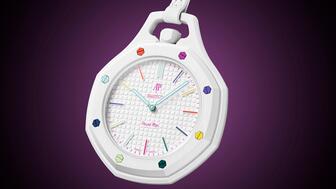
The $400 pocket watch is a blend of Audemars Piguet’s iconic eight-sided Royal Oak and Swatch’s unserious Pop watches from the ‘80s.

With gold prices on the rise, the “Modern Electrum” collection uses an alternative, non-tarnishing metal alloy composed of gold and silver.

Fruchtman Marketing has new owners, Erin Moyer-Carballea and Manuel Carballea, and will relocate to Miami.

In a column for the 2026 State of the Majors issue, Smith lists 10 time-tested principles about sales that still ring true.

In a column for the 2026 State of the Majors issue, Golan spells out how the growing economic divide in the U.S. is reshaping the market.

The “Limitless Expansion of Joy and Hope” collection evokes summer through colored gemstones and motifs of butterflies and florals.

The jewel, circa 1890, is from the late Victorian era and was owned by descendants of the last high king of Ireland.

This is what the nine recipients plan to do with the funds.

The Western star’s 14-karat gold signet ring sold for six times its low estimate following a bidding war at U.K. auction house Elmwood’s.

The discussion, "Rebuilding the Jewelry Workforce," will take place on Saturday, May 16, in Troy, Michigan.

The jewelry industry is reassessing its positioning as Gen Z reshapes the retail landscape and lab grown continues to gain market share.

A matching pair of 18.38-carat, D-color diamonds from Botswana’s Jwaneng mine sold for $3.3 million, the top lot of the jewelry auction.

Sponsored by A Diamond Is Forever

The next generation of lapidarists are entrepreneurial, engaged online, and see the craft as a means for artistic expression.



This site uses cookies to give you the best online experience. By continuing to use & browse this site, we assume you agree to our Privacy Policy