







Lab-GrownJun 02, 2022
Pnina Tornai’s New Bridal Collection Features Lab-Grown DiamondsLab-GrownJun 22, 2022
LVMH Luxury Ventures Sinks Money Into Lab-Grown Diamond Start-Up
LVMH’s investment arm has taken a stake in Lusix, a lab-grown diamond company based in Israel.


Lusix held a press conference at its booth at JCK Las Vegas on June 10 to announce a $90 million round of funding that includes support from LVMH’s investment arm, LVMH Luxury Ventures. Lusix founder Benny Landa is pictured at center. (Photo courtesy of Lusix)
Las Vegas—A big name in luxury has just made an investment in lab-grown diamonds.
During the JCK Las Vegas show, Israeli company Lusix announced completion of a $90 million round of funding, with LVMH Luxury Ventures, LVMH’s private equity arm, as the most prominent investor.
Lusix’s diamonds are grown using the chemical-vapor deposition (CVD) process in factory located outside Tel Aviv that runs on solar power exclusively.
During a press conference held at the company’s booth at JCK Las Vegas, inventor and Lusix founder Benny Landa said the diamonds are the highest quality lab-grown diamonds in the industry.
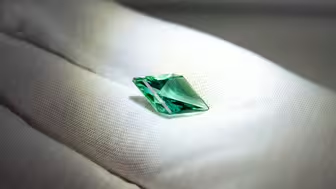
He said Lusix is able control the shape of the diamond during the growing process—creating stones such as the company’s trademarked Pyramid Diamonds—and to grow them in different colors. (Lab-grown diamonds normally are treated after growth to give them their color.)
They also are “carbon negative”—Lusix’s solar farm produces more power than the factory consumes, Landa said—and are certified as “sustainable” by SCS Global Services, traits that appeal to today’s consumers, many of whom are concerned about climate change.
“They (consumers) won’t buy products that aren’t consistent with their values,” he said.
Related stories will be right here …
During the JCK Las Vegas show, Israeli company Lusix announced completion of a $90 million round of funding, with LVMH Luxury Ventures, LVMH’s private equity arm, as the most prominent investor.
Lusix’s diamonds are grown using the chemical-vapor deposition (CVD) process in factory located outside Tel Aviv that runs on solar power exclusively.
During a press conference held at the company’s booth at JCK Las Vegas, inventor and Lusix founder Benny Landa said the diamonds are the highest quality lab-grown diamonds in the industry.
He said Lusix is able control the shape of the diamond during the growing process—creating stones such as the company’s trademarked Pyramid Diamonds—and to grow them in different colors. (Lab-grown diamonds normally are treated after growth to give them their color.)
They also are “carbon negative”—Lusix’s solar farm produces more power than the factory consumes, Landa said—and are certified as “sustainable” by SCS Global Services, traits that appeal to today’s consumers, many of whom are concerned about climate change.
“They (consumers) won’t buy products that aren’t consistent with their values,” he said.
At its booth at JCK Las Vegas and on its website, Lusix uses the tagline “Sun Grown Diamonds,” a phrase it has trademarked, though its future viability in the U.S. market remains unclear.
Under the Federal Trade Commission’s Jewelry Guides, which were updated in 2018, sellers of lab-grown diamonds must make it clear that their product is man-made.
It recommends using one of three terms to do so: laboratory-grown, laboratory-created or [manufacturer name]-created. The word “cultured” can be used too, but must be “immediately accompanied, with equal conspicuousness” by one of these three terms, according to the FTC.
“Sun Grown Diamonds,” with no mention of Lusix or the word laboratory, does not appear to fit within the FTC’s guidelines, though a Lusix spokesperson told National Jeweler on Tuesday that the company has asked the FTC to review its new tagline, which Lusix believes will stand.
If not, Lusix will modify as the FTC recommends, she added.

The one-of-a-kind “Carrera Plasma,” the 44 mm watch set with lab-grown diamonds TAG Heuer introduced at Watches & Wonders Geneva earlier this year. Lusix supplied some of the diamonds to the LVMH-owned brand.
In addition to LVMH, the $90 million in funding included investment from Israel-based companies Ragnar Crossover Fund and More Investments.
Lusix said it will use the money to expand its production capacity, most notably with the opening of a second solar-powered facility slated to start production this summer. The new factory will “enable Lusix to better serve the increasing demand for lab-grown diamonds.”
The company does not share production figures, though the spokesperson said the new facility will increase the company’s output five-fold.
LVMH did not respond to request for comment on its investment in Lusix, including an inquiry about the future use of lab-grown diamonds by its watch and jewelry brands, though at least one of its brands already has begun experimenting.
At Watches & Wonders Geneva this past spring, TAG Heuer unveiled the $375,000 “Carrera Plasma,” an automatic chronograph set with 11.7 carats of lab-grown diamonds supplied by Lusix as well as two other growers.
Editors' Picks
Sponsored by


More on Lab-Grown




The Latest

IndependentsOct 14, 2026
Retailer Hall of Fame 2026: Coleman and Mitchell ClarkFourth-generation jewelers Coleman and Mitchell Clark exemplify the best qualities of their predecessors: humility, modesty, and confidence.


SourcingOct 14, 2026
Manuel Marcial de Gomar, ‘The Emerald Whisperer,’ Dies at 90The gem hunter, whose 70-year career was defined by adventure and exploration, is remembered for his steadfast faith and sense of wonder.


FinancialsOct 14, 2026
LVMH’s Jewelry Brands Turn in ‘Very Good’ Performance in Q3 Tiffany & Co. continued its full-scale store renovation project while Bulgari’s high jewelry collection generated “record-breaking revenue.”

Brought to you by
Meet Gemology’s Next Generation Microscope: GIA® Gemolite® NXT Professional EditionExperience gemstones with greater precision and comfort than ever before.


Events & AwardsOct 14, 2026
Chicago Responsible Jewelry Conference Releases 2026 ProgramThis year’s sessions feature leading voices from human rights, legal, and conservation organizations.

Weekly QuizOct 08, 2026
This Week’s QuizTest your jewelry news knowledge by answering these questions.


MajorsOct 13, 2026
David Webb Owner Purchases Lugano JewelryThe high-end jewelry retailer was sold to private investment firm Middle West Partners and a group of longtime clients.

IndependentsOct 13, 2026
Retailer Hall of Fame 2026: Sean DunnDunn, this year’s Single-Store Independent inductee, is passionate about innovation and telling the story of natural diamonds.
Brought to you by
Your Piece Could Be the One Editors Talk AboutSubmit your pieces for a chance to win in this year's competition.


AuctionsOct 13, 2026
Christie's Geneva To Auction 'Bulgari Pink' DiamondThe 24-carat fancy intense pink diamond ring could fetch up to $18 million at the November sale.

IndependentsOct 13, 2026
Greenwich St. Jewelers’ New Candle Smells Like HomeThe “Island Jewel” candle honors New York City and Puerto Rico and raises money for the island’s water relief efforts.
TechnologyOct 13, 2026
GemFind Is a New JA Member Benefit Partner The partnership will give JA members access to preferred pricing, exclusive benefits, technology solutions, education, and resources.

SurveysOct 09, 2026
These Will Be the 10 Busiest Days for In-Store Shopping This Holiday SeasonStores should expect to see the most customers on Nov. 27, and Christmas week is expected to be hectic too, as Dec. 25 falls on a Friday.

CollectionsOct 09, 2026
Elisa Solomon Collabs With Serendipity 3 on ‘Frozen Hot Chocolate’ CharmThe charm, our Piece of the Week, features brown diamond frozen hot chocolate topped with white diamond whipped cream and a ruby straw.

AuctionsOct 09, 2026
8-Carat Blue Diamond Goes Unsold at UK Jewelry Auction The top lot of Elmwood’s recent fine jewelry sale in London was a 1.84-carat, D color Tiffany & Co. solitaire diamond ring.

WatchesOct 09, 2026
Movado to Sell Majority Stake in Ebel for $66.5MThe watch company agreed to sell a 95 percent interest to a group comprised of F.P. Journe, Chanel, and Swiss watch exec Pierre Jacques.

Policies & IssuesOct 08, 2026
Third Wave of IEEPA Tariff Refunds Begins This round of tariff refunds is for importers that have sued over IEEPA tariffs in the Court of International Trade and won.

CollectionsOct 08, 2026
Brent Neale’s New Collection Goes ‘Back to Basics’It revisits the brand’s most requested silhouettes, from "Pillow"-set necklaces and bracelets to "Signature"-set rings and earrings.

SourcingOct 08, 2026
Ethical Gem Fair Heads Back to BrooklynThe trade-only event includes buying opportunities as well as educational sessions on artisanal mining, the new Paraíba source, and more.

Events & AwardsOct 08, 2026
Pattons Fine Jewelry Sweeps Local Design ContestAra Chanakian, a jeweler at Pattons, took home top honors in every category at Jewelers of Louisiana’s annual jewelry design competition.

AuctionsOct 08, 2026
Reba McEntire’s Jewelry, Watches Head to Julien’s AuctionsThe live charity benefit sale in Nashville will also feature gowns, boots, and other memorabilia from the country music legend.


Supplier BulletinOct 08, 2026
Overnight Mountings’ Bridal Builder Helps Jewelers Turn Custom Design into a Hands-On Selling ExperienceSponsored by Overnight Mountings

Policies & IssuesOct 07, 2026
The Plumb Club Amplifies Its Voice as Geopolitical Pressures MountThe supplier organization recently joined JA and JVC to have more input on political issues affecting the jewelry industry.

CollectionsOct 07, 2026
Blue Nile, Royal Asscher Collection Highlights Natural Diamond BeautyBlue Nile, a Signet Jewelers-owned brand, is now Royal Asscher’s exclusive licensed retailer in North America.

CollectionsOct 07, 2026
4 Standout Pieces in Audemars Piguet’s First High Jewelry Collection “Royal Oak” pays homage to the brand’s most popular watch model using 18-karat gold as well as diamonds, emeralds, and sapphires.

MajorsOct 07, 2026
Empire Safe & Vault Promotes Juan Morales to CEOAs part of the transition, Joseph Nicosia has stepped into the role of COO.

SourcingOct 07, 2026
AGTA Extends Deadline for 2026 Spectrum Awards EntriesParticipants now have until Oct. 14 to complete their submissions.

CrimeOct 06, 2026
6 Charged in Connection to String of New Jersey Smash-and-GrabsThe alleged thieves used crow bars and sledgehammers to smash into jewelry stores across the state.